
This AI search glossary explains 30 terms business owners hear when they ask how to show up in ChatGPT, Google’s AI Overviews and other AI tools. Each one gets a plain definition and, where it matters, what it means for your business. Where a term comes from Google or OpenAI, we link to their own documentation, so you can check the definition yourself.
Keep it open the next time a vendor uses a term you don’t recognize. If you’d rather see how AI tools describe your business today, start with a free AI visibility check.
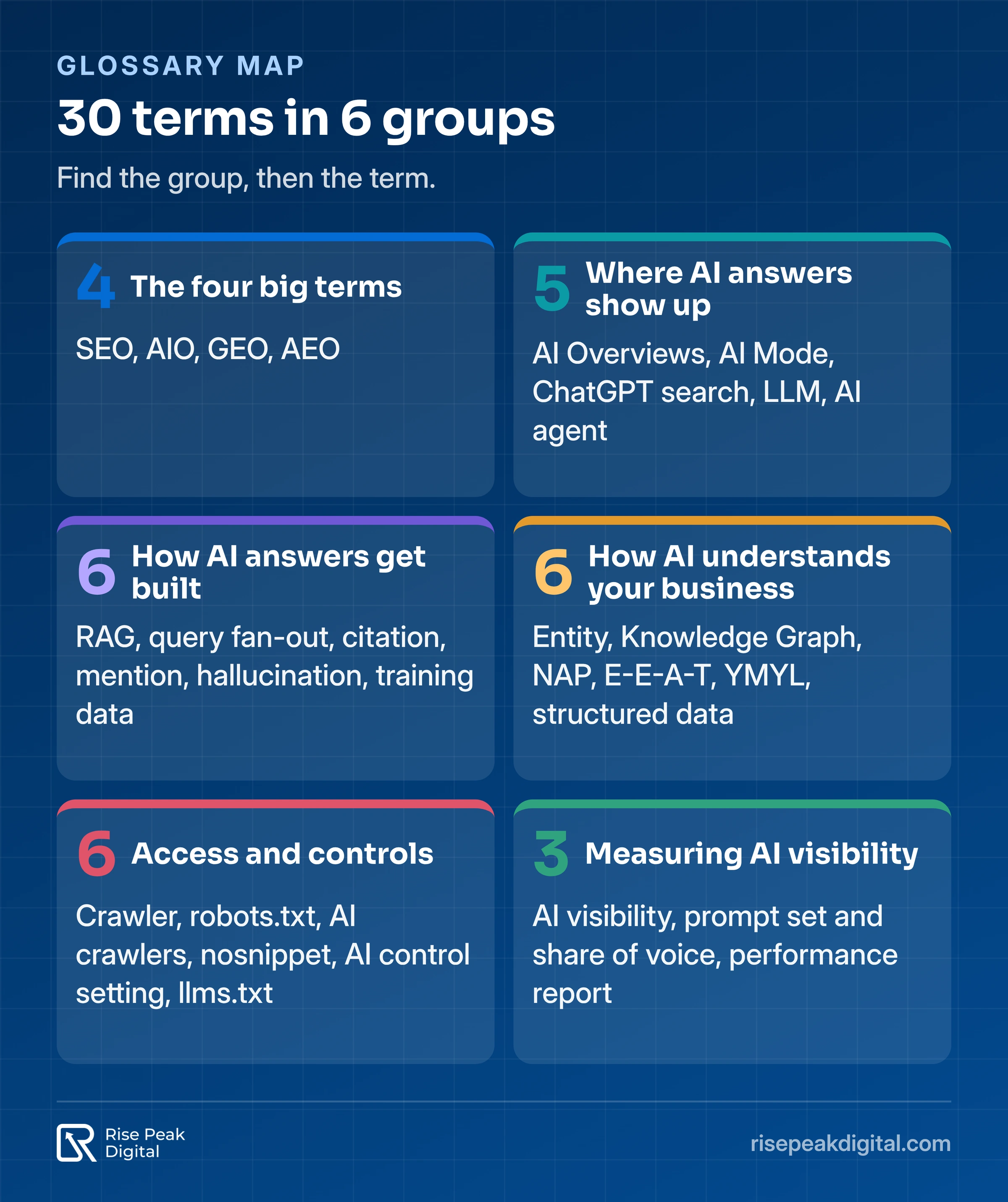
The four big terms: SEO, AIO, GEO and AEO
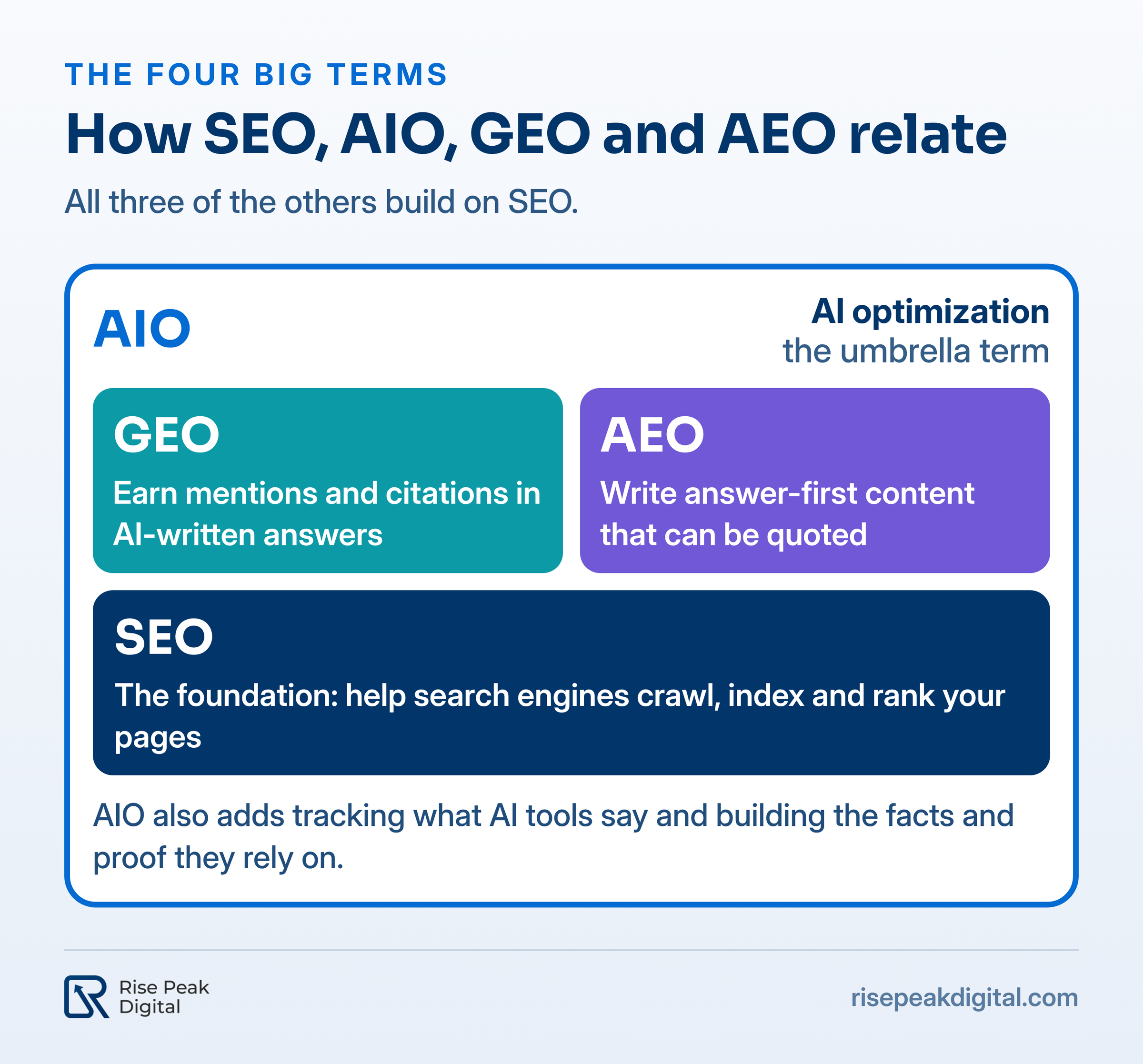
These four get mixed up more than any others. Here’s how they relate.
| Term | Stands for | What it means | Where it focuses |
|---|---|---|---|
| SEO | Search engine optimization | Making your site easy for search engines to find, understand and rank | Google and Bing results, including their AI features |
| AIO | AI optimization | Making your business the one AI tools understand, trust and recommend | ChatGPT, Gemini, Perplexity, Copilot and Google’s AI features |
| GEO | Generative engine optimization | Earning mentions and citations in AI-written answers | The sources AI answers draw on and cite |
| AEO | Answer engine optimization | Writing clear, answer-first content that can be quoted directly | The page content itself |
1. SEO (search engine optimization). The work of helping search engines crawl, index and rank your pages. Google says the best practices for SEO continue to be relevant for generative AI search, because its AI features are rooted in its core Search ranking and quality systems (Google Search Central).
2. AIO (AI optimization). The umbrella term we use for getting your business named and described correctly in AI answers. It includes SEO, plus tracking AI answers and building the facts and proof AI tools rely on. Our full explainer is what is AI optimization (AIO).
3. GEO (generative engine optimization). Work focused on being cited in answers written by generative AI. See what is generative engine optimization and how it compares in GEO vs SEO.
4. AEO (answer engine optimization). Structuring content so it directly answers the questions people ask, in a way an AI tool can lift and quote. Our guide is what is answer engine optimization (AEO).
Google’s own view is worth knowing: it says AEO and GEO are terms used to describe work focused on visibility in AI search, but from Google Search’s perspective, optimizing for generative AI search is still SEO (same Google guide).
Our view: don’t get stuck on the label. Ask any vendor which of these four they actually do, and how they’ll show you it’s working.
Where AI answers show up
5. AI Overviews. AI-generated summaries at the top of some Google results, with links to learn more. Google says they’re shown only when its systems decide they add something beyond classic Search, so they often don’t appear (Google Search Central).
6. AI Mode. Google’s more conversational AI search experience, built for questions that need exploration, reasoning or comparisons, with follow-up questions and links to the web (Google Search Help).
7. ChatGPT search. The part of ChatGPT that searches the web and links to sources. OpenAI says it ranks results using multiple factors and that placement is not guaranteed (OpenAI Help Center). Our guide to how to rank in ChatGPT covers what helps.
8. LLM (large language model). The kind of AI model behind tools like ChatGPT and Gemini. It writes answers by predicting the next words, and OpenAI says that next-word prediction is part of why models sometimes state things confidently that aren’t true (OpenAI). See hallucination, below.
9. AI agent. An AI system that does tasks for someone, such as comparing products or booking a reservation. Google says agents may visit your site and read its rendered page and structure to get what they need (Google Search Central).
How AI answers get built
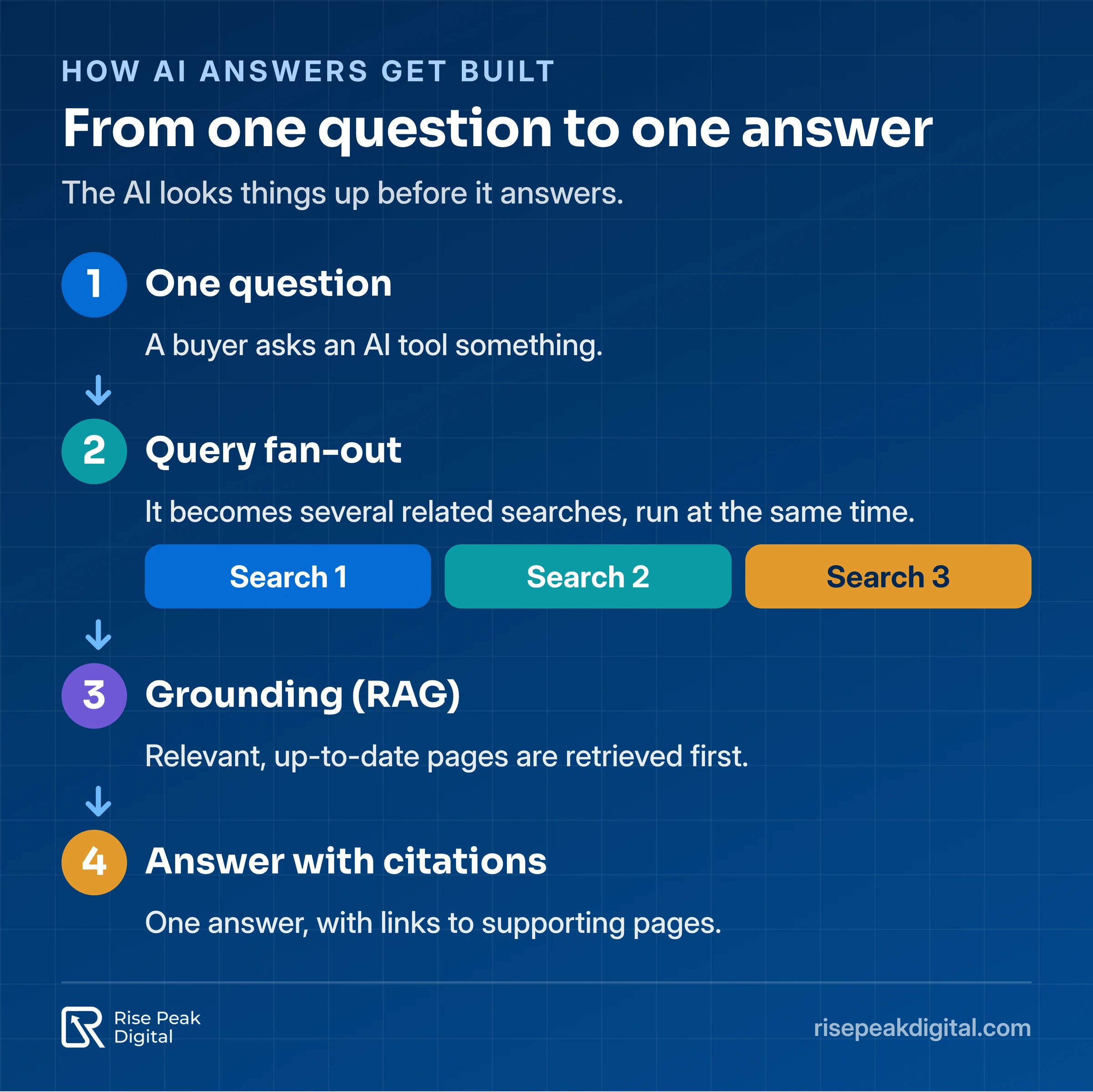
10. Retrieval-augmented generation (RAG), also called grounding. Google describes this as using its core ranking systems to retrieve relevant, up-to-date pages from its index, then using the information on those pages to write a more reliable answer with links to supporting pages (Google Search Central). In plain terms: the AI looks things up before it answers.
11. Query fan-out. When an AI tool turns one question into several related searches to gather more information. Google says AI Mode divides a question into subtopics and searches for each one at the same time across multiple data sources (Google Search Help). This is why a page that answers the follow-up questions around a topic can show up more often.
12. Citation. A link or source an AI answer points to as support. Being cited is usually more valuable than being mentioned, because it sends people to your site.
13. Mention. Your business named in an AI answer, with or without a link. Mentions often come from what other sites say about you, which is why reviews and real coverage matter. We explain how that works in how AI search engines choose which brands to recommend.
14. Hallucination. OpenAI defines hallucinations as plausible but false statements generated by language models (OpenAI). For a business, that can mean wrong hours, services or prices in an answer. Clear, consistent facts across the web give AI tools less room to guess.
15. Training data vs live search. Some answers come from what a model learned during training; others come from searching the web at the moment someone asks. The two are controlled differently, which matters for the crawler terms below.
How AI understands your business
16. Entity. A specific, well-defined thing, such as a person, place, organization or product, that search engines can tell apart from everything else. Your business is an entity. For a short explainer, see what is an entity in SEO and AI search; our entity SEO guide goes deeper.
17. Knowledge Graph and knowledge panel. Google says knowledge panels are information boxes that appear when you search for entities in its Knowledge Graph, and that they’re generated automatically from various sources across the web (Google Knowledge Panel Help).
18. NAP consistency. Name, address and phone number matching everywhere your business appears. Google’s Business Profile guidelines ask that your name reflect your real-world business name, as used consistently on your storefront, website and stationery (Google Business Profile Help).
19. E-E-A-T. Experience, expertise, authoritativeness and trustworthiness. Google says trust is the most important of the four, that E-E-A-T itself isn’t a specific ranking factor, and that its systems give even more weight to strong E-E-A-T on topics that could affect health, financial stability or safety (Google Search Central).
20. YMYL (“Your Money or Your Life”). Google’s name for those high-stakes topics (same source). Healthcare, legal and financial businesses fall here, so their content needs extra care.
21. Structured data (schema markup). Google describes structured data as a standardized format for providing information about a page and classifying its content (Google Search Central). Google says it isn’t required for its generative AI features and there’s no special markup for them, though it still helps with rich results (Google Search Central).
Our view: most of the terms in this section come down to one idea. Say clearly who you are and what you do, and say it the same way everywhere.
Access and controls
These terms decide whether AI tools can read your site at all.
22. Crawler (bot). Software that visits web pages to read them. Search engines and AI companies each run their own.
23. robots.txt. A file that tells crawlers which URLs they can access on your site. Google says it’s used mainly to avoid overloading your site and is not a way to keep a page out of Google (Google Search Central).
24. OAI-SearchBot, GPTBot and other AI crawlers. Each AI company names its crawlers so you can allow or block them separately. Blocking the wrong one can take you out of AI answers.
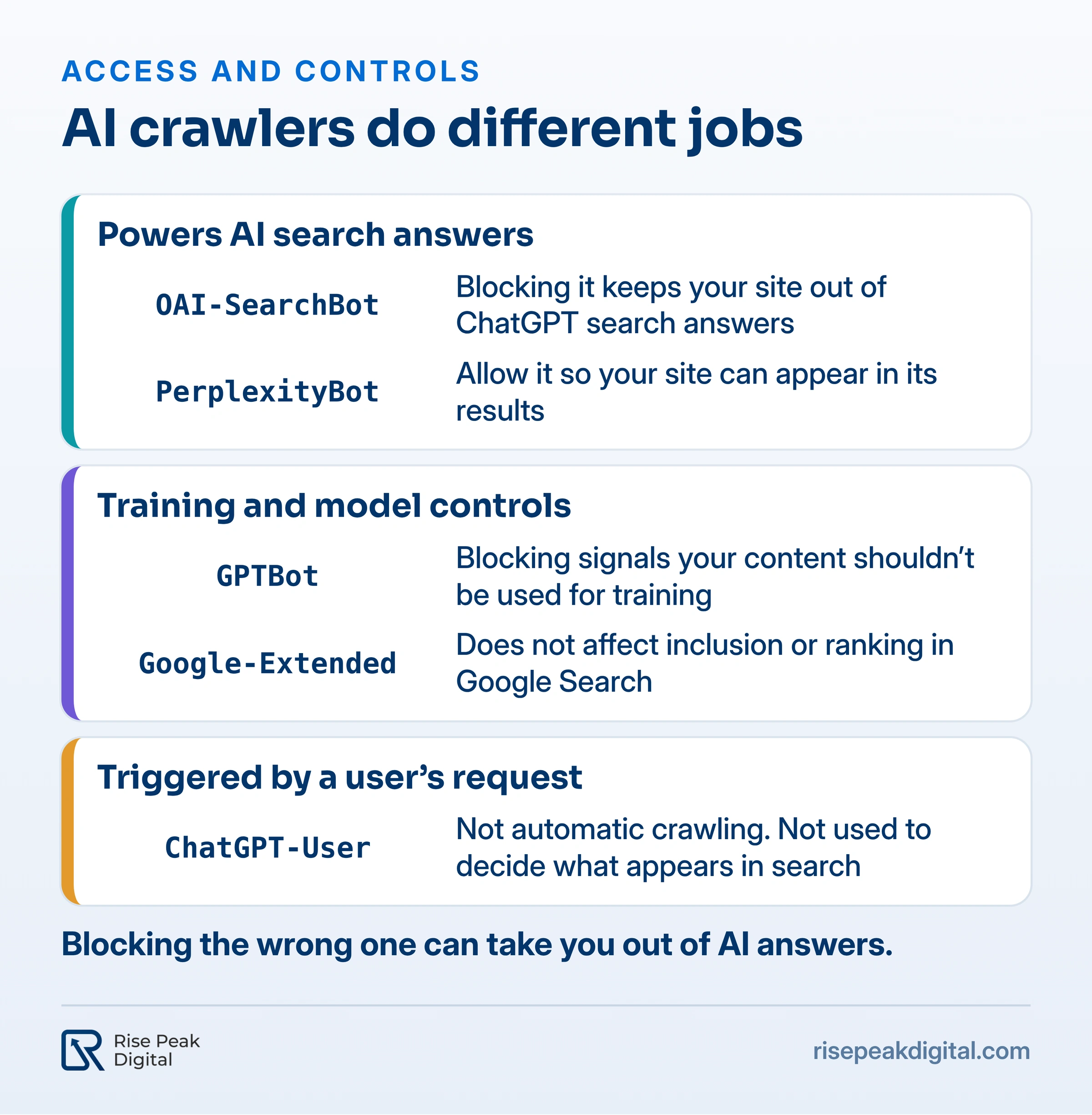
| Crawler | Run by | What it’s for | If you block it |
|---|---|---|---|
| OAI-SearchBot | OpenAI | Surfacing websites in ChatGPT’s search features | OpenAI says your site won’t be shown in ChatGPT search answers, though it can still appear as a navigational link |
| GPTBot | OpenAI | Crawling content that may be used to train OpenAI’s models | Signals your content shouldn’t be used for training |
| ChatGPT-User | OpenAI | Visits triggered by a user’s request, not automatic crawling | OpenAI says robots.txt rules may not apply, and it isn’t used to decide what appears in search |
| Google-Extended | A control for Gemini model training and grounding in Gemini Apps | Google says it doesn’t affect inclusion or ranking in Google Search | |
| PerplexityBot | Perplexity | Surfacing and linking websites in Perplexity search results | Perplexity recommends allowing it so your site can appear in its results |
Sources: OpenAI, Google Search Central, Perplexity.
25. nosnippet. A robots meta rule that stops Google showing a text snippet for a page. Google says it applies to all its search results, including AI Overviews and AI Mode, and also prevents the content being used as a direct input for those features (Google Search Central).
26. Search generative AI control. A Search Console setting for including or excluding your site from AI Overviews, AI Mode and generative AI features in Discover. Google says inclusion is the default for all properties (Search Console Help).
27. llms.txt. A proposed file that gives AI agents a summary of a website (llmstxt.org). Google says Google Search doesn’t use llms.txt files, and creating one will neither help nor harm your visibility in Google Search (Google Search Central). More in what is llms.txt.
Measuring AI visibility
28. AI visibility. How often, and how accurately, AI tools name your business when people ask about what you do. We explain how to measure it in AI search visibility.
29. Prompt set and share of voice. A prompt set is a fixed list of buyer questions you ask AI tools on a schedule. Share of voice is how often you’re named across that list compared with competitors. Our AI visibility audit guide shows how to build one.
30. Generative AI performance report and AI referral traffic. Search Console’s Generative AI performance report shows how often links to your site appeared in Google’s AI features, and Google says it rolled the report out to all websites worldwide as of August 31, 2026 (Search Console Help). AI referral traffic is visits to your site from AI tools, as recorded in your analytics. Watch both, and above all watch leads. In many cases AI-recommended visits convert about 20 to 25 times higher than typical Google top-10 search.
Our view: the terms that matter most are the ones you can measure. If a vendor can’t show you a prompt set, a report and leads, the vocabulary doesn’t help you.
Terms to be wary of
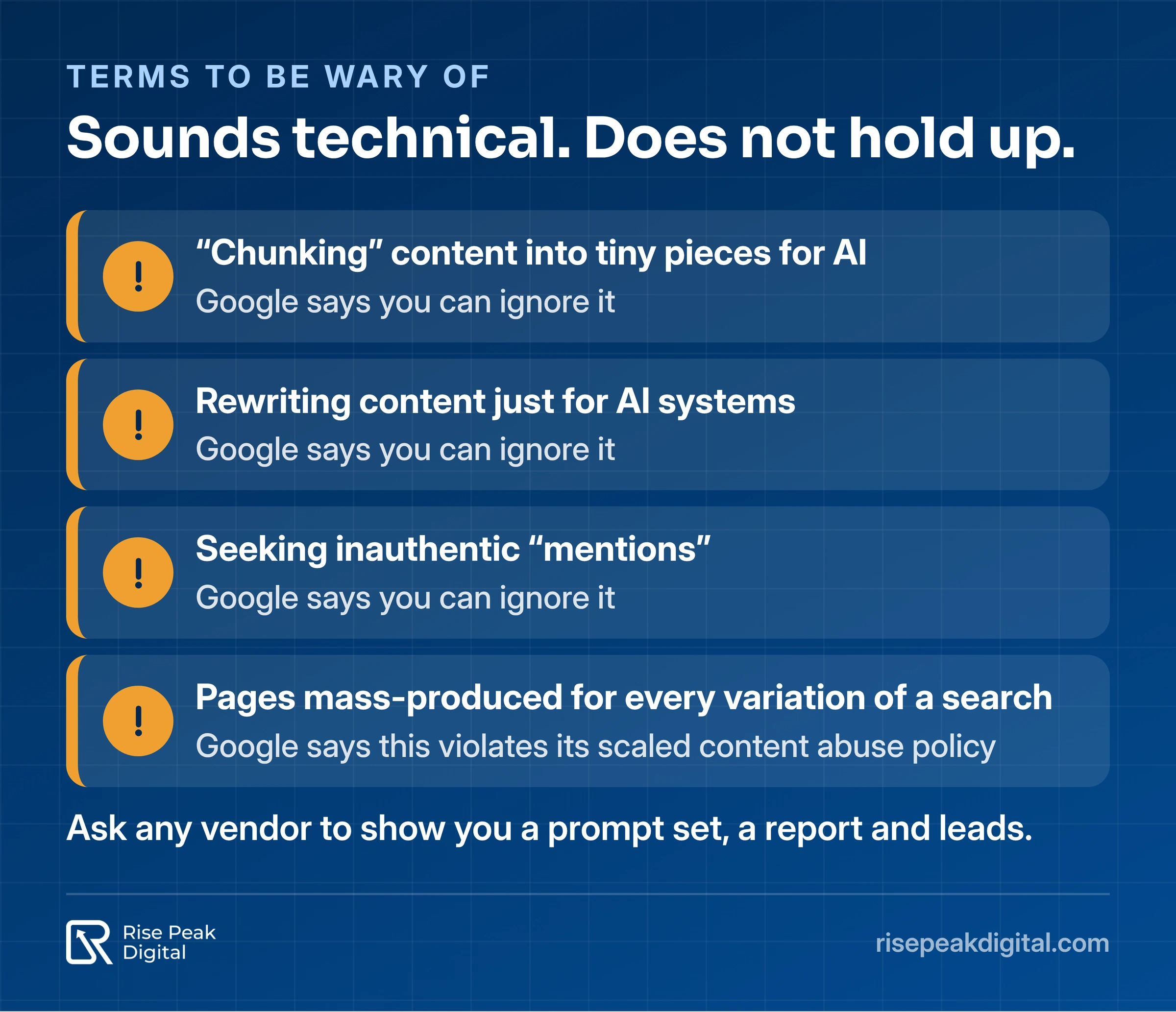
You’ll also hear a few phrases that sound technical but don’t hold up. Google says you can ignore “chunking” content into tiny pieces for AI, rewriting content just for AI systems, and seeking inauthentic “mentions” (Google Search Central). Be careful with “guaranteed AI placement” too: OpenAI says placement in ChatGPT search isn’t guaranteed. And be wary of pages mass-produced for every variation of a search. Google says doing that mainly to manipulate rankings or AI responses violates its scaled content abuse policy (same Google guide). If an agency leans on these phrases, run it through our AIO agency scorecard, and see what AI search optimization should cost.
Where Rise Peak Digital fits
Rise Peak Digital is a done-for-you SEO and AI Optimization (AIO) agency that helps established US businesses in luxury home services, real estate, healthcare and wellness, professional services, multi-location and ecommerce become the brand Google and AI search recommend. We use these terms every day, but we report in plain language: what AI tools say about you, what we changed and what it did for leads. See how our AIO services work alongside search optimization, AEO and GEO.
To see where you stand, start with a free AI visibility check, or book an AIO strategy call and bring any terms you’d like explained.
FAQ
What is AI search?
AI search is any search experience where an AI tool writes an answer instead of only listing links. Examples include ChatGPT search, Google’s AI Overviews and AI Mode, Gemini, Perplexity and Copilot. Most still look up web pages before they answer and link to their sources.
What is the difference between AIO, GEO and AEO?
AIO is the umbrella term for getting your business understood and recommended by AI tools. GEO focuses on earning mentions and citations in AI answers. AEO focuses on writing answer-first content that can be quoted. All three build on SEO.
Is AI optimization the same as SEO?
They overlap heavily. Google says optimizing for generative AI search is still SEO from its perspective, because its AI features rely on its core Search ranking systems. AIO adds tracking what AI tools actually say and building the facts and proof they rely on.
What is query fan-out?
Query fan-out is when an AI tool splits one question into several related searches to gather more information. Google says AI Mode searches subtopics at the same time across multiple data sources, then combines the results into one answer.
Should I block AI crawlers?
Usually not the ones that power search. OpenAI says sites that block OAI-SearchBot won’t be shown in ChatGPT search answers. Training crawlers like GPTBot are a separate choice, and Google says Google-Extended doesn’t affect inclusion or ranking in Google Search.
Do I need llms.txt or special schema for AI search?
Not for Google. Google says Google Search doesn’t use llms.txt files and that no special schema markup is needed for its generative AI features. Structured data still helps with rich results, so it’s worth keeping as part of normal SEO.