
AI search optimization has no standard price. What you pay depends on how much work your site needs, how many services and locations you want to show up for, how competitive your market is, and how much content and proof the plan includes. Neither Google nor ChatGPT sells spots in their organic answers, so every quote you get is for work, not placement.
This guide explains what that work is, what drives the cost up or down, the pricing models you’ll see, and what you shouldn’t pay extra for. It doesn’t list prices, because a number without a scope tells you very little. If you want to know what your own site needs before you ask anyone for a quote, start with a free AI visibility check.
You pay for work, not for a spot in the answer
Start with the part that surprises people. Google says it never accepts money to include or rank sites in its search results, that it costs nothing to appear in its organic results, and that advertising with Google won’t have any effect on your site’s presence in them (Google Search Central). Google’s AI Overviews and AI Mode are built on the same core Search ranking and quality systems (Google Search Central). OpenAI says ChatGPT ranks search results using multiple factors and that placement is not guaranteed; to be eligible, a site needs to let its OAI-SearchBot crawler in (OpenAI Help Center). ChatGPT now shows ads to some users, but OpenAI says ads don’t influence ChatGPT’s answers and are separate and clearly labeled (OpenAI Help Center). Paid ads are a separate budget and a separate decision.
So when you pay for AI search optimization, you’re paying people to make your business easier to find, understand and trust: fixing the site, writing better pages, getting your facts straight everywhere, earning real proof and measuring what changes. That’s also why quotes vary so widely. Two businesses can need very different amounts of that work.
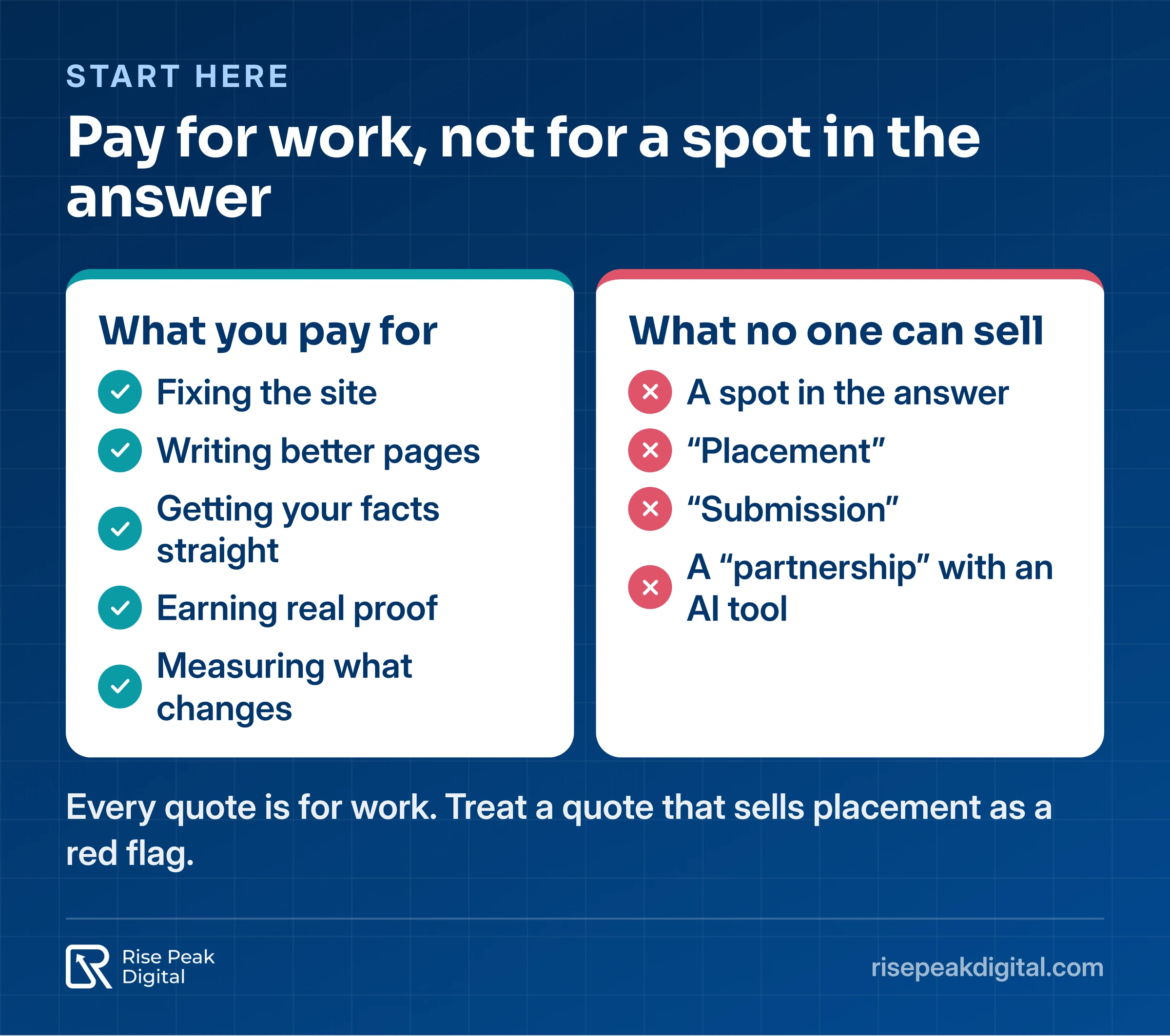
Our view: if a quote sells “placement,” “submission” or a “partnership” with an AI tool, treat it as a red flag. Nobody can sell you a guaranteed spot in an AI answer.
What you’re actually paying for
Google says that, from its point of view, optimizing for generative AI search is still SEO (Google Search Central), so most AI search plans are built from the same seven areas of work as good SEO, with extra attention on AI answers. The table shows what each one covers and why it moves the cost.
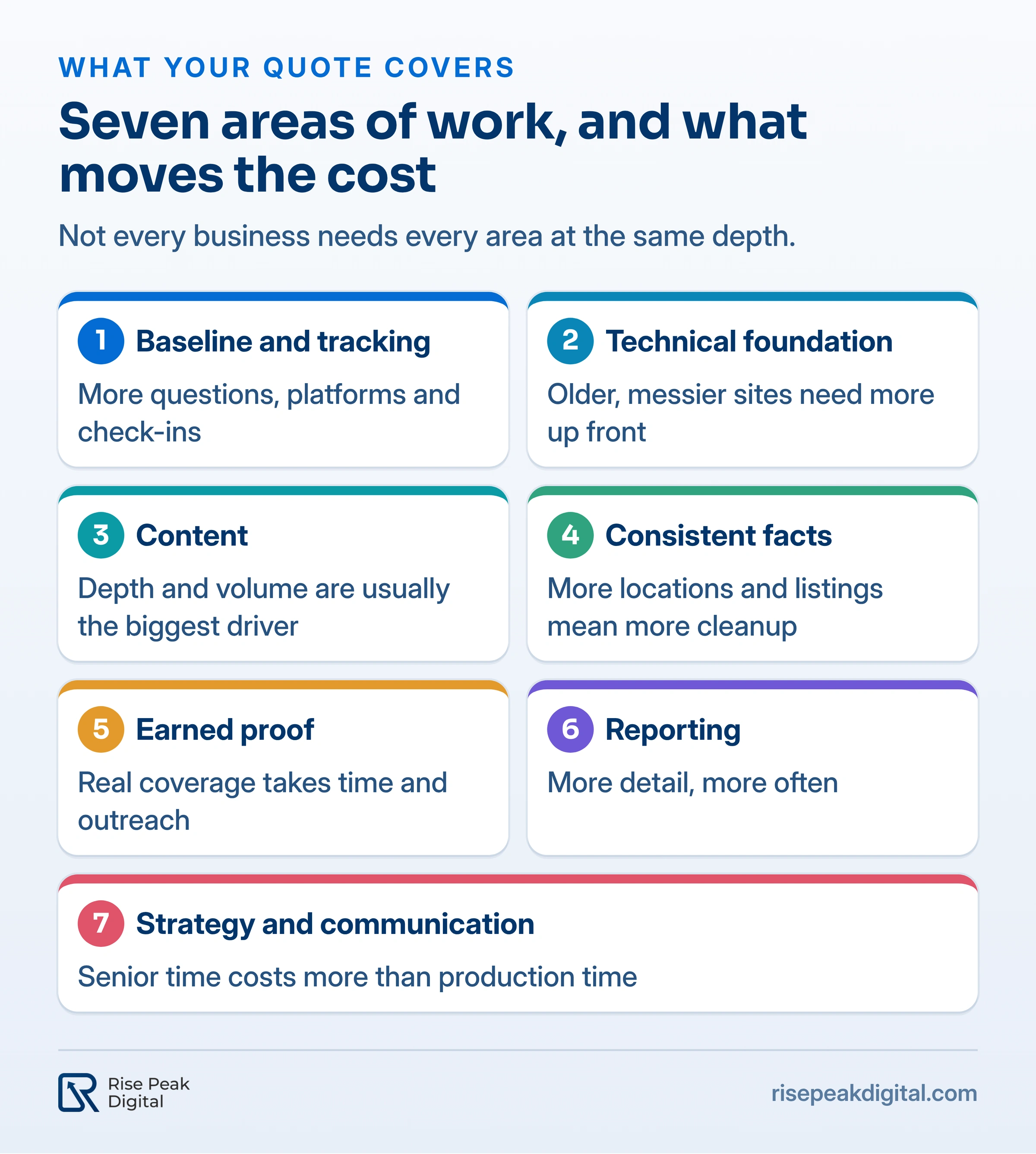
| Work area | What it covers | Why it moves the cost |
|---|---|---|
| Baseline and tracking | Asking AI tools the questions your buyers ask, recording who gets named, and repeating it on a schedule | More questions, platforms and check-ins mean more hours |
| Technical foundation | Indexing, crawling, site speed and making sure search and AI crawlers can reach your pages | Older or messier sites need more fixing up front |
| Content | New and rewritten pages that answer buyer questions with real expertise | Depth and volume are usually the biggest cost driver |
| Consistent facts | Your name, services, service area and credentials matched across your site, Business Profile and listings | More locations and listings mean more cleanup |
| Earned proof | Reviews, case examples and genuine mentions on trusted sites | Earning real coverage takes time and outreach |
| Reporting | Search Console, analytics referrals from AI tools and leads, explained in plain language | More detail and more frequent reports add time |
| Strategy and communication | Planning, calls and explaining every change | Senior time costs more than production time |
Not every business needs every row at the same depth. A clean site with good reviews might need mostly content and tracking. A site with indexing problems needs the foundation fixed first, because Google says a page must be indexed and eligible to show with a snippet before it can appear in its AI features (Google Search Central). We walk through how to find your own gaps in how to run an AI visibility audit.
Six things that drive the price
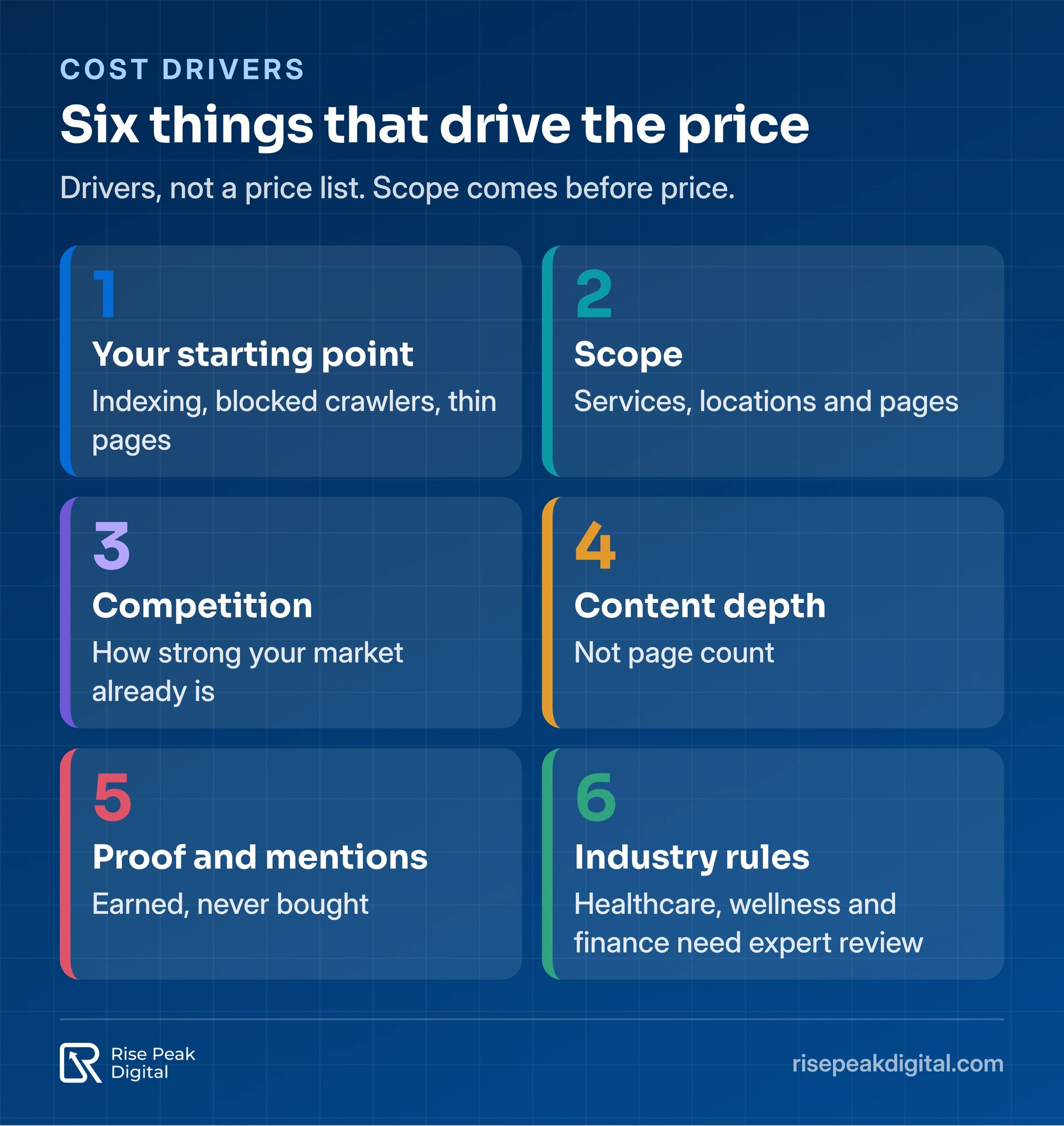
1. Your starting point
The condition of your site sets the first part of the bill. Pages that aren’t indexed, crawlers blocked by a firewall or robots.txt rule, thin service pages and duplicate content all need fixing before new work pays off. Google notes that duplicate content can mean search engines waste crawling resources on URLs you don’t even care about (Google Search Central). A short audit up front often saves money, because it stops you paying for content on a site that can’t be read properly.
2. Scope: services, locations and pages
A single-location business with three core services is a smaller job than a group with ten locations and twenty services. Each location needs accurate details, and Google’s Business Profile guidelines ask you to use your real-world business name as used consistently on your storefront, website and stationery (Google Business Profile Help). Multiply that by every location and listing and you can see why multi-location work costs more.
3. How competitive your market is
If five strong competitors already answer every buyer question well, you’ll need more depth and more proof to stand out. In a quieter niche, fewer, better pages can be enough. A good agency should tell you which situation you’re in after looking at your baseline, not before.
4. Content depth, not page count
This is where cheap plans and good plans split. Google says content that people find unique, compelling and useful will likely influence your presence in AI search more than anything else in its guide, and it warns that creating separate pages for every variation of a search, mainly to manipulate rankings or AI responses, violates its scaled content abuse policy (Google Search Central). Expert-led content takes interviews, editing and fact-checking. That costs more per page than mass-produced posts, but you need fewer of them. This answer-first writing is the core of answer engine optimization (AEO).
5. Proof and mentions
AI tools pay attention to what other people say about you. Google says its AI features can show what’s being said about products and services across the web, but that seeking inauthentic “mentions” isn’t as helpful as it might seem, because its generative AI features depend on its core ranking systems and its spam-blocking systems (Google Search Central). Buying links for ranking purposes counts as link spam under Google’s policies (Google Search Central). Earning reviews, case examples and real coverage is slower, which is why it shows up as its own line in a serious plan. We explain how AI tools weigh that proof in how AI search engines choose which brands to recommend.
6. Your industry’s rules
Some industries need more care. Google says its systems give even more weight to content with strong experience, expertise, authoritativeness and trust (E-E-A-T) on topics that could significantly affect people’s health, financial stability or safety (Google Search Central). For healthcare, wellness and financial services, that usually means expert review of every page, which adds time.
Our view: the biggest swing in price is rarely the tools. It’s how much real expert content and earned proof your market demands.
Common pricing models
Agencies usually price this work in one of a few ways. None is right for everyone.
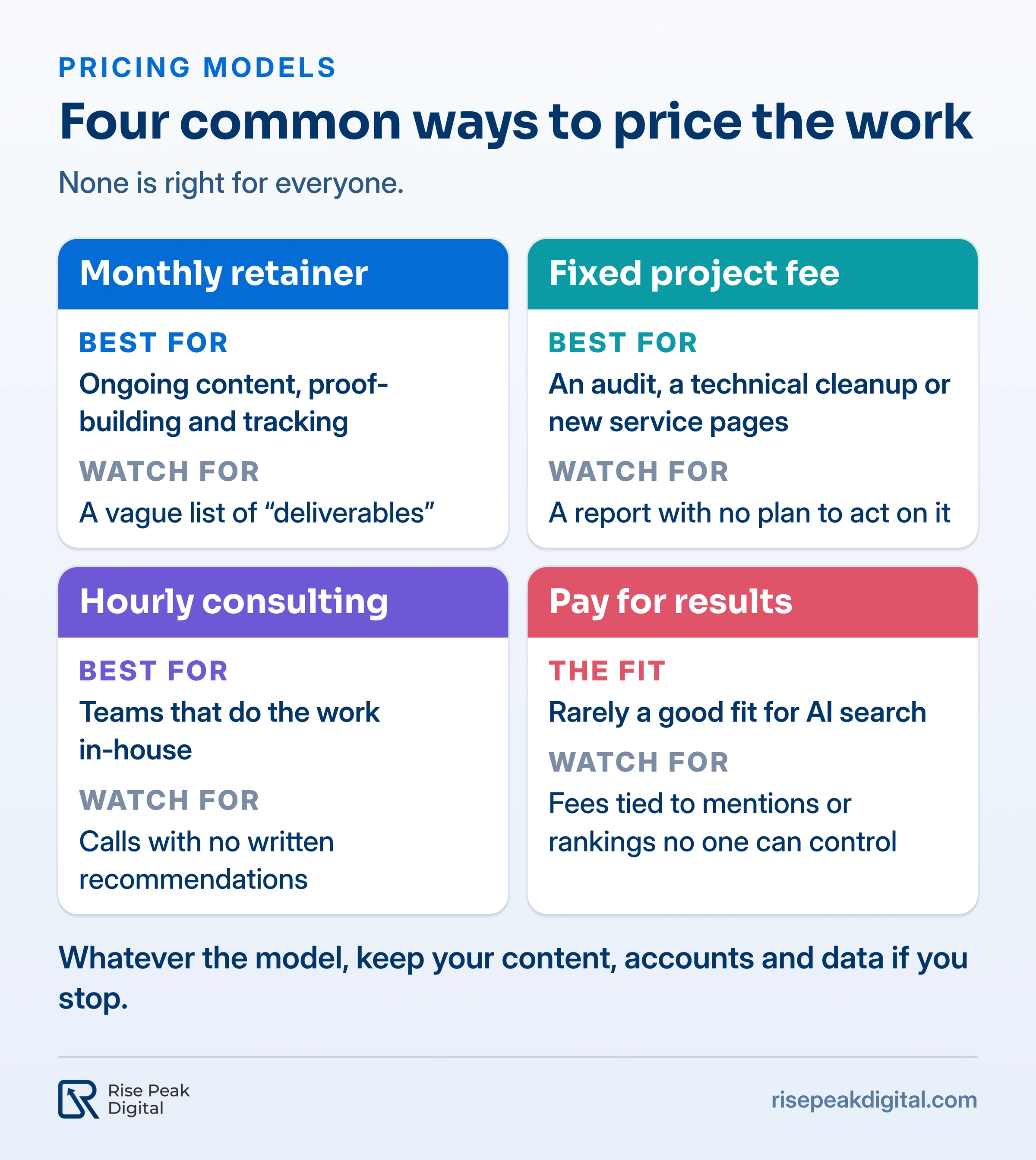
| Model | Best for | Watch out for |
|---|---|---|
| Monthly retainer | Ongoing content, proof-building and tracking over several months | A vague list of “deliverables” with no tracked buyer questions |
| Fixed project fee | An audit, a technical cleanup or a set of new service pages | A project that ends with a report and no plan to act on it |
| Hourly consulting | Teams that do the work in-house and want expert review | Hours used up on calls without written recommendations |
| Pay for results | Rarely a good fit for AI search | Fees tied to “mentions” or rankings no one can guarantee |
Whatever the model, ask what happens if you stop. You should keep your content, your accounts and your data. We cover what to ask about contracts and ownership in AIO agency vs SEO agency.
What’s free, and what you shouldn’t pay extra for
A lot of the measuring and setup costs nothing:
- Google Search Console is a free service from Google for monitoring your site’s presence in Google Search (Search Console Help). Its Generative AI performance report shows impressions from AI features on Google Search and was rolled out to all websites worldwide as of August 31, 2026 (Search Console Help).
- A Google Business Profile is free to create and manage (Google Business Profile).
- Google’s own guide to generative AI features in Search is free to read, and it’s the best check on any advice you’re paying for (Google Search Central).
And some things you shouldn’t pay extra for at all. Google says that for Google Search you can ignore tactics like “chunking” content, creating AI text files such as llms.txt, and pursuing inauthentic mentions, and that structured data isn’t required for its generative AI features (Google Search Central). Structured data is still useful for rich results, so it belongs in good SEO work, just not as a pricey “AI schema” add-on. (If a quote uses terms you have not seen before, our AI search glossary explains them.) Google also says that if you run a small local business, you can probably do much of the SEO work yourself (Google Search Central). That’s worth knowing before you sign anything.
Hidden costs to ask about
The fee on the proposal isn’t always the full cost. Ask these before you compare numbers:
- Is content writing included, or billed per page on top?
- Are tool or software fees passed on to you separately?
- Who fixes technical issues the agency finds: them, your web developer, or you?
- Is there a setup or onboarding fee, and what does it cover?
- How long is the contract, and what’s the notice period?
- Who owns the accounts (website, Search Console, analytics, Business Profile) if you part ways?
How to compare quotes
- Ask for a written scope. List the work areas from the table above and ask each agency to say what they’ll do in each one. Our 12-point AIO agency scorecard gives you the questions to send.
- Ask for a baseline first. An agency should show you what AI tools say about you today before you pay for months of work. Our guide to AI search visibility explains how that baseline is measured.
- Compare like with like. Make sure each quote tracks a similar set of buyer questions and platforms.
- Check how progress will be reported. Data you can see yourself beats a score from a tool you can’t log in to. Google warns that no third-party tool has access to its internal ranking or AI systems (Google Search Central).
- Walk away from guarantees. Google says no one can guarantee a number one ranking on Google (Google Search Central).
How to tell if it’s worth it
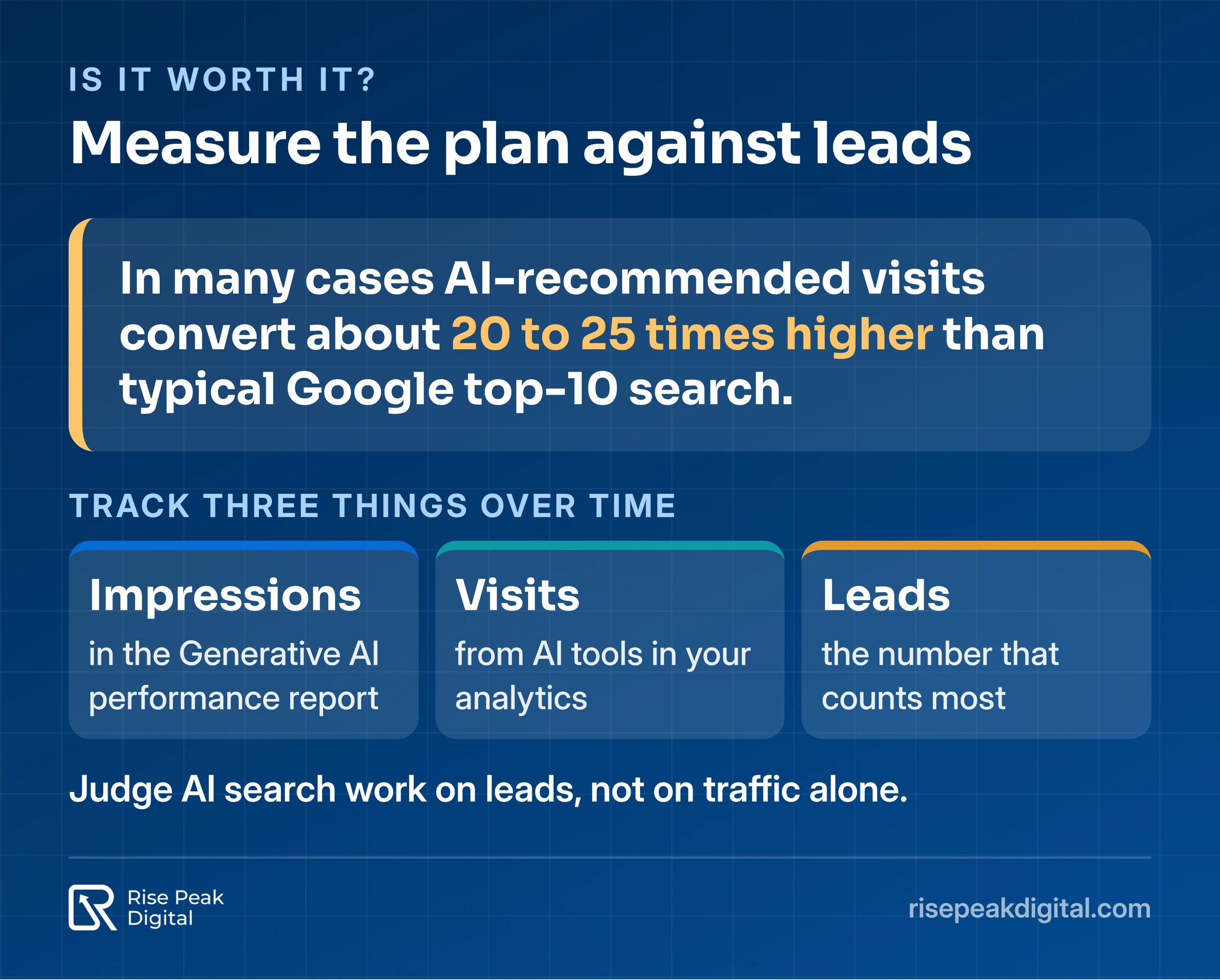
The right question isn’t only what it costs. It’s what a new customer is worth to you, and whether the plan can be measured against that. In many cases AI-recommended visits convert about 20 to 25 times higher than typical Google top-10 search. That’s why we judge AI search work on leads, not on traffic alone.
Track three things over time: impressions in Search Console’s Generative AI performance report, visits from AI tools in your analytics, and leads. Ask every new lead how they found you. If an AI tool keeps coming up, the work is paying off. Our guide to how to rank in ChatGPT covers what to check outside Google.
Our view: a plan you can measure against leads is worth more than a cheaper one you can only measure against activity.
Where Rise Peak Digital fits
Rise Peak Digital is a done-for-you SEO and AI Optimization (AIO) agency that helps established US businesses in luxury home services, real estate, healthcare and wellness, professional services, multi-location and ecommerce become the brand Google and AI search recommend. Our work covers the same areas in the table above: search optimization for the foundation, AIO services for AI answers, and generative engine optimization (GEO) for earned proof and citations. Our entity SEO guide explains why consistent facts matter so much.
Scope comes before price. Start with a free AI visibility check to see where you stand, then book an AIO strategy call and we’ll walk through what your site actually needs.
FAQ
How much does AI search optimization cost?
There’s no standard price. Cost depends on your site’s starting condition, how many services and locations you cover, how competitive your market is, and how much expert content and earned proof the plan includes. Ask for a written scope so you can compare quotes fairly.
Do I have to pay Google or ChatGPT to appear in AI answers?
No. Google says it never accepts money to include or rank sites in its search results, and OpenAI says ads don’t influence ChatGPT’s answers. Ads on either platform are separate and labeled. What you pay an agency for is the work that makes your business easier to find, understand and trust.
Why do AI search optimization quotes vary so much?
Because the work varies. A clean site in a quiet market needs far less than a multi-location business in a competitive one. Quotes also differ in how much content, proof-building and reporting they include, so compare the scope, not just the fee.
Is AI search optimization separate from SEO?
Mostly it builds on SEO. Google says its generative AI features are rooted in its core Search ranking and quality systems, and that optimizing for them is still SEO. Most good plans cover both together.
What should an AI search optimization plan include?
A baseline of what AI tools say about you today, a tracked set of buyer questions, technical fixes, expert content, consistent business facts, earned reviews and mentions, and reporting with data you can check yourself.
Can I do AI search optimization myself?
Some of it. Google says a small local business can probably do much of its SEO work itself, and tools like Search Console and a Google Business Profile are free. Hiring help makes more sense when you have several services or locations, a competitive market, or no time to write expert content.