
llms.txt is a plain Markdown file at yoursite.com/llms.txt that gives AI tools a short summary of a site and links to its key pages. It’s a proposal, not an official standard, and as of November 2026 there’s no public evidence it helps a business get cited in AI answers. Google says Google Search ignores it, so treat it as a cheap extra, not an AI visibility strategy.
If someone has told you your site “needs” an llms.txt file to show up in ChatGPT or Google’s AI Overviews, this guide explains what the file is, who actually uses it, what’s proven and what isn’t, and how to make one in an afternoon if you decide it’s worth it. If you’d rather know how AI tools describe your business right now, start with a free AI visibility check.
What llms.txt is
The idea was proposed by Jeremy Howard in September 2024 on llmstxt.org, and the proposal was updated to a second version in August 2026 (llmstxt.org). The goal is simple. Web pages are built for people, wrapped in menus, scripts and ads, and AI agents work better with concise, clean text gathered in one place (same source).
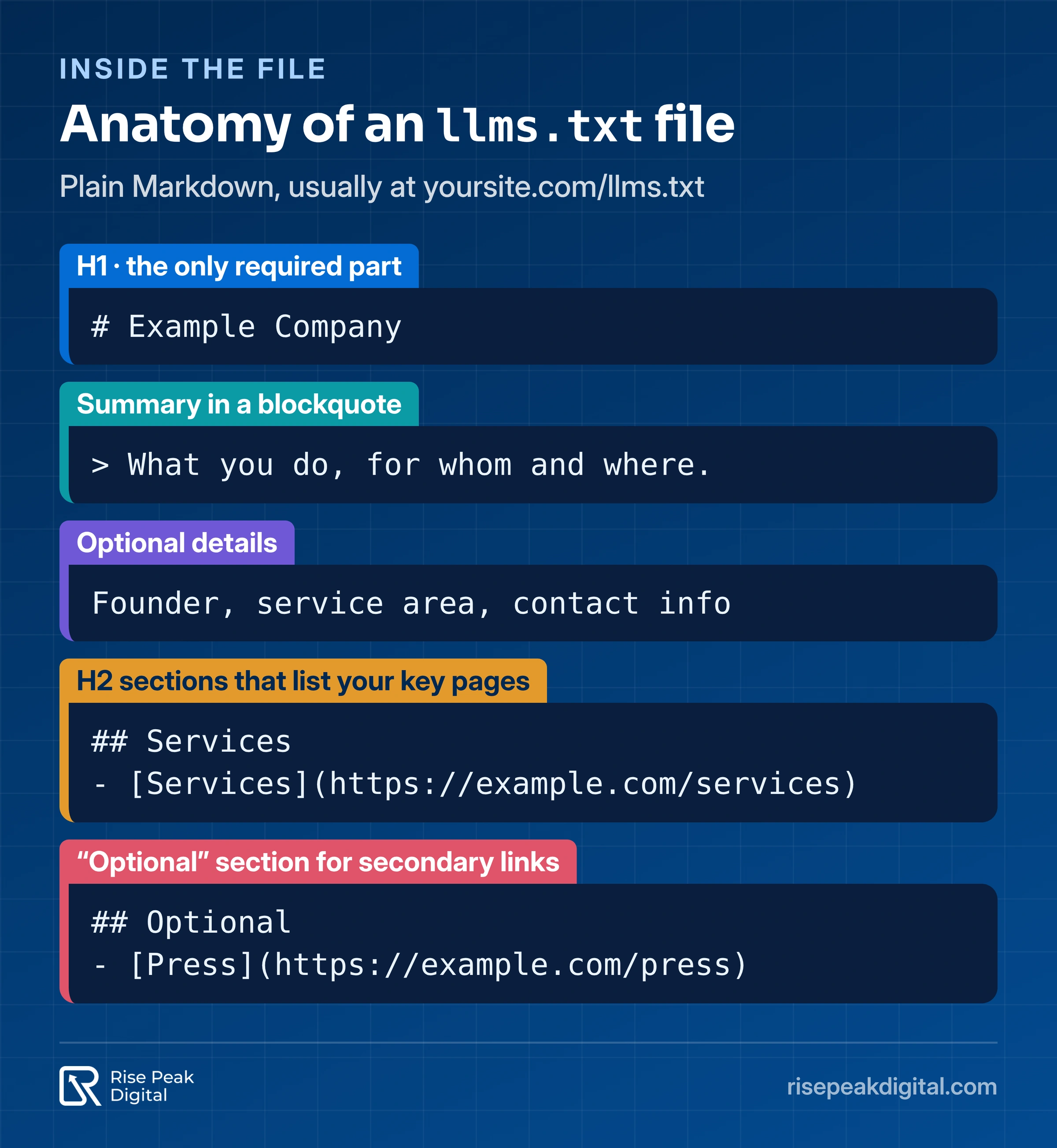
Under the proposal, an llms.txt file is written in Markdown and follows a set order:
- An H1 with the name of the site or project. This is the only required part.
- A short summary in a blockquote with the key facts needed to understand the rest of the file.
- Optional details in plain paragraphs or lists.
- Sections under H2 headings that list links to pages with more detail, each with an optional short note.
- An “Optional” section, by convention, for secondary links an agent can skip.
The file usually sits at the site root, but the current version of the proposal also allows one at a sub-path, such as /docs/llms.txt, covering the pages under it. Version 2 also suggests offering clean Markdown copies of important pages and pointing to them with standard link tags (same source).
llms.txt vs robots.txt vs sitemap.xml
The three files are often lumped together, but they do different jobs and have very different standing. For quick definitions of these and related terms, see our AI search glossary.
| robots.txt | sitemap.xml | llms.txt | |
|---|---|---|---|
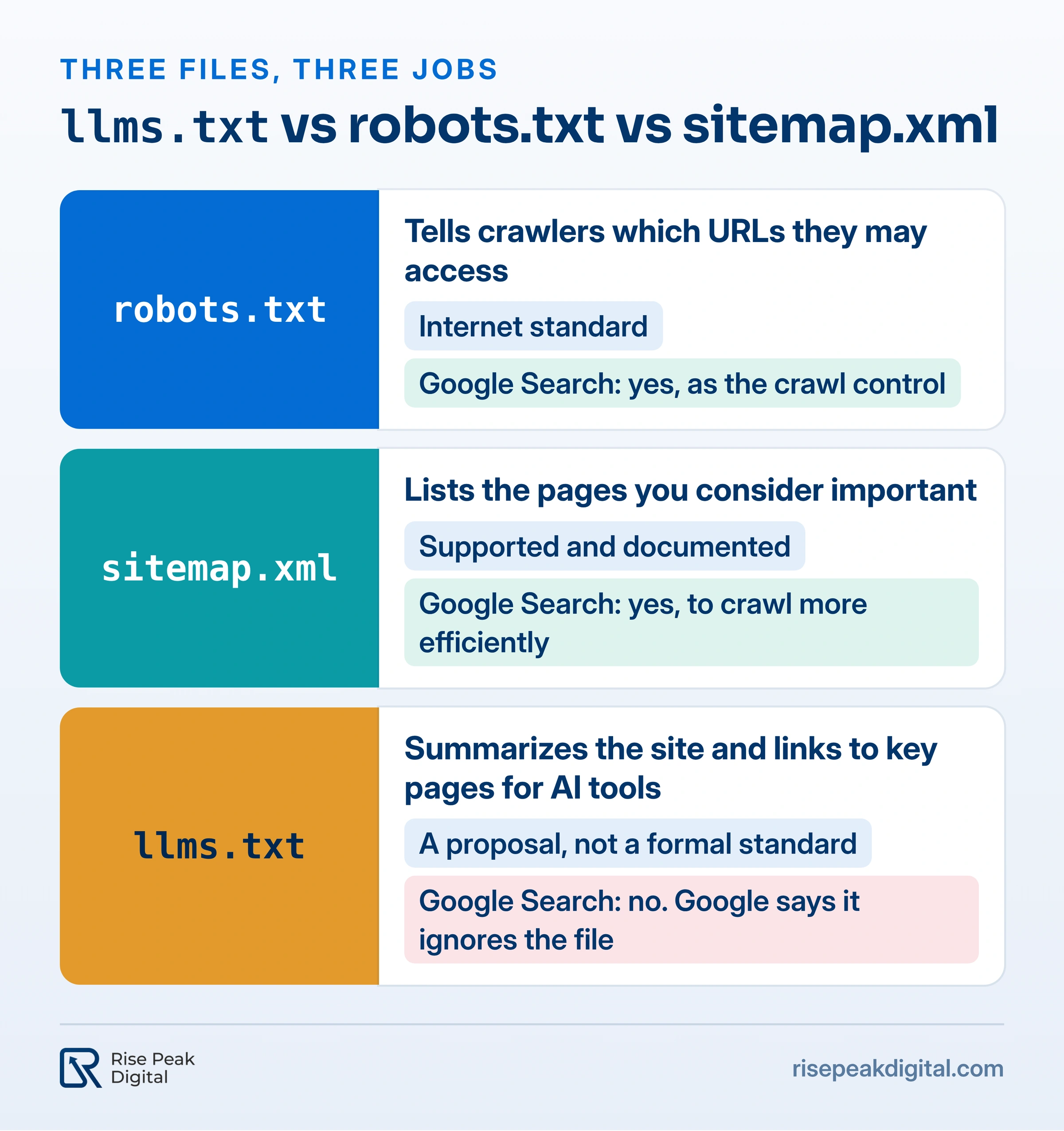
| What it does | Tells crawlers which URLs they may access | Lists the pages and files you consider important, with details such as last update | Summarizes the site and links to key pages for AI tools and agents |
| Who reads it | Search engine and AI crawlers | Search engines | AI agents and tools that choose to look for it |
| Official status | Internet standard (RFC 9309, 2022) | Supported and documented by Google | A proposal, not a formal standard |
| Used by Google Search? | Yes, as the crawl control | Yes, to crawl more efficiently | No. Google says Search ignores it |
Sources: robots.txt is defined in RFC 9309, and Google explains its use in its robots.txt introduction; Google describes sitemaps in Learn about sitemaps; llms.txt status is covered below.
The proposal itself says llms.txt is meant to work alongside these files, not replace them: robots.txt says what automated tools may access, while llms.txt is used on demand when an agent needs information about a site (llmstxt.org). Allowing or blocking AI crawlers still happens in robots.txt, as we cover in how to rank in ChatGPT.
Who supports llms.txt in 2026
“Support” gets used loosely. Publishing your own llms.txt file isn’t the same as reading everyone else’s to decide what to cite. Here’s what the companies involved have actually said or done, as of November 2026.
| Who | What they say or do | What it means for your business |
|---|---|---|
| Google Search | Its guide to generative AI features says you don’t need AI text files or Markdown to appear in Google Search, including AI Overviews and AI Mode, because Google Search doesn’t use them. Creating one “will neither harm nor help” your visibility | No effect on Google rankings or AI Overviews either way |
| Chrome Lighthouse | An experimental Agentic Browsing category checks for a valid /llms.txt file. A missing file is marked “Not Applicable” because it’s optional | A readiness check for AI agents, not a search ranking signal |
| OpenAI, Anthropic, Google (Gemini API), Perplexity | Each publishes an llms.txt file for its own developer documentation. None of the crawler documentation we checked from OpenAI or Anthropic mentions reading other sites’ llms.txt files | Publishing one for their docs isn’t the same as using yours to choose sources |
| Website platforms | Yoast SEO and AIOSEO for WordPress, and Wix, can generate the file automatically | Many files exist because a setting created them, not because anyone measured a benefit |
Sources: Google Search Central; Chrome for Developers and Lighthouse scoring; OpenAI crawlers; Anthropic crawler help; published files at OpenAI, Anthropic, Google AI Studio and Perplexity; platform list from llmstxt.org.
Does llms.txt help AI visibility?
Here’s the honest split between what’s known and what isn’t.
What’s known
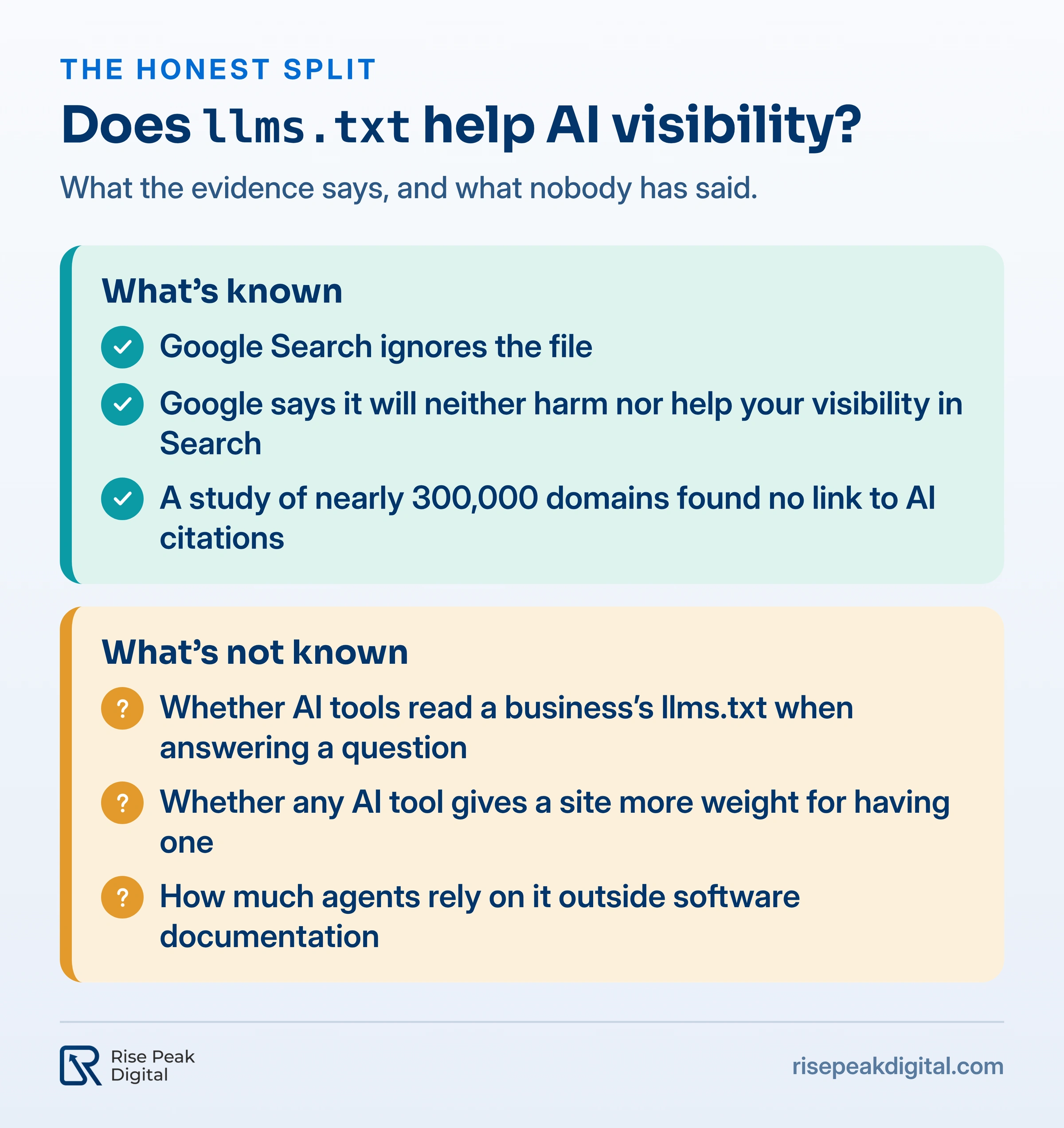
- Google Search ignores it. Google says it’s completely fine to keep an llms.txt file for other services, but it won’t harm or help your visibility or rankings in Google Search, because Google Search ignores it. Its summary also lists “creating unnecessary AI text files (like llms.txt)” among tactics you can ignore for Google Search (Google Search Central).
- Large-scale data shows no link to AI citations. An analysis of nearly 300,000 domains by SEO software company SE Ranking found only about 10% had an llms.txt file and found no correlation between having one and how often a domain is cited by AI tools. Removing the llms.txt factor from its model actually made the model more accurate (SE Ranking). That’s a correlation study, so it can’t rule out a small effect, but it found nothing to suggest a meaningful one.
- Google’s search team doubts it can work for discovery. Google’s John Mueller argued on the Search Off the Record podcast that an AI system can’t trust a file in which a site describes itself as a way to tell competing sites apart. He suggested it might help an automated system that’s already on your site, such as an agent trying to complete a purchase (Search Engine Journal).
What’s not known
- Whether ChatGPT, Claude, Gemini or Perplexity read a business’s llms.txt file when answering a user’s question. None has said publicly that it uses third-party llms.txt files to pick sources.
- Whether any AI tool gives a site more weight because it has the file.
- How much AI agents and coding tools rely on llms.txt outside software documentation, which the proposal says is where it’s used most heavily (llmstxt.org).
Our view: if anyone sells you an llms.txt file as the key to showing up in ChatGPT, they’re selling a hope, not a result.
Should your business publish one?
It’s reasonable to have one, as long as you’re clear about why. The file costs little, Google says it does no harm in Search, and it gives any agent that does look for it an accurate, up-to-date summary of who you are and where your key pages live. Many WordPress sites can turn one on with a plugin setting.
Where it goes wrong is when it takes time or budget away from the work that’s known to matter, or when it falls out of date. A file that lists an old address or a service you no longer offer is one more place for wrong facts about your business to live. Our guide to AI search optimization cost lists other things you should not pay extra for.
Our view: treat llms.txt like a tidy reception desk sign: worth having, but nobody chooses a business because of the sign.
How to create a useful llms.txt file
If you decide to publish one, keep it short, accurate and in the format the proposal describes.
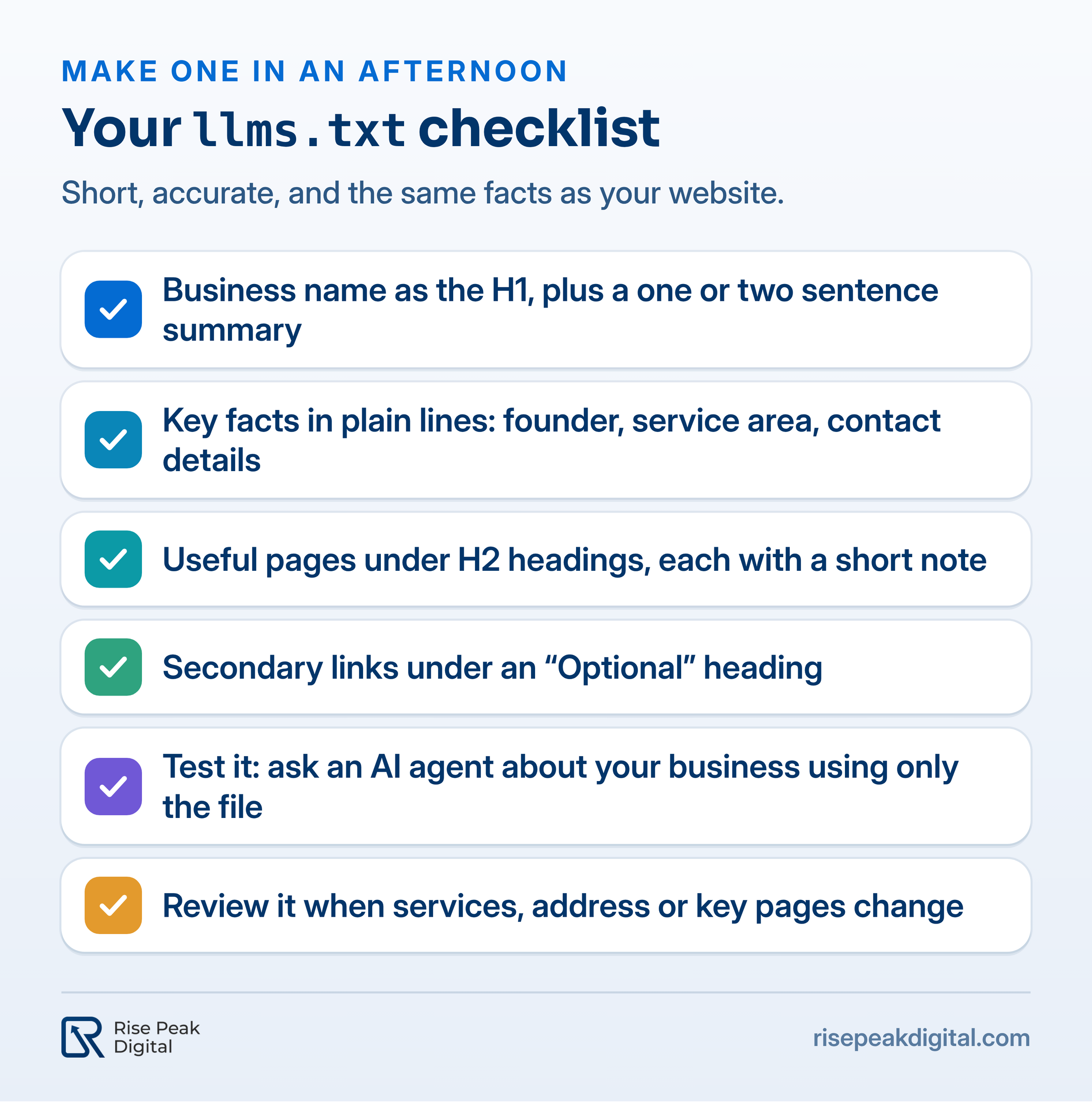
- Start with your business name as the H1 and a one or two sentence summary in a blockquote: what you do, for whom and where.
- Add the key facts in plain lines: founder, service area, contact details and your main call to action. Use exactly the same facts that appear on your website and Business Profile.
- List your most useful pages under H2 headings, such as Services, Industries and Guides, each as a Markdown link with a short note.
- Put secondary links under an “Optional” heading so an agent can skip them.
- Test it. The proposal suggests asking an AI agent questions about your business while giving it only your llms.txt as a starting point (llmstxt.org). Chrome’s Lighthouse also checks the file in its experimental Agentic Browsing audits and flags server errors when fetching it (Chrome for Developers).
- Review it whenever your services, address or key pages change.
Don’t put anything in the file that isn’t true on your website. If your WordPress SEO plugin generates one automatically, open it and check what it says.
What matters more for AI visibility
If your goal is to be named and cited in AI answers, these come first:
- Crawler access. Make sure robots.txt and your host or CDN let search and AI crawlers in. OpenAI recommends allowing OAI-SearchBot and its published IP ranges to help a site appear in ChatGPT search (OpenAI).
- Indexed, crawlable pages. For Google’s AI features, a page must be indexed and eligible to show with a snippet (Google Search Central). That’s core search optimization work.
- Original, expert-led content. Google says unique, useful content will likely matter more to your presence in generative AI search over time than any of its other suggestions (same source).
- Consistent business facts and earned proof. Reviews, case examples and real mentions on trusted sites, the citation work often called generative engine optimization (GEO). We cover how AI tools weigh those signals in how AI search engines choose which brands to recommend, and why it starts with being a clear entity.
- Measurement. Check a fixed set of buyer questions on a schedule, as we explain in AI search visibility, or run a one-off AI visibility audit.
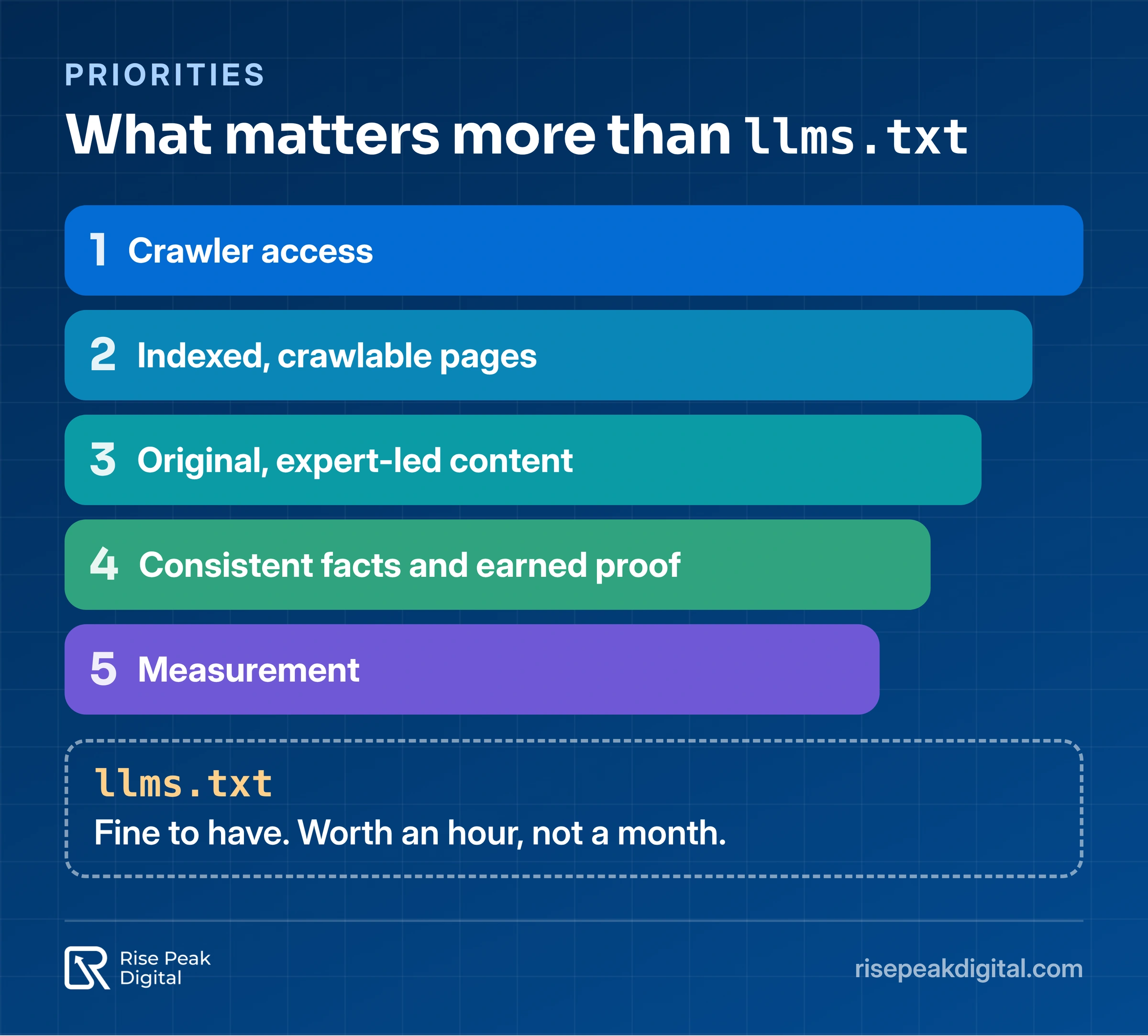
Our view: an hour on llms.txt is fine; a month on it while your key pages aren’t indexed is not.
Our own llms.txt
Rise Peak Digital publishes one at risepeakdigital.com/llms.txt. It sums up our business details, services, industries and guides, using the same facts as our website. We keep it because it’s cheap to maintain and gives any agent that reads it an accurate summary. We don’t claim it has driven any result, and we don’t sell it as a standalone service. If you’re comparing agencies, our AIO agency vs SEO agency guide lists what to ask and what to avoid.
Where Rise Peak Digital fits
Rise Peak Digital is a done-for-you SEO and AI Optimization (AIO) agency that helps established US businesses in luxury home services, real estate, healthcare and wellness, professional services, multi-location and ecommerce become the brand Google and AI search recommend. In many cases AI-recommended visits convert about 20 to 25 times higher than typical Google top-10 search. We focus on the work that’s known to matter, from crawler access and indexing to content, consistent facts and earned proof, and we treat files like llms.txt as housekeeping. See how our AIO services work, start with a free AI visibility check, or book an AIO strategy call.
FAQ
What is an llms.txt file?
An llms.txt file is a Markdown file, usually at yoursite.com/llms.txt, that gives AI tools a short summary of a website and links to its most useful pages. It was proposed by Jeremy Howard in 2024 and is still a proposal, not a formal standard.
Does Google use llms.txt?
No. Google says Google Search doesn’t use llms.txt or other AI text files, including for AI Overviews and AI Mode, and that having one will neither harm nor help your visibility in Google Search. Chrome’s Lighthouse tool does check for one in an experimental AI agent category.
Does llms.txt help you show up in ChatGPT?
There’s no public evidence that it does. OpenAI hasn’t said ChatGPT uses other sites’ llms.txt files to choose sources, and a study of nearly 300,000 domains found no link between having the file and being cited by AI tools.
Is llms.txt the same as robots.txt?
No. robots.txt is an internet standard that tells crawlers which URLs they may access. llms.txt is a proposed summary file for AI tools. Allowing or blocking AI crawlers still happens in robots.txt.
Can an llms.txt file hurt my site?
Google says it won’t harm your visibility in Google Search. The main risk is an outdated file that repeats old facts, such as a previous address or a retired service, so keep it in sync with your website.
Should my business create an llms.txt file?
It’s fine to have one if it’s quick to set up and kept accurate, and many WordPress SEO plugins can generate it. Just don’t treat it as an AI visibility strategy or pay extra for it at the expense of crawler access, indexing, content and proof.