
To choose an AIO agency, score every candidate on the same 12 points, from whether they show you what AI tools say about your business today to how they’ll prove progress with data you can check yourself. Strong agencies answer each point with specifics. Vague answers, secret methods and guarantees score zero.
This scorecard is for owners and marketing leads who already know they want help with AI search and need a fair way to compare agencies. If you’re still deciding between an AIO agency and an SEO agency, or want the list of red flags, read AIO agency vs SEO agency: which do you need? first. This guide picks up where that one stops. And if you’d like a baseline before your first sales call, start with a free AI visibility check.
The 12-point AIO agency scorecard
Bring this table to every call. Each row is a criterion, what a good agency’s answer looks like, and the question that gets you there.
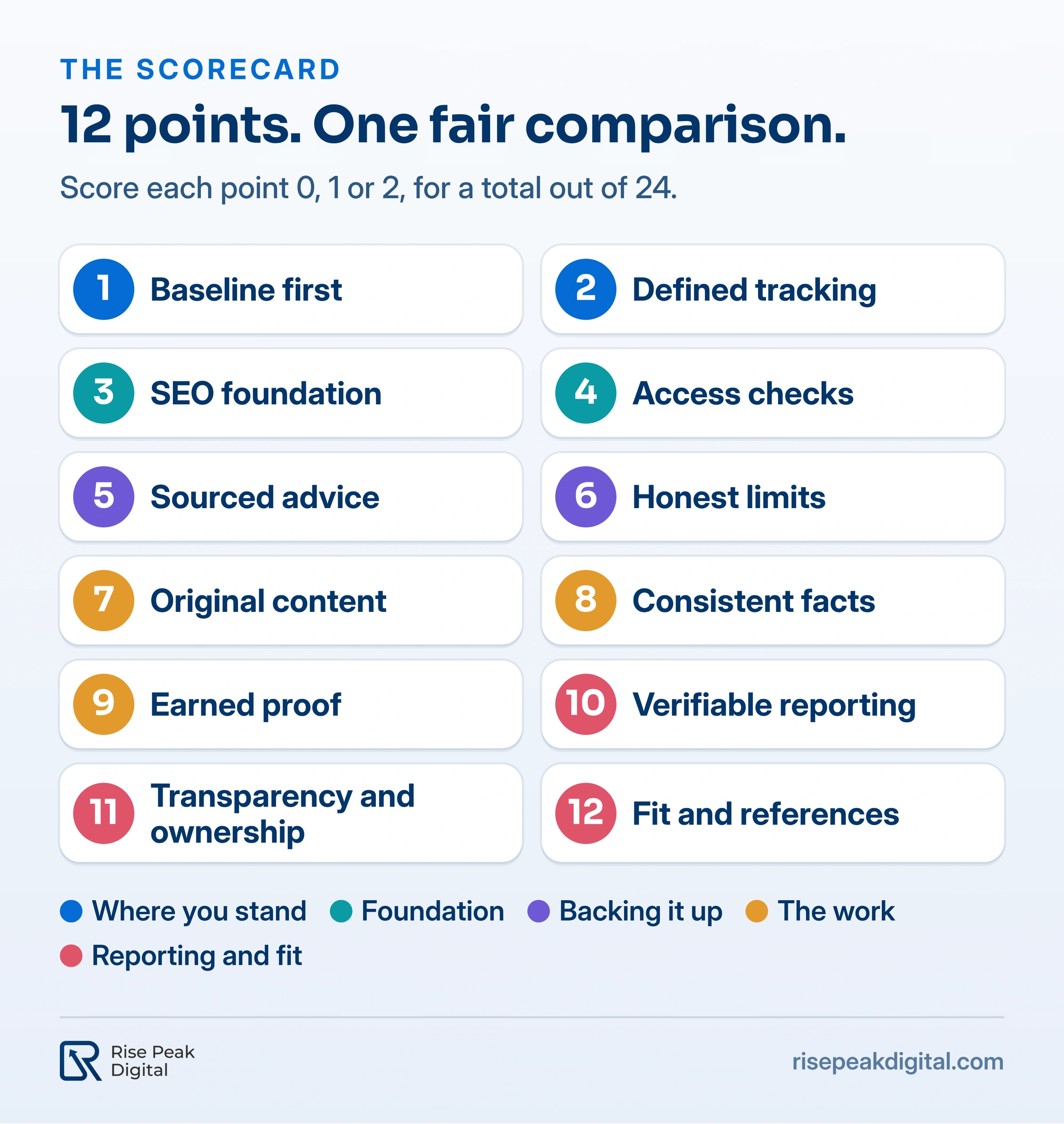
| # | Criterion | What good looks like | Question to ask |
|---|---|---|---|
| 1 | Baseline first | They show you what AI tools say about your business today, before you sign | “What do ChatGPT, Gemini and Google’s AI features say about us right now?” |
| 2 | Defined tracking | A written list of buyer questions and AI platforms, checked on a set schedule | “Which questions and which tools will you track, and how often?” |
| 3 | SEO foundation | Indexing, crawling and technical SEO are included or clearly coordinated | “Who handles indexing and technical SEO, and how?” |
| 4 | Access checks | Robots.txt, CDN or firewall settings and Search Console’s generative AI setting are reviewed early | “How will you confirm AI and search crawlers can reach our site?” |
| 5 | Sourced advice | Recommendations cite official documentation or are labeled as their opinion or experience | “Where does this recommendation come from?” |
| 6 | Honest limits | No guaranteed rankings, mentions or dates | “What can’t you promise us?” |
| 7 | Original content | A content plan built on your expertise, not page volume | “Who writes the content, and what will make it different from what’s already out there?” |
| 8 | Consistent facts | Your name, services, service area and credentials matched across your site, Business Profile and listings | “How will you make sure AI tools describe us correctly?” |
| 9 | Earned proof | Reviews, case examples and real mentions on trusted sites, never bought links or fake mentions | “How do you earn mentions and links, and what won’t you do?” |
| 10 | Verifiable reporting | Reports you can check yourself: Search Console, analytics referrals from AI tools, and leads | “What will a monthly report show, and can I see the raw data?” |
| 11 | Transparency and ownership | Every change explained; you keep ownership of your accounts and content | “Will you share every change you make, and who owns the accounts?” |
| 12 | Fit and references | Relevant industry and market experience, references you can call, and a named person doing the work | “Who will do the work, and can I speak with a current client?” |
How to score each agency
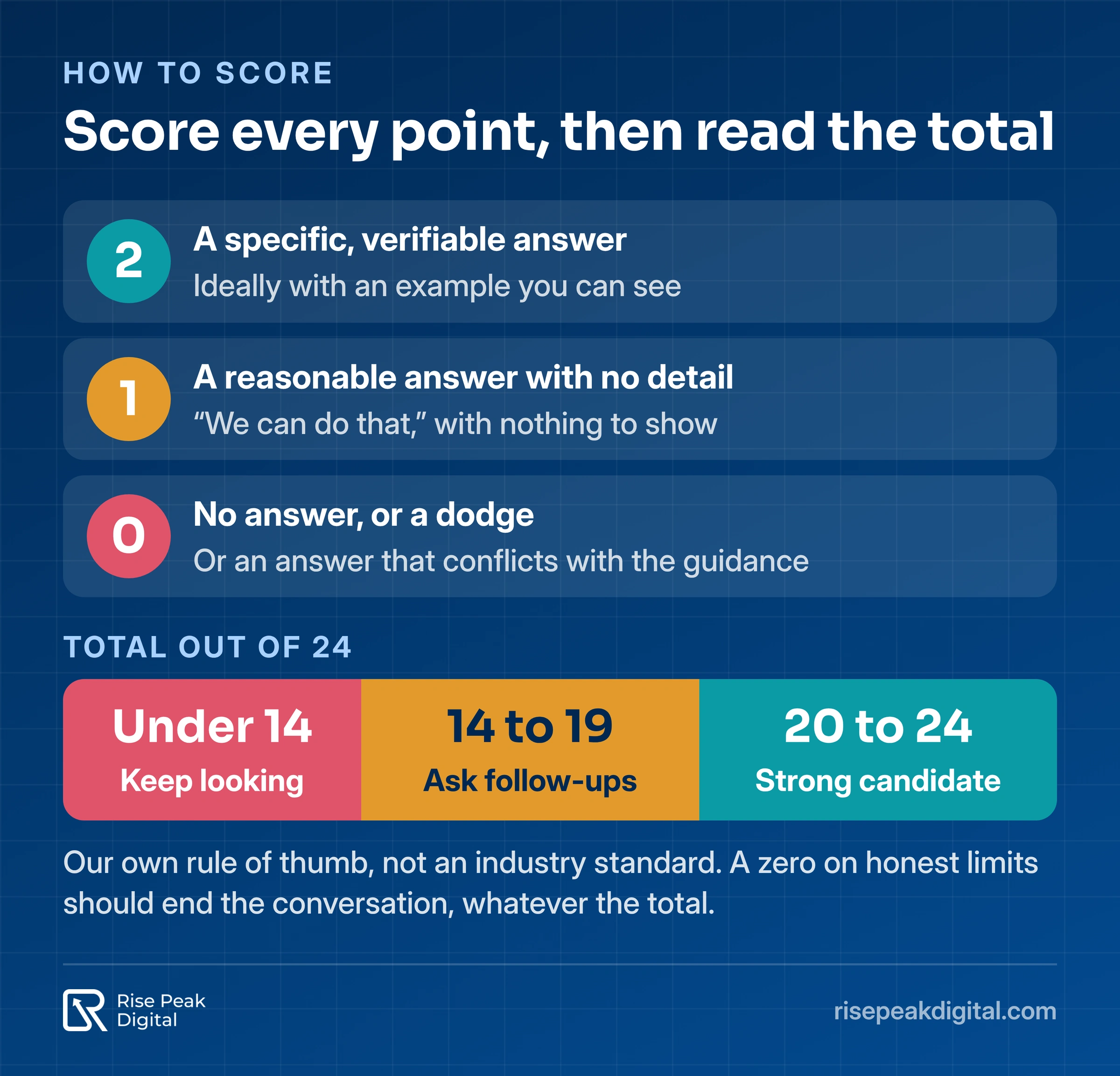
Give each point 0, 1 or 2:
- 2: A specific, verifiable answer, ideally with an example you can see.
- 1: A reasonable answer with no detail, or “we can do that” with nothing to show.
- 0: No answer, a dodge, or an answer that conflicts with the guidance below.
Add up the points for a score out of 24. As a rule of thumb, 20 to 24 is a strong candidate, 14 to 19 means ask follow-up questions before deciding, and under 14 means keep looking. These bands are our own suggestion, not an industry standard. A zero on point 6 (honest limits) should end the conversation whatever the total.
The 12 points explained
Points 1 and 2: where you stand and what gets tracked
An agency can’t improve what it hasn’t measured. A good one will show you, before you sign, how AI tools answer the questions your buyers ask and which businesses get named. That’s the same process we lay out in our guide to running an AI visibility audit.
Then ask for the tracking plan in writing: the exact questions, the platforms and how often they’ll be checked. A fixed question set checked on a schedule is what turns AI visibility into something you can measure, as we explain in AI search visibility.
Our view: an agency that won’t show you a baseline before you sign is asking you to judge its work later with nothing to compare against.
Points 3 and 4: the foundation
Google says its generative AI features in Search are rooted in its core Search ranking and quality systems, and that SEO best practices remain relevant to them (Google Search Central). To be eligible for those features, a page must be indexed and eligible to show in Google Search with a snippet, and the site must be included in Search generative AI features in Search Console (same source). Inclusion is the default setting, but it’s worth checking (Search Console Help). An AIO agency that skips SEO basics is skipping the ground AI search stands on. See what that groundwork covers in our search optimization services.
Access matters outside Google too. OpenAI recommends allowing its OAI-SearchBot crawler in your robots.txt and allowing requests from its published IP ranges to help your site appear in ChatGPT search (OpenAI). A good agency checks these settings early, because content a crawler can’t reach can’t be cited. Our guide to how to rank in ChatGPT covers the settings.
Points 5 and 6: how they back up what they say
Google’s guidance on third-party SEO advice, which it says also applies to services sold as “AEO” or “GEO”, says good advice either qualifies its claims as opinion based on data or experience, or backs them up by citing official Google Search guidance (Google Search Central). Google also says it doesn’t evaluate third-party services, and that third-party tools don’t have access to its internal ranking data (same source). So if an agency says something is “approved by Google” or that its tool sees Google’s internal metrics, score it zero. If the jargon in a proposal loses you, our AI search glossary defines 30 common terms.
On limits, the official word is clear. Google says no one can guarantee a number one ranking on Google (Google Search Central), and OpenAI says placement in ChatGPT search results is not guaranteed (OpenAI Help Center). The best answer to “what can’t you promise?” is a calm, specific list.
Points 7 to 9: the work itself
Content. Google says creating content people find unique, compelling and useful will likely influence a site’s presence in generative AI search over the long run more than any other suggestion in its guide, and it warns against recycling what others have already said (Google Search Central). It also says creating separate content for every variation of a search, mainly to manipulate rankings or AI responses, violates its scaled content abuse policy (same source). Ask who writes your content and how your own expertise gets into it. That answer-first, expert-led writing is the heart of answer engine optimization (AEO).
Facts. AI tools describe businesses from what they find. Google’s Business Profile guidelines ask you to use your real-world business name, as used consistently on your storefront, website and stationery and as known to customers (Google Business Profile Help). A good agency audits your name, services, service area and credentials everywhere they appear. Our plain-English explainer on what an entity is in SEO and AI search and our entity SEO guide explain why consistency matters.
Proof. Google says seeking inauthentic “mentions” across the web isn’t as helpful as it might seem, because its generative AI features depend on its core ranking systems and its spam-blocking systems (Google Search Central). Buying links for ranking purposes is link spam under Google’s policies (Google Search Central). The right plan earns reviews, case examples and real mentions, the citation work often called generative engine optimization (GEO). We cover how AI tools weigh that proof in how AI search engines choose which brands to recommend.
Our view: points 7 to 9 are where cheap plans cut corners, so ask to see a real example of each before you score them.
Points 10 to 12: reporting, transparency and fit
Reporting. Search Console now has a Generative AI performance report showing impressions from AI Overviews and AI Mode, and Google says it rolled the report out to all websites worldwide as of August 31, 2026 (Search Console Help). A good report pairs that with referral visits from AI tools in your analytics and, most important, leads. Be wary of a single “AI score” from a tool you can’t check.
Transparency. Google suggests asking any SEO whether they’ll share all the changes they make to your site along with the reasoning, and advises granting only read access to Search Console during an audit, not write access (Google Search Central). Google also notes you’re responsible for what the companies you hire do on your behalf (same source). We’d add one more: you should own your website, Search Console, analytics and Business Profile, with the agency added as a user.
Fit. Google’s suggested questions include experience in your industry and in your country or city, and it recommends checking references with past clients. It also says a good SEO should be interested in your business and ask what makes it unique, who your competitors are and how your customers find you (same source).
Our view: the agency that asks you the most questions on the first call usually understands that AI tools recommend businesses they can describe clearly.
How to use the scorecard
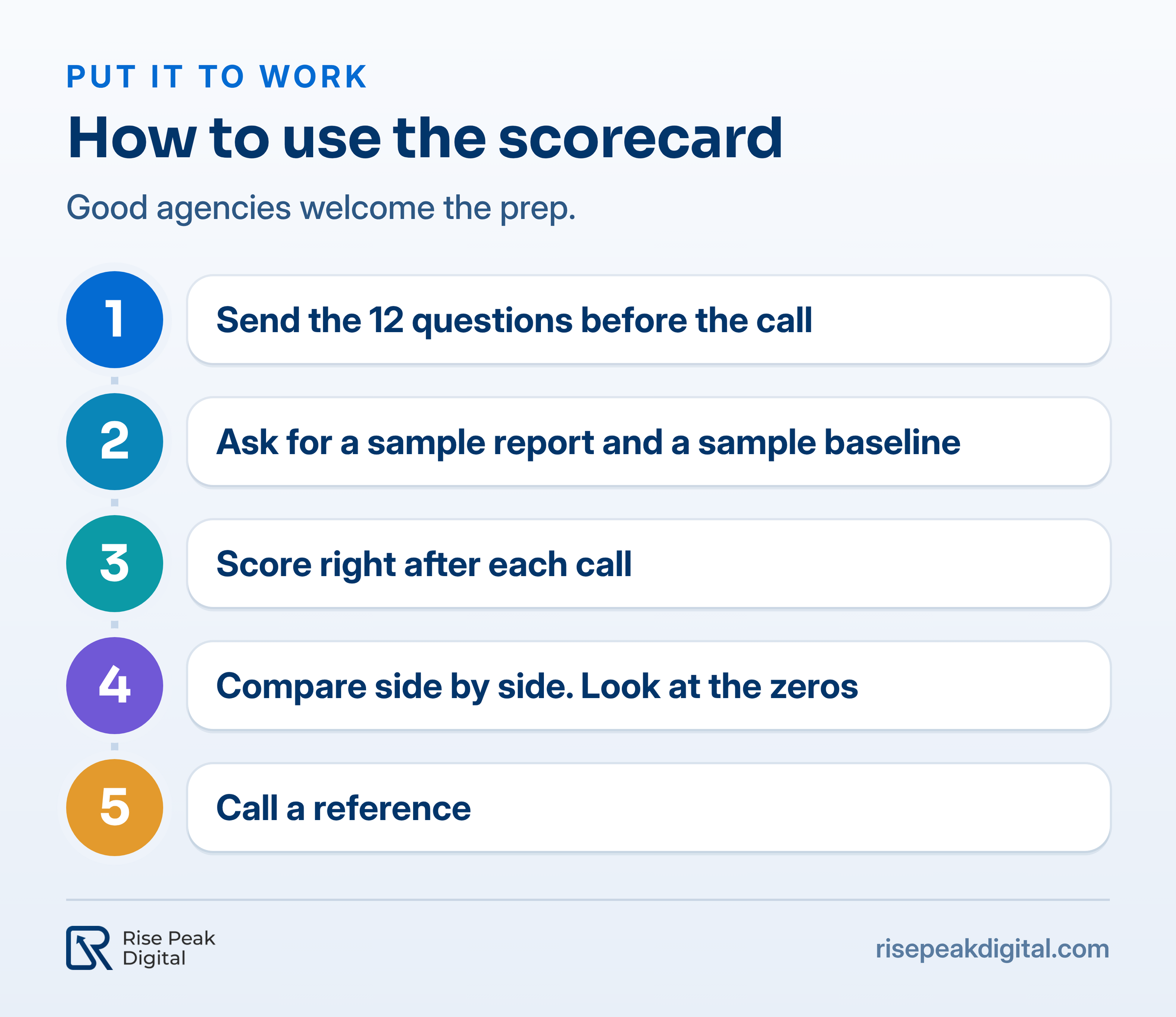
- Send the 12 questions before the call. Good agencies welcome the prep. It also shows who answers in writing.
- Ask for a sample report and a sample baseline. Anonymized is fine. You’re scoring points 1, 2 and 10 on what you can see.
- Score right after each call, while the answers are fresh. Note any point where they changed the subject.
- Compare side by side. Look at the total, then at any zeros. One zero on honest limits or transparency outweighs a high total. To see what drives the quotes themselves, read how much AI search optimization costs.
- Call a reference. Ask what changed in the first few months and how the agency reported it.
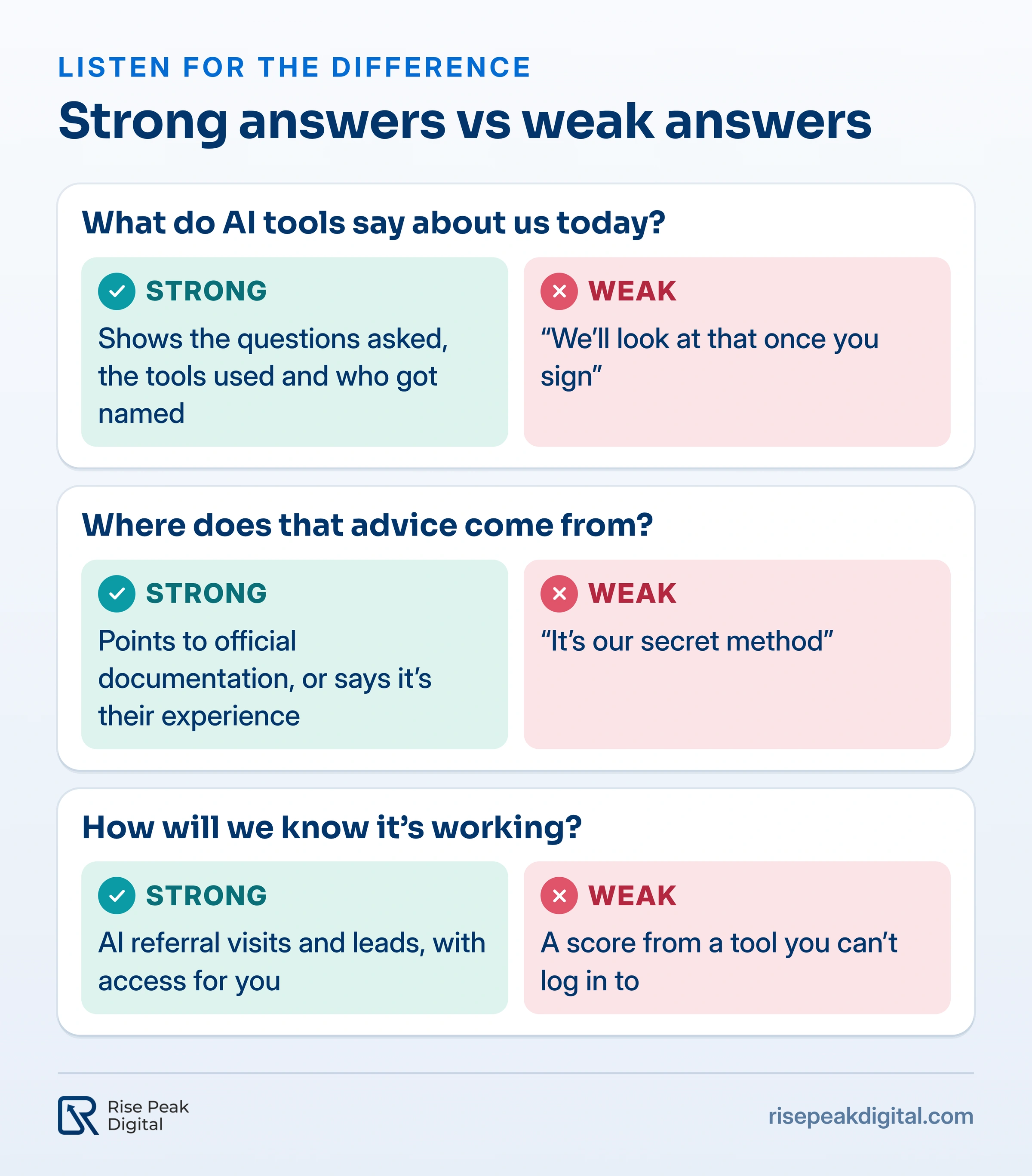
Strong answers vs weak answers
| Question | A strong answer | A weak answer |
|---|---|---|
| What do AI tools say about us today? | Shows the questions asked, the tools used and who got named | “We’ll look at that once you sign” |
| What can’t you promise? | Names rankings, AI mentions and timelines as things no one controls | “We guarantee page one” or “we guarantee ChatGPT mentions” |
| Where does that advice come from? | Points to official documentation or says it’s their experience | “It’s our secret method” |
| How will we know it’s working? | Search Console, AI referral visits and leads, with access for you | A score from a tool you can’t log in to |
Where Rise Peak Digital fits
Rise Peak Digital is a done-for-you SEO and AI Optimization (AIO) agency that helps established US businesses in luxury home services, real estate, healthcare and wellness, professional services, multi-location and ecommerce become the brand Google and AI search recommend. We’d encourage you to score us with this exact table. In many cases AI-recommended visits convert about 20 to 25 times higher than typical Google top-10 search. See how our AIO services work, start with a free AI visibility check to get your baseline, or book an AIO strategy call and bring your 12 questions.
FAQ
How do I choose an AIO agency?
Score each agency on the same 12 points: baseline, tracking, SEO foundation, access checks, sourced advice, honest limits, original content, consistent facts, earned proof, verifiable reporting, transparency and fit. Give each 0, 1 or 2 and compare totals, paying close attention to any zeros.
What questions should I ask an AIO agency?
Ask what AI tools say about your business today, which questions and platforms they’ll track, how they’ll confirm crawlers can reach your site, where their advice comes from, what they can’t promise, and whether they’ll share every change they make.
Can an AIO agency guarantee results in ChatGPT or Google?
No. Google says no one can guarantee a number one ranking, and OpenAI says placement in ChatGPT search results is not guaranteed. Treat any guarantee as a reason to walk away.
Does an AIO agency need to do SEO too?
Yes, or work closely with whoever does. Google says its generative AI features are rooted in its core Search ranking and quality systems, and a page must be indexed to be eligible to appear in them.
How should an AIO agency report progress?
With data you can check yourself: the Generative AI performance report and other Search Console data, referral visits from AI tools in your analytics, repeated checks of a fixed set of buyer questions, and leads.
What score should an agency get before I hire them?
As a rule of thumb, 20 or more out of 24 is a strong candidate and under 14 means keep looking. Whatever the total, a zero on honest limits or transparency should rule an agency out.