
An entity is a specific, real-world thing a search engine can identify and tell apart from everything else: a person, place, product, organization or idea. Your business is one. Search engines store facts about entities and how they connect, and AI search tools need those facts to say who you are, what you do and where.
This is the short, plain-English version for owners and marketing leads. If you want the full playbook for building your brand’s entity signals, read our guide to entity SEO. To see how AI describes your business today, start with a free AI visibility check.
What “entity” means, in plain English
When Google introduced its Knowledge Graph in 2012, it described the change as “things, not strings.” Its example was the search [taj mahal]: to an old-style search engine that’s just two words, but a person knows it could mean the monument, a Grammy-winning musician or a casino in Atlantic City. Google said it was building a model “that understands real-world entities and their relationships to one another” (Google).
Three ideas sit behind the word:
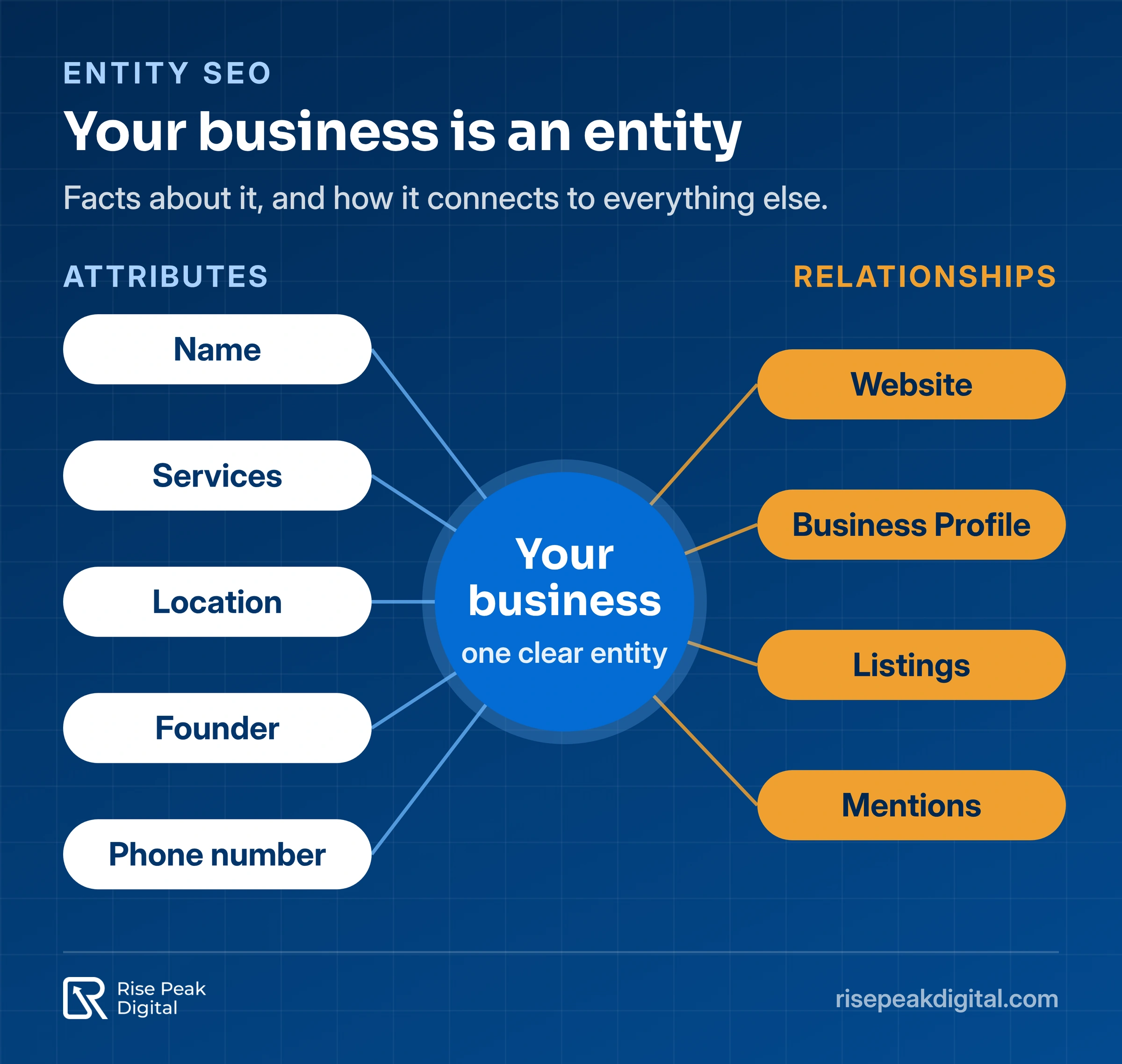
- Identity: the entity is one specific thing, not every thing that shares its name.
- Attributes: facts about it, such as a business’s name, services, location, founder and phone number.
- Relationships: how it connects to other entities. Google’s own example was Marie Curie, linked in its graph to her husband, her children and the Nobel Prizes they won (same source).
For a business, being a clear entity means a search engine can answer, without guessing, “which business is this, what does it do, where does it work, and who’s behind it?”
Entity vs keyword: what’s the difference?
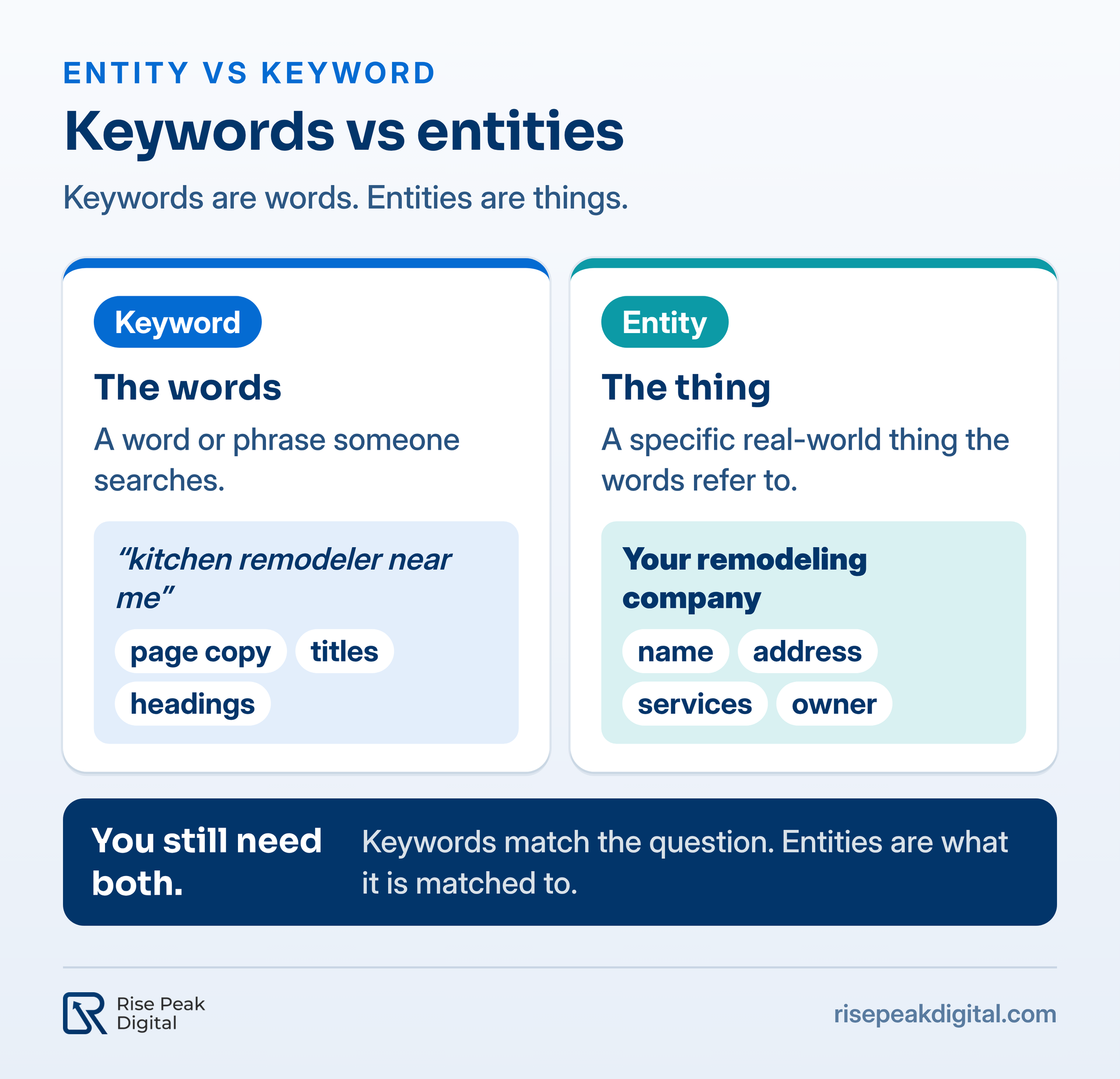
Keywords are the words people type or say. Entities are the things those words refer to. You still need both: keywords tell you how buyers phrase a question, and entities are what search engines try to match that question to.
| Keyword | Entity | |
|---|---|---|
| What it is | A word or phrase someone searches | A specific real-world thing: a business, person, place or product |
| Example | “kitchen remodeler near me” | Your remodeling company, with its name, address, services and owner |
| The search engine’s job | Match the words to relevant pages | Work out which thing is meant and what’s true about it |
| Where it lives | Your page copy, titles and headings | Your whole web presence: website, Business Profile, listings, mentions |
| What can go wrong | You use different words than your buyers | Your facts conflict, or you’re confused with a similar name |
Our view: most businesses we look at have spent years on keywords and almost no time making sure the basic facts about them match everywhere.
How Google uses entities
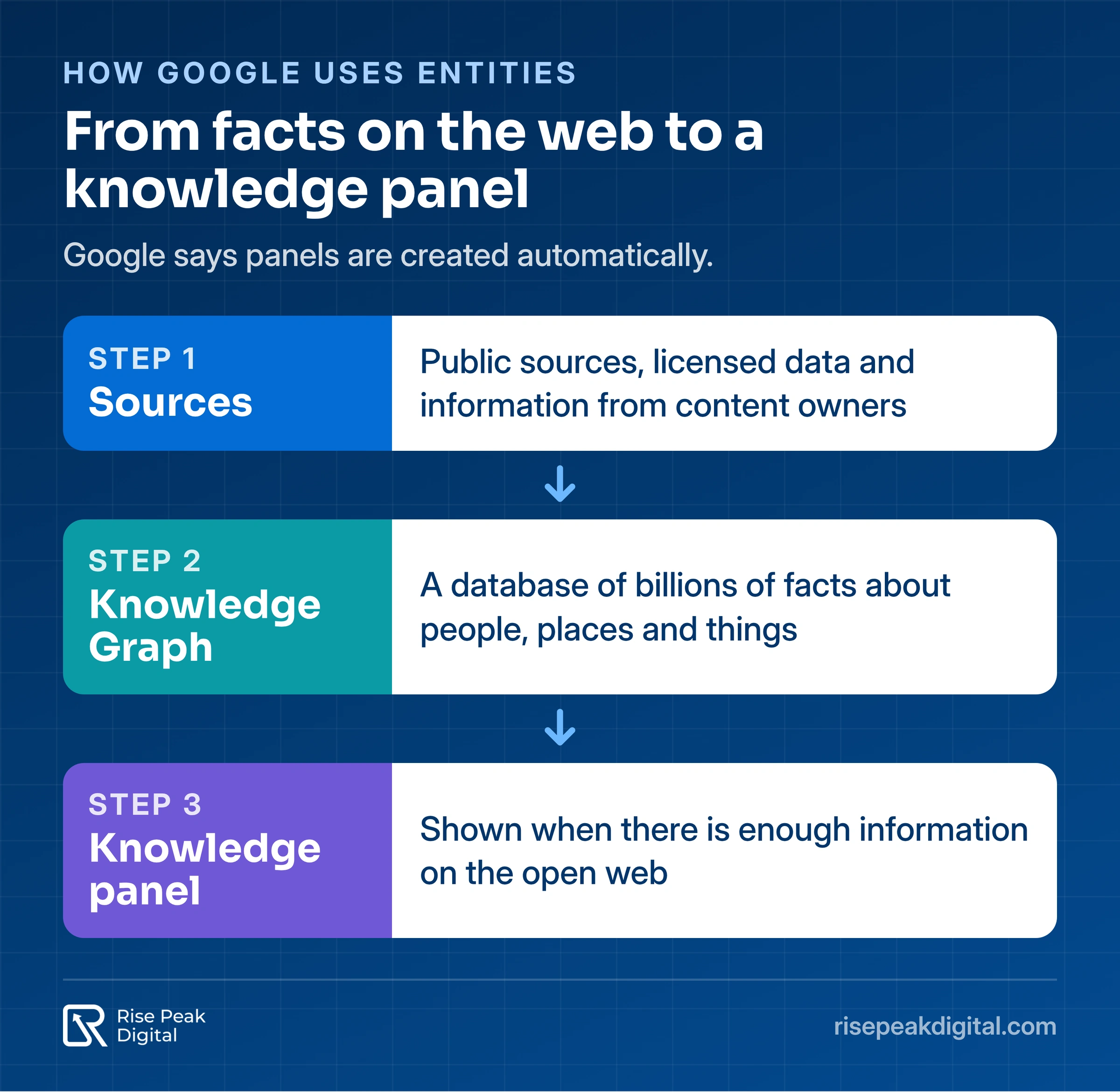
Google’s Knowledge Graph is, in Google’s words, “our database of billions of facts about people, places, and things.” Those facts come from a variety of sources, including public sources, licensed data and information from content owners (Google Knowledge Panel Help).
A few practical points from Google’s own documentation:
- Knowledge panels are automatic. Google says knowledge panels are created automatically when there’s enough information available on the open web, and that businesses should use their Business Profile to create, claim and suggest changes to their panel (same source).
- Businesses are a recognized entity type. Google’s Knowledge Graph Search API lists entity types that include Organization, LocalBusiness, Person and Place (Google for Developers).
- Structured data helps Google learn about the world, not just the page. Google says it uses structured data to understand a page’s content and to gather information about the web and the world, such as the people, books or companies in the markup (Google Search Central).
- Organization markup helps with disambiguation. Google says Organization structured data on your home page can help it understand your organization’s administrative details and disambiguate your organization in search results (Google Search Central).
How entities show up in AI search
AI search tools write an answer instead of handing you a list of links, so they have to decide which businesses to name and what to say about them.
On Google, the AI features follow the same rules as Search. Google says there are no additional requirements or special optimizations for AI Overviews or AI Mode, that a page must be indexed and eligible to show with a snippet to be a supporting link, and that its best practices include keeping your Business Profile information up to date (Google Search Central).
In ChatGPT, OpenAI says search may rewrite a question into more targeted queries for its search partners. For example, a “near me” question can become a search that names the city (OpenAI Help Center). OpenAI also says search results and citations can be incomplete, outdated or incorrect (same source). Our guide to how to rank in ChatGPT covers the crawler settings that let ChatGPT read your site in the first place.
Our view: that last point is why entity clarity matters so much for AI search. If the facts about your business are scattered or contradict each other, the answer about you is more likely to be vague, out of date or about someone else. We cover the wider set of signals in how AI search engines choose which brands to recommend.
Signs your business isn’t a clear entity yet
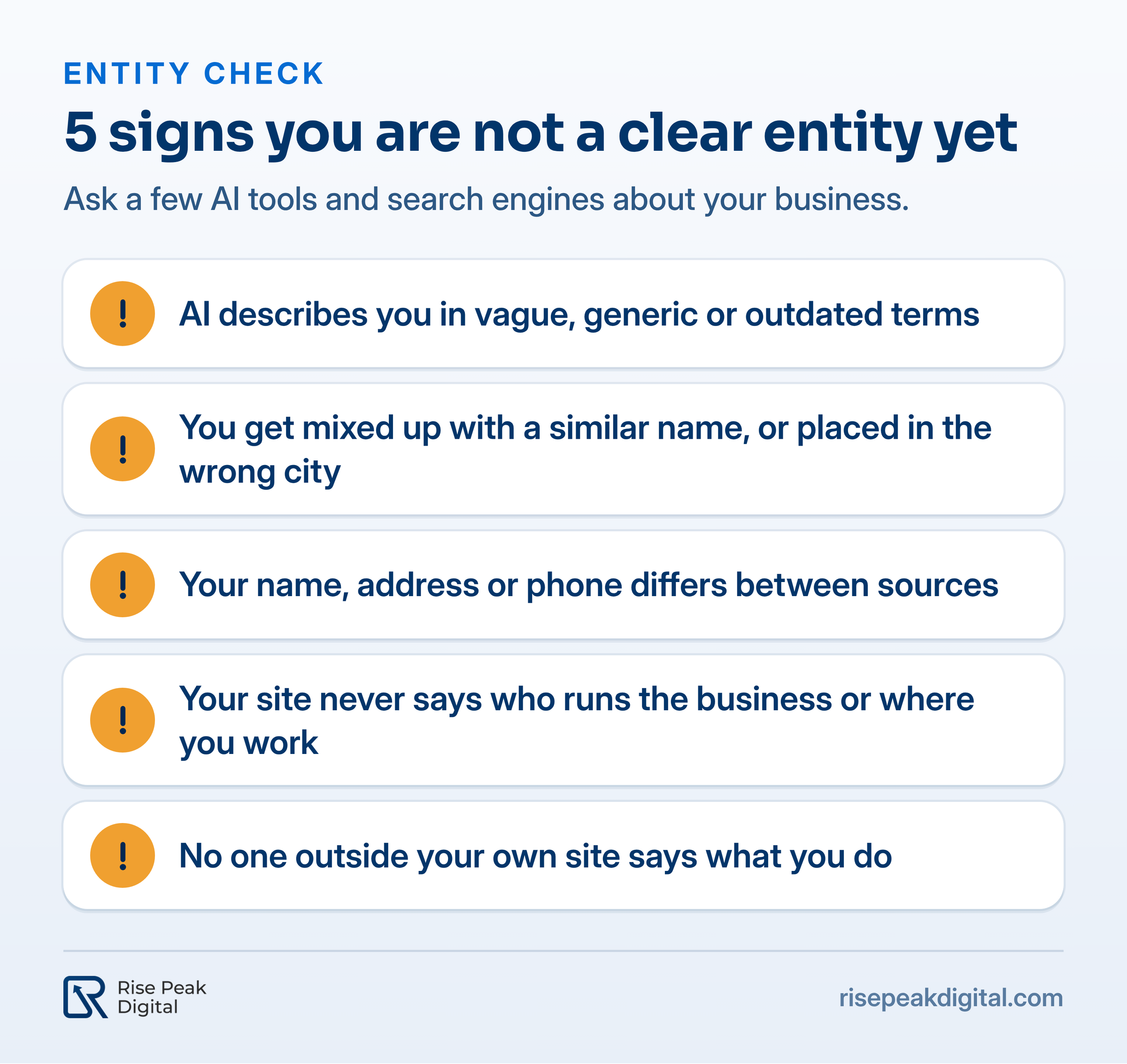
You can spot most of these by asking ChatGPT, Gemini and Google a few questions about your business:
- AI describes you in vague, generic terms, or lists services you stopped offering.
- It mixes you up with a business that has a similar name, or puts you in the wrong city.
- Your business name, address or phone number differs between your website, Business Profile and directories.
- Your website never says plainly who runs the business, where you work or what you specialize in.
- No one outside your own website says what you do.
Our step-by-step guide to running an AI visibility audit shows how to check this properly and record what you find.
How to make your business a clear entity
These are the basics. The entity SEO guide goes deeper on each one.
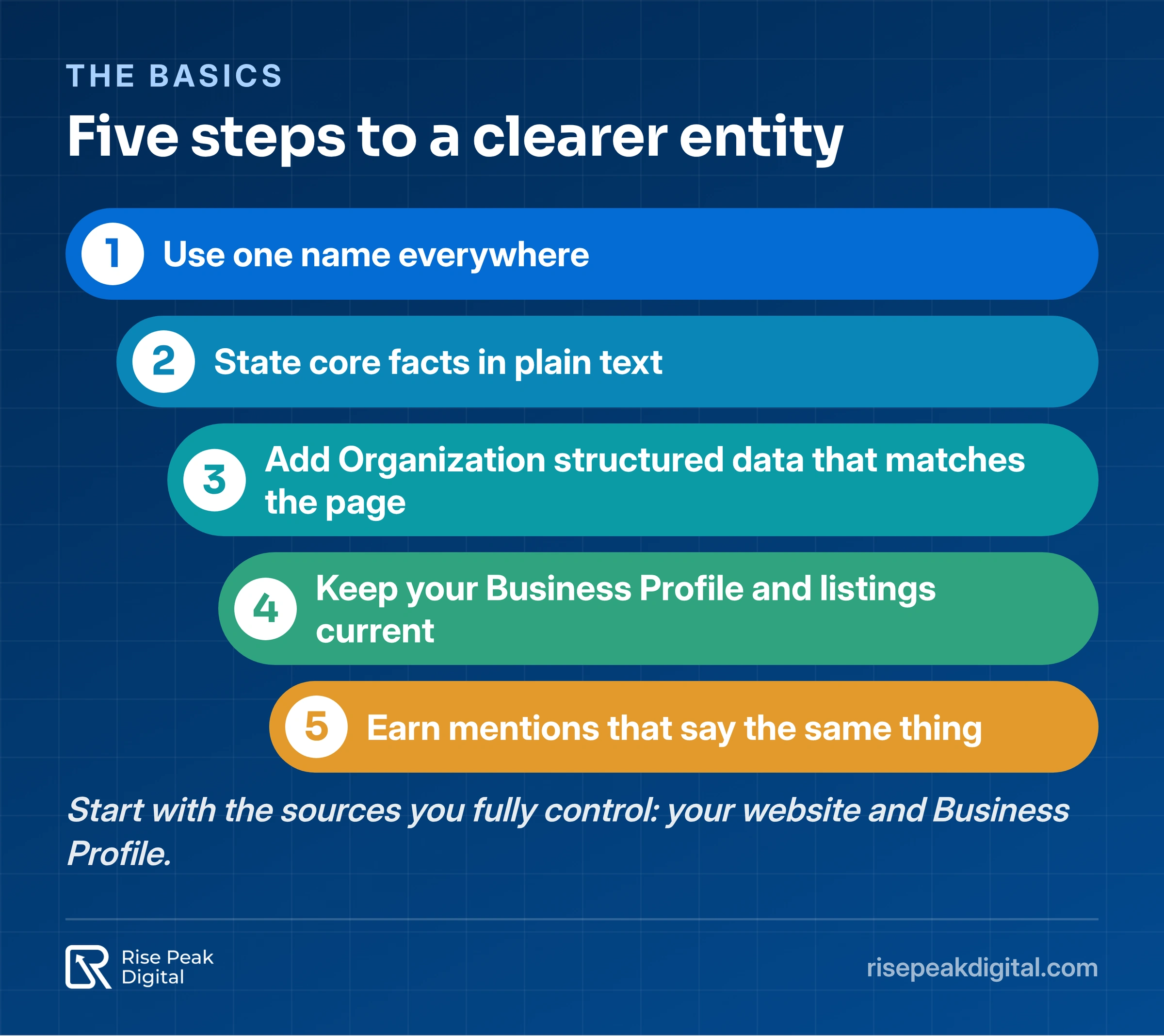
- Use one name everywhere. Google asks businesses to use their real-world name, as used consistently on their storefront, website and stationery and as known to customers (Google Business Profile Help).
- State your core facts in plain text. Put what you do, who you serve, where you work and who leads the business on your home, about and service pages. Google lists making sure important content is available in text form among its best practices for AI features (Google Search Central). A short llms.txt file can repeat those facts for AI tools, but it is no substitute for the pages themselves.
- Add Organization structured data that matches the page. Google says there are no required properties and recommends adding the ones that apply (Google Search Central). The schema.org sameAs property points to pages that “unambiguously” indicate the item’s identity, such as an official profile (Schema.org). Only mark up what’s visible on the page: Google says not to add structured data about information that isn’t visible to users (Google Search Central).
- Keep your Business Profile and listings current. Correct old addresses, phone numbers, categories and services wherever they appear.
- Earn mentions that say the same thing. Knowledge Graph facts come from a variety of sources, and panels appear when there’s enough information on the open web (Google Knowledge Panel Help). Real mentions in trade associations, local press and industry sites help. Bought links don’t: Google treats buying links for ranking purposes as link spam (Google Search Central).
Our view: fix the facts on your own website and Business Profile first. They’re the sources you fully control, and other listings often copy from them.
Entity terms, defined
| Term | What it means |
|---|---|
| Entity | A specific, identifiable thing: a person, place, organization, product or idea |
| Attribute | A fact about an entity, such as a business’s address or founder |
| Relationship | A connection between entities, such as a founder and the company they run |
| Knowledge Graph | Google’s database of facts about people, places and things |
| Knowledge panel | The information box Google shows when it has enough information about an entity |
| Structured data | Code that labels the facts on a page in a standard format, usually schema.org in JSON-LD |
| sameAs | A schema.org property linking to other pages that confirm an entity’s identity |
| Disambiguation | Telling apart entities that share a name |
For 30 more terms in plain English, see our AI search glossary.
Where Rise Peak Digital fits
Rise Peak Digital is a done-for-you SEO and AI Optimization (AIO) agency that helps established US businesses in luxury home services, real estate, healthcare and wellness, professional services, multi-location and ecommerce become the brand Google and AI search recommend. In many cases AI-recommended visits convert about 20 to 25 times higher than typical Google top-10 search. Entity clean-up is part of our AIO services, built on SEO and the answer-first work behind answer engine optimization. If you are comparing agencies for this work, use our 12-point AIO agency scorecard. Start with a free AI visibility check, or book an AIO strategy call to talk it through.
FAQ
What is an entity in SEO?
An entity is a specific, real-world thing a search engine can identify and tell apart from others, such as a person, place, product, organization or idea. Your business is an entity, with attributes like its name, services, location and founder.
Is an entity the same as a keyword?
No. A keyword is the words someone searches. An entity is the thing those words refer to. Search engines try to work out which entity a search is about, then show what’s true about it. You still need keywords to match how buyers phrase questions.
Does my business need a knowledge panel to be an entity?
No. Google says knowledge panels are created automatically when there’s enough information on the open web. A business can be a clear entity without one. Businesses manage their Google panel through their Business Profile.
Do I need schema markup to be recognized as an entity?
It isn’t required, but it helps. Google says Organization structured data can help it understand your details and disambiguate your organization. It should match the visible page, and Google says no special schema is needed for its AI features.
What does sameAs do in structured data?
sameAs is a schema.org property that lists other web pages that unambiguously identify the same thing, such as your official profiles. It helps search engines connect your website with those profiles as one entity.
How do entities affect AI search results?
AI tools write answers about specific businesses, so they need to know which business is which and what’s true about it. When your facts match across your website, Business Profile and listings, there’s less room for a vague or wrong description.