
Navigating the Evolution of Digital Discovery for Modern Brands
Quick Summary / Key Takeaways
- SEO remains the technical foundation. It ensures your site is crawlable, indexable, and able to rank in traditional search results.
- GEO focuses on getting your content cited and used in AI-generated answers across platforms like Perplexity, ChatGPT, and Google’s AI Overviews. Visibility depends on being selected as a source, not just appearing in results.
- AEO targets clear, direct answers that can be surfaced in featured snippets, voice assistants, and AI summaries. It improves how your content is extracted and delivered without requiring a click.
- AIO strengthens how your content is structured, understood, and trusted by AI systems. It focuses on entity clarity, consistent context, and authority signals, not content automation.
- Real performance comes from combining all four into a single system. Rankings support visibility, but citations and structured authority drive pipeline and influence decisions.
Introduction
Search is no longer limited to blue links. Buyers now rely on AI systems like ChatGPT, Perplexity, and Google’s AI Overviews to get direct answers before visiting a website. This changes how visibility is earned. It is no longer just about ranking on a results page. It is about being selected, cited, and trusted inside AI-generated responses where early decisions happen.
This shift introduces four connected strategies: SEO, GEO, AEO, and AIO. SEO ensures your site is crawlable and visible in traditional search. GEO focuses on being cited in generative AI responses. AEO improves how your content is delivered as direct answers. AIO strengthens how your content is structured, understood, and trusted across both search engines and AI systems. These are not separate tactics. They are layers of a single system that supports visibility, authority, and qualified pipeline growth.
This guide breaks down how each approach works, where they overlap, and how to integrate them into a unified strategy. If your current approach focuses only on rankings, it misses how buyers now discover and evaluate solutions. Rise Peak Digital focuses on building structured search systems that align SEO, GEO, AEO, and AIO so brands remain visible across both traditional results and AI-driven discovery.
SEO vs GEO vs AEO vs AIO: Core Strategy Differences
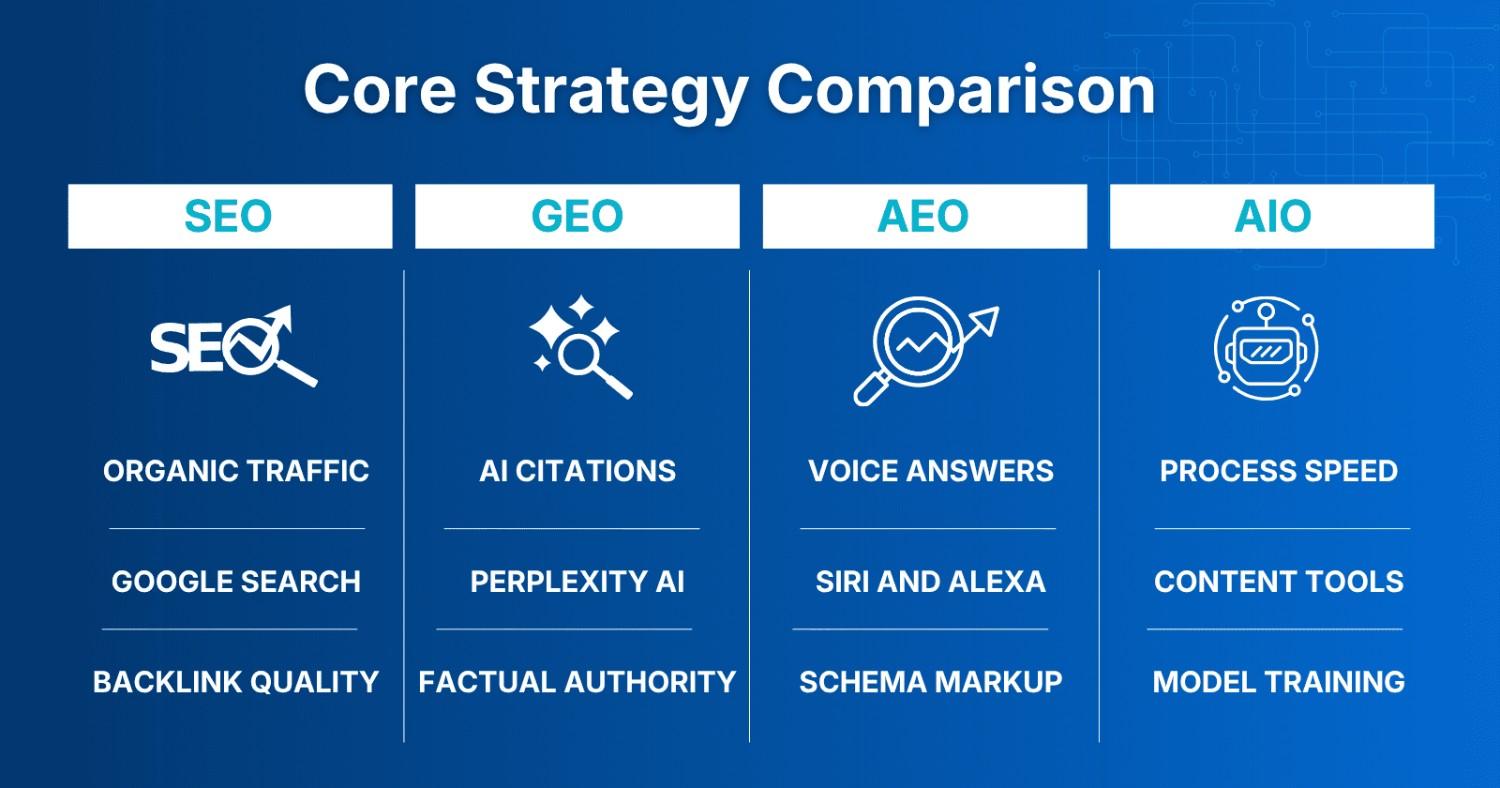
| Strategy | Primary Focus | Where It Shows Up | What Drives Success |
|---|---|---|---|
| SEO | Ranking and discoverability | Google Search results | Technical SEO, content relevance, backlinks |
| GEO | Inclusion in AI-generated answers | ChatGPT, Perplexity, Google AI Overviews | Citation signals, entity clarity, source consistency |
| AEO | Direct answer delivery | Featured snippets, voice assistants, AI summaries | Clear answers, structured content, schema markup |
| AIO | Content understanding and authority | Across search engines and AI systems | Structured content, entity relationships, technical clarity |
Measuring Performance Across SEO, GEO, AEO, and AIO
| Comparison Area | Key Signal to Track | User Intent Stage | Content That Performs |
|---|---|---|---|
| SEO | Rankings and organic traffic | Active search and comparison | Service pages, landing pages |
| GEO | Citation presence and share of voice | Early research and discovery | Structured guides, authoritative resources |
| AEO | Featured snippet and answer selection | Immediate answers and quick queries | Concise Q&A sections, definitions |
| AIO | Content clarity and conversion impact | Full funnel influence | Structured content systems, topic clusters |
Pre-Implementation Checklist: Preparing for SEO, GEO, AEO, and AIO Alignment
- Audit your current visibility across both traditional search and AI-driven platforms. This includes Google Search, Google’s AI Overviews, and tools like Perplexity to understand where your brand is appearing and where it is absent.
- Identify high-intent, question-based queries your audience is asking. Focus on how buyers phrase problems in conversational search, not just keyword variations. These queries will guide how content should be structured.
- Review your site architecture and structured data. Ensure schema markup, internal linking, and page hierarchies clearly define your services, entities, and topics so content can be interpreted and extracted accurately.
- Establish a baseline for brand presence. This includes tracking existing mentions, citations, and how your brand is currently represented across third-party sources and AI-generated responses.
Post-Implementation Checklist: Measuring and Refining AI Search Visibility
- Track how often your brand is cited or surfaced in AI-generated answers. Focus on presence across relevant queries, not just isolated mentions.
- Monitor how AI-driven features like Google’s AI Overviews affect your organic traffic and click patterns. Look for shifts in impressions, clicks, and engagement.
- Refine content based on real query behavior. Identify how AI systems summarize your content and adjust clarity, structure, and coverage where gaps appear.
- Keep structured data and content updated. As your services evolve, ensure your pages, schema, and supporting context remain accurate and consistent so AI systems continue to trust and surface your content.
Table of Contents
Section 1: DEFINING SEO, GEO, AEO, AND AIO IN MODERN SEARCH
Section 2: KEY DIFFERENCES IN HOW EACH APPROACH WORKS
Section 3: HOW THESE STRATEGIES IMPACT VISIBILITY AND PERFORMANCE
Section 4: BUILDING A UNIFIED SEARCH STRATEGY FOR THE AI ERA
Frequently Asked Questions
Section 1: DEFINING SEO, GEO, AEO, AND AIO IN MODERN SEARCH
FAQ 1: How does SEO differ from GEO for B2B companies?
SEO focuses on improving rankings and visibility within traditional search engine results. It relies on keyword targeting, technical SEO, and backlinks to help pages appear for relevant queries. The goal is to drive clicks to a website. GEO, or Generative Engine Optimization, focuses on whether your content is selected and cited inside AI-generated responses from platforms like ChatGPT, Perplexity, and Google’s AI Overviews. Instead of competing for position on a results page, you are competing to be included in the answer itself.
For B2B companies, the difference is where influence happens. SEO captures demand once a user is actively searching and comparing options. GEO positions your brand earlier, when buyers are asking complex questions and evaluating solutions through AI systems. This requires structured content, clear entity definition, and consistent authority signals across your site and third-party sources. The focus shifts from driving traffic to becoming a trusted source that AI systems use to inform decisions.
FAQ 2: What role does AEO play in capturing voice search traffic?
Answer Engine Optimization (AEO) focuses on structuring content so it can be selected as a direct response by voice assistants and AI-powered search features. Systems like Google Assistant, Siri, and AI Overviews prioritize concise, well-structured answers that clearly address a specific question. This often involves using clear headings, direct responses, and structured data such as schema markup to help systems interpret context and intent accurately.
For voice and answer-based queries, users expect a single, reliable response rather than multiple options. AEO improves the likelihood that your content is chosen for that position by making answers easy to extract and validate. This is especially relevant for high-intent or informational queries where speed and clarity matter. When combined with structured authority and consistent context, AEO supports visibility at the earliest stage of discovery, before users begin comparing providers.
Section 2: KEY DIFFERENCES IN HOW EACH APPROACH WORKS
FAQ 3: Why is AIO becoming a necessity for content teams?
AIO is becoming necessary because content is no longer evaluated only by search engines. It is interpreted, summarized, and selected by AI systems that prioritize clarity, structure, and verifiable context. Content teams are no longer competing on volume alone. They are competing on whether their content can be understood and reused inside AI-generated answers. If structure, entity definition, and topic coverage are weak, the content is ignored even if it ranks.
This changes how content teams operate. The focus shifts to structured content systems, clear information architecture, and consistent authority signals across pages. Content audits, gap identification, and rewrites become critical to remove ambiguity and improve how information is processed. This is not about producing more content faster. It is about making existing and new content usable for AI systems so it can be selected, cited, and trusted.
FAQ 4: Can you explain the main differences between aio vs seo?
AIO and SEO differ in what they optimize for. SEO focuses on improving rankings in traditional search engines through keyword targeting, technical optimization, and backlinks. Its goal is to drive clicks from search results. AIO focuses on whether your content is clear, structured, and authoritative enough to be selected and cited in AI-generated answers from platforms like ChatGPT, Perplexity, and Google’s AI Overviews. The goal is not just visibility in results, but inclusion in the answer itself.
The difference is not automation versus manual work. It is how information is evaluated. SEO signals help search engines index and rank pages. AIO strengthens how content is interpreted through entity clarity, structured context, and consistent authority signals. Both are necessary. SEO provides the foundation for discoverability, while AIO determines whether your content is trusted and used at the point where decisions are formed.
Section 3: HOW THESE STRATEGIES IMPACT VISIBILITY AND PERFORMANCE
FAQ 5: How do generative engines select sources in geo vs seo?
Generative engines select sources based on clarity, consistency, and verifiable context, not just length or keyword relevance. In traditional SEO, ranking is influenced by signals like backlinks, keyword alignment, and overall page authority. In GEO, systems like ChatGPT, Perplexity, and Google’s AI Overviews evaluate whether content can be clearly understood, cross-checked with other sources, and used to construct a reliable answer. They prioritize content that provides direct, well-structured explanations supported by consistent signals across the web.
This changes how content needs to be written and structured. Long-form content alone is not enough if the key points are unclear or buried. What matters is whether information can be extracted, validated, and connected to known entities and topics. This is where structured sections, clear answers, and supporting authority signals make a difference. The goal is to make your content usable for synthesis, not just readable for humans.
FAQ 6: What are the best ways to measure success in aio vs geo?
Success in AIO and GEO is measured by how often your brand is surfaced, cited, and trusted in AI-generated responses, not by production speed. For GEO, the focus is on citation presence, share of voice across high-intent queries, and how frequently your brand appears in answers from platforms like ChatGPT, Perplexity, and Google’s AI Overviews. These signals show whether your content is being selected as a source during early-stage research.
For AIO, measurement goes deeper into how well your content is structured and understood. This includes improvements in entity clarity, consistency across pages, engagement quality, and conversion outcomes from AI-influenced traffic. Content performance, visibility audits, and authority signal tracking help identify whether your search infrastructure is working as intended. The goal is not efficiency in output, but consistent inclusion in answers that influence buying decisions.
Section 4: BUILDING A UNIFIED SEARCH STRATEGY FOR THE AI ERA
FAQ 7: How do these four strategies work together in a single system?
SEO, GEO, AEO, and AIO work as interconnected layers of a single search system, each supporting a different part of how visibility is earned. SEO provides the technical foundation. It ensures your site is crawlable, indexable, and structured correctly. AEO focuses on delivering clear, direct answers that can be selected for featured snippets, voice responses, and AI summaries. GEO strengthens your presence in generative engines by making your content citation-ready across platforms like ChatGPT and Perplexity. AIO ties everything together by improving how your content is structured, understood, and trusted by both search engines and AI systems.
This is not about running separate strategies. It is about building a unified structure where technical SEO, content clarity, and authority signals align. Content is created and organized so it can rank, be extracted, and be cited without friction. That approach ensures visibility across traditional results and AI-generated answers while supporting qualified pipeline growth. When the system is aligned, search becomes a compounding asset instead of a series of disconnected efforts.
FAQ 8: What is the first step to transitioning from SEO to GEO?
The first step is identifying how your buyers ask questions, not just what keywords they use. GEO starts with understanding real, multi-step queries that appear in platforms like ChatGPT and Perplexity. These are often problem-driven and require clear, direct answers. From there, your priority is restructuring key pages so they answer those questions with clarity, using well-defined sections, consistent terminology, and supporting context that AI systems can interpret and validate.
At Rise Peak Digital, this transition typically begins with a search and visibility audit to identify where content lacks clarity, structure, or authority signals. The next step is rebuilding those pages into structured, citation-ready content that aligns with how generative engines retrieve and synthesize information. This approach ensures your content is not only indexed, but also selected and used in AI-generated answers.