

Turning Strategic Assets Into a Predictable Revenue Engine
Quick Summary / Key Takeaways
- Content marketing lead generation depends on intent alignment, not traffic volume. High-intent content paired with clear conversion paths drives qualified pipeline, not just visits.
- Gated assets must deliver real utility. Buyers will only exchange contact information for content that helps them make a decision or solve a defined problem.
- B2B lead generation requires mapping content to the full buyer journey. Each asset should support a specific stage, from problem awareness to vendor evaluation.
- Consistency builds authority. Regular publishing across core topics strengthens trust and improves conversion performance over time.
- Performance should be measured in pipeline impact. Data-driven iteration improves conversion rates, reduces customer acquisition costs, and increases sales velocity.
Introduction
Content marketing is no longer just a brand awareness play. According to the Content Marketing Institute, 87% of B2B marketers use content marketing to generate leads, not just traffic, but measurable pipeline. In longer B2B sales cycles, buyers do not convert after a single click. They research, compare, and validate before engaging.
That is where content marketing lead generation becomes critical. Instead of interrupting buyers like paid ads, content meets them during decision-making. It builds trust early and reduces friction later.
This guide breaks down how content marketing for lead generation works in practice, including how to structure content across the funnel and connect it directly to pipeline. When done correctly, content is not just a tactic. It becomes a system that compounds.
Why Content Marketing Is a Lead Generation Engine
Content marketing generates leads by attracting buyers during research, building trust before sales conversations, and guiding them toward conversion over time.
B2B buying behavior has shifted. Buyers do not start with sales calls. They start with research. According to the Demand Gen Report, 76% of B2B buyers rely on content before speaking to a vendor. If your content is not present at that stage, you are not part of the consideration set.
Content works because it aligns with how decisions are made. It answers questions, frames problems, and introduces solutions before a conversation happens. This creates familiarity and trust long before a form is filled.
It also compounds. Paid campaigns generate traffic only while you spend. Content continues to attract and convert over time. Each asset contributes to a system that supports discovery and conversion.
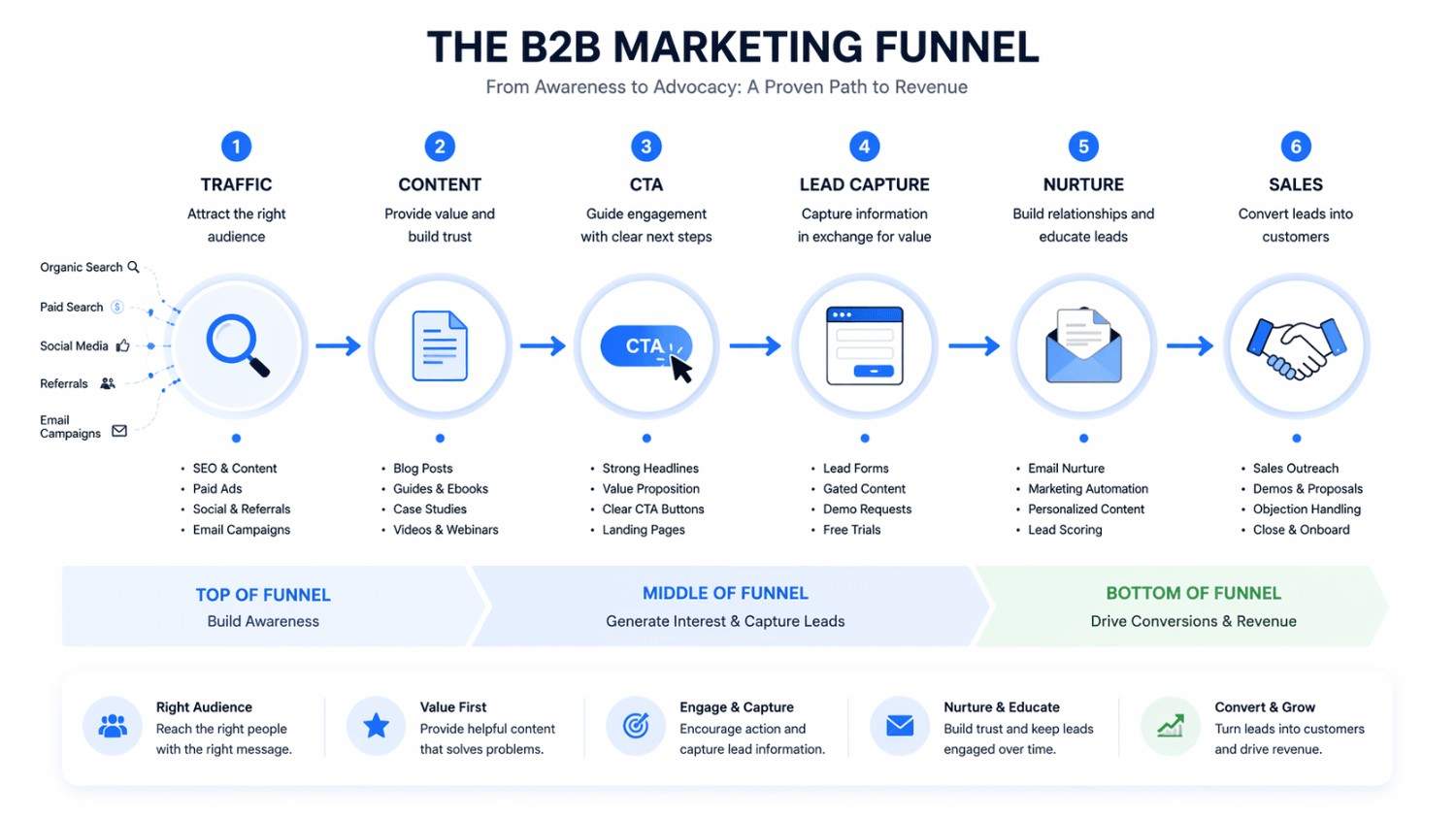
At a practical level, the process looks like this:
Traffic → Content → CTA → Lead capture → Nurture → Sales
- Traffic comes from search, social, or AI-driven discovery
- Content delivers value and builds trust
- CTAs guide the next step
- Lead capture turns visitors into contacts
- Nurture sequences qualify and educate
- Sales converts qualified demand into revenue
This is how content marketing and lead generation connect. Not through volume, but through structure. If you want to understand how to generate leads with content marketing, the focus should be on alignment between intent, content, and conversion.

The Content Marketing Funnel: Matching Content to Buyer Stage
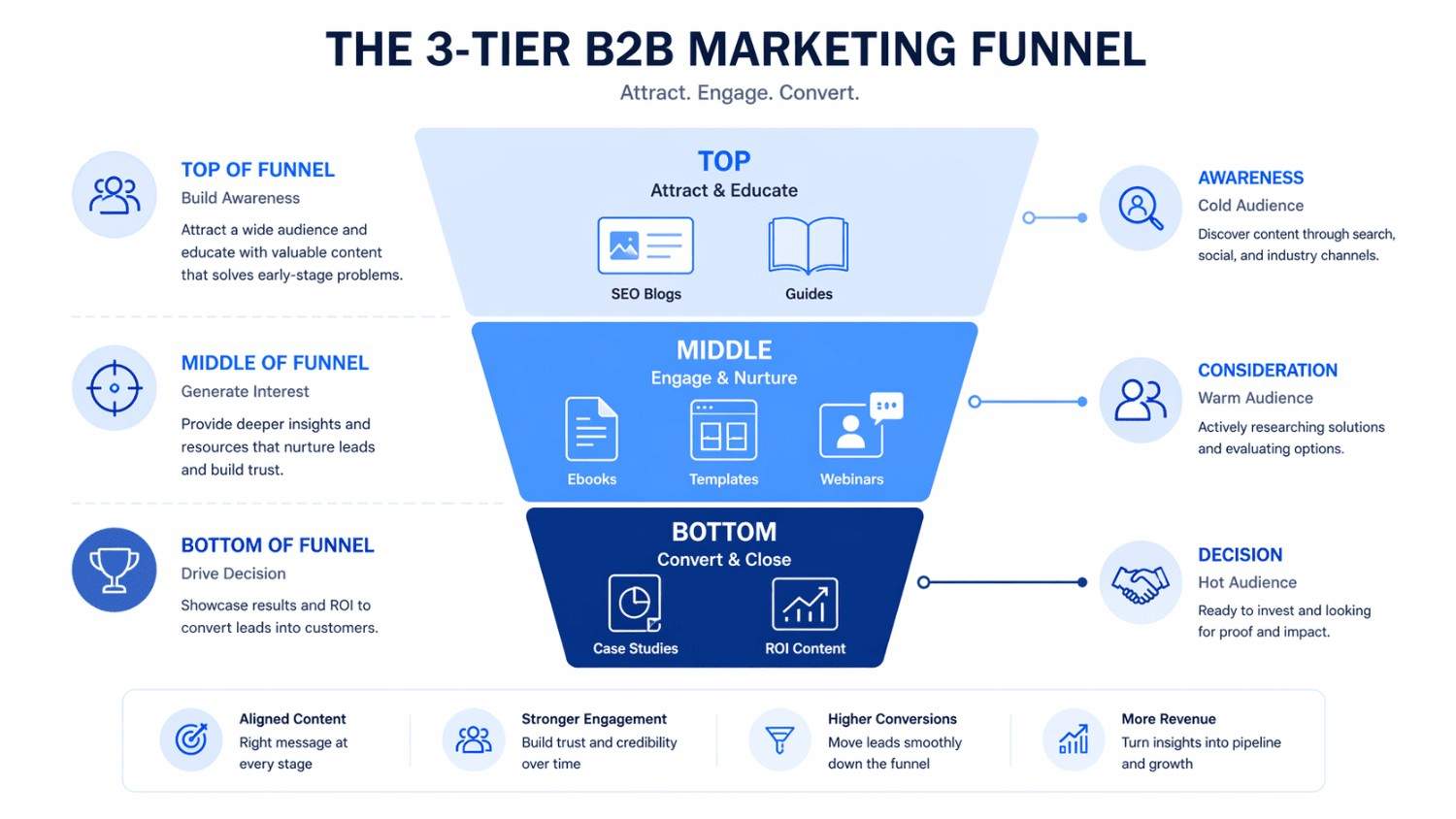
Content marketing generates leads by aligning content with each stage of the buyer’s decision process, from early research to final purchase.
Content only generates leads when it matches where the buyer is in their decision process. Not all content is meant to convert immediately. Some content creates awareness. Some qualifies interest. Some drive action.
Top of Funnel (Awareness): Capture Demand Early
At this stage, buyers are identifying problems and exploring solutions. They are searching for information, not vendors.
Content here should be:
- Educational and search-driven
- Focused on high-volume queries
- Built to establish visibility and credibility
Common formats include blog posts, long-form guides, and SEO-driven articles. This is where content marketing lead generation begins, by capturing attention early.
Middle of Funnel (Consideration): Build Trust and Qualification
Buyers now understand their problem and are evaluating options. This is where differentiation starts to matter.
Content here should:
- Compare approaches or solutions
- Introduce your perspective
- Begin capturing leads through light gating
Effective formats include case studies, comparison pages, webinars, and email sequences. This is the core of content marketing B2B lead generation, where interest becomes identifiable demand.
Bottom of Funnel (Decision): Convert to Pipeline
At this stage, buyers are evaluating vendors and preparing to act. Content needs to support decision-making, not just educate.
Content here should:
- Provide proof and clarity
- Reduce risk
- Guide toward a clear next step
ROI calculators, testimonials, demos, and proposals are critical here. Strong CTAs are required. This is where lead generation through content marketing turns into actual pipeline.
Content Performance by Funnel Stage and Lead Impact
| Content Format | Buyer Stage | Typical Conversion Range | Primary Success Metric |
|---|---|---|---|
| White Papers | Middle of Funnel | Moderate to High | Qualified Lead Downloads |
| Webinars | Bottom of Funnel | High | Attendee-to-Demo Rate |
| Blog Posts | Top of Funnel | Low | Email or Newsletter Signups |
| Case Studies | Bottom of Funnel | High | Demo Requests / Sales Calls |
Core Metrics That Drive Content-Led Pipeline
| Metric | Focus Area | Benchmark Direction | Business Impact |
|---|---|---|---|
| MQL Volume | Quantity | Consistent monthly growth | Pipeline Expansion |
| SQL Conversion | Quality | Strong MQL to SQL ratio | Sales Efficiency |
| Cost Per Lead | Efficiency | Decreasing over time | CAC Reduction |
| Content ROI | Revenue | Positive return on spend | Scalable Budget Allocation |
What Type of Content Generates the Most Leads?
Different content types perform at different stages. High-performing programs use a mix that works together, not in isolation.
Long-Form SEO Content (Top Funnel Scale)
Long-form content captures search demand at scale. It ranks for high-intent queries and drives consistent inbound traffic.
This is the foundation of content marketing lead generation. It creates the entry point for new buyers and supports long-term visibility.
Gated Content & Lead Magnets (Conversion Layer)
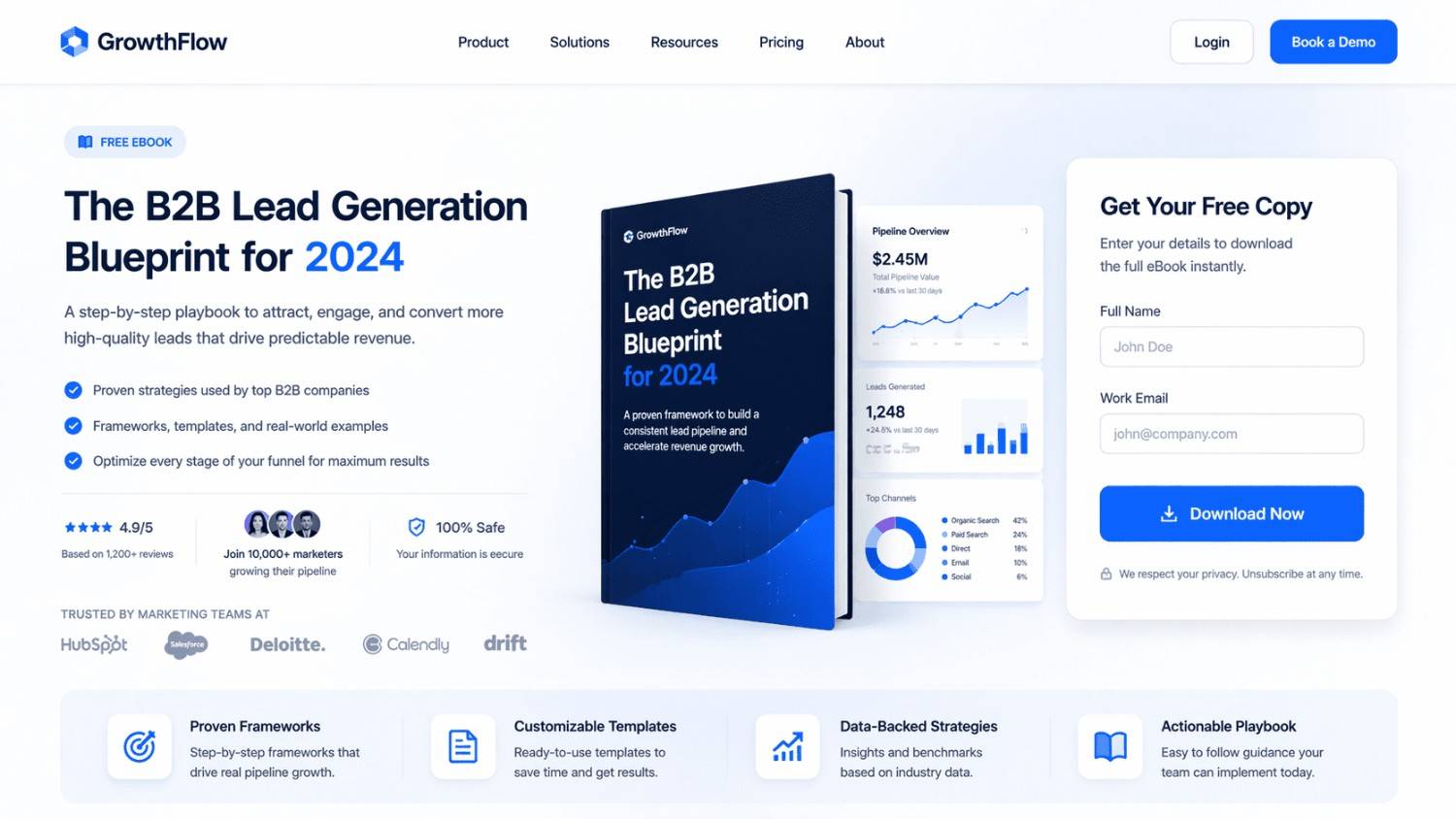
Traffic alone does not generate leads. Conversion happens when you offer something valuable in exchange for contact information.
Effective formats include:
- Ebooks
- Templates
- Tools
These assets require clear value and strong positioning. They rely on forms and landing pages to convert anonymous visitors into leads. This is where content marketing for lead generation becomes measurable.
Case Studies & ROI Content (Decision Acceleration)
Proof drives decisions. Case studies show how your solution works in real scenarios.
They:
- Reduce perceived risk
- Demonstrate outcomes
- Speak to multiple stakeholders
This is essential for content marketing B2B lead generation, especially in high-consideration environments.
Webinars & High-Intent Content
Webinars create real-time engagement. They attract buyers who are actively researching and willing to invest time.
This often results in:
- Stronger qualification signals
- Higher engagement
- Better lead quality
Structured Content (FAQs, Snippets, AI Visibility)
Structured content improves discoverability. FAQ sections, schema markup, and clear answers
increase visibility in:
- Featured snippets
- AI-generated responses
This aligns with how modern buyers search, through both traditional engines and AI systems. Structured content improves how often your brand is surfaced.
How to Use SEO to Maximize Content Marketing Lead Generation?
SEO maximizes content marketing lead generation by aligning keywords with buyer intent, structuring content for discoverability, and guiding users toward conversion.
SEO drives visibility. But visibility alone does not create leads. Conversion paths turn traffic into pipelines.
Map Keywords to Buyer Intent
Not all keywords are equal. Some indicate curiosity. Others signal readiness.
Effective strategies:
- Map keywords to awareness, consideration, and decision stages
- Prioritize intent over volume
- Avoid traffic that does not convert
This is where content marketing lead generation strategies become efficient.
Build a Pillar-Cluster Content System
A strong content system is structured, not scattered.
It includes:
- Pillar pages, like this guide
- Supporting cluster content
- Internal linking between related topics
This improves both SEO performance and user navigation
Design Conversion Paths Inside Content
Traffic without conversion paths is wasted.
Effective content includes:
- Inline CTAs
- Mid-content offers
- End-of-post actions
Common CTA types:
- Demo requests
- Free audits
- Downloadable resources
The goal is simple. Guide the reader toward a next step.
Internal Linking to Revenue Pages
Content should not exist in isolation. It should connect to revenue-driving pages.
Strategic internal links:
- Guide readers toward services
- Reinforce relevance
- Support conversion journeys
This is where content connects directly to business outcomes.
How Long Does Content Marketing Take to Generate Leads?
Content marketing typically takes 6 to 18 months to generate consistent organic leads, but earlier results are possible through gated content, paid distribution, and email capture.
Content marketing is not immediate. It is a compounding investment.
Organic Timeline (6–18 Months)
It typically takes 6 to 18 months to:
- Build authority
- Rank for competitive terms
- Generate consistent traffic
As content accumulates, performance improves. Returns increase as more assets contribute to visibility and conversion.
How to Accelerate Lead Generation
You do not have to rely on organic growth alone.
You can generate leads sooner through:
- Gated content with email capture
- Paid amplification of high-performing content
- Distribution through existing audiences
This is how to balance short-term results with long-term growth when learning how to generate leads with content marketing.
How Rise Peak Digital Uses Content to Drive B2B Leads
Content works best when it is part of a structured system. That’s how we approach it.
Strategy: Intent-Driven Content Architecture
We map keywords, topics, and content angles to buyer intent and decision stages. Each piece of content has a clear role in moving prospects forward.
We also define content pillars and messaging themes so your content stays consistent and aligned with what your audience is actually searching for.
Execution: AI-Ready, Structured Content
We build content for:
- Search engines
- AI systems like ChatGPT and Perplexity
- Human decision-makers
Content is written to be clear, structured, and easy to understand. We refine messaging, improve clarity, and enhance existing content so it performs better, not just produce more content.
This approach reflects how we build a content marketing strategy for lead generation that supports both visibility and engagement.
Conversion: Turning Traffic Into Pipeline
We integrate:
- Conversion-focused UX
- Clear CTA strategy
- Lead capture systems
Content is designed to guide users toward action, not just engagement. Messaging, structure, and flow are refined so visitors understand what to do next.
Our conversion strategy and CRO process ensures that visibility turns into measurable pipeline.
Traffic only matters if it converts.
Measurement: Pipeline, Not Traffic
We track:
- Lead volume
- Conversion rates
- Lead quality and engagement signals
- Pipeline influenced by content
We use these insights to refine content strategy and improve performance based on what drives actual results.
Success is measured in revenue impact, not rankings alone.
Pre-Launch Checklist for Content-Led Lead Generation Systems
- Define clear lead generation goals tied to pipeline outcomes, not just traffic targets.
- Map buyer personas and intent stages to ensure each asset aligns with a specific decision point.Create high-value gated assets for each stage.
- Develop high-value gated assets that justify data exchange and support mid to bottom funnel conversion.
- Build conversion-focused landing pages with a single objective and clear value proposition.
- Set up tracking infrastructure, including CRM integration and conversion tracking, to capture lead data accurately.
Post-Launch Optimization Checklist for Pipeline Growth
- Analyze lead quality, not just volume, by tracking progression from MQL to SQL.
- Test and refine headlines, offers, and calls to action to improve conversion efficiency.
- Distribute content across both organic and paid channels to maximize qualified reach.
- Implement structured email nurture sequences to move leads through the funnel.
- Continuously optimize based on performance data to improve conversion rates and reduce acquisition costs.
Frequently Asked Questions
How does content marketing generate leads?
Content marketing generates leads by attracting buyers during research and guiding them toward a next step. According to the Demand Gen Report, 76% of B2B buyers rely on content before speaking to sales, making content the entry point. The system is simple: traffic → content → CTA → lead capture → nurture → sales. When aligned with buyer intent across awareness, consideration, and decision stages, this creates a steady flow of qualified inbound leads.
What type of content generates the most leads?
Long-form SEO content generates the most top-of-funnel leads by capturing search demand at scale. Gated assets such as ebooks, templates, and tools convert that traffic into known contacts. Case studies and ROI-focused content perform best at the decision stage. Webinars also produce higher-quality leads because they signal stronger intent. In practice, it is not one format. It is how content works together across the funnel.
How long does content marketing take to generate leads?
Content marketing typically takes 6 to 18 months to generate consistent organic traffic and lead volume. This timeline reflects how long it takes to build authority and rank in search. However, you can generate leads sooner through gated content, email capture, and paid distribution. As more content accumulates, the compounding effect improves cost efficiency and can outperform paid channels at scale.
What are the best content marketing strategies for B2B lead generation?
The best content marketing strategies for B2B lead generation include SEO-driven pillar content, targeted lead magnets, case studies that demonstrate ROI, webinars for high-intent engagement, and clear CTAs that guide prospects toward conversion. These strategies work when content is aligned with buyer intent and structured across the funnel. SEO-driven pillar content captures demand. Lead magnets convert that traffic into contacts. Case studies and comparison content support evaluation. Webinars help qualify high-intent prospects.
The key is to connect all content to a clear next step so it contributes directly to the pipeline.
How do you measure content marketing lead generation?
Content marketing lead generation is measured by tracking traffic, conversions, lead attribution, cost per lead, and pipeline revenue influenced by content. You measure content marketing by its impact on pipeline, not just traffic. Key metrics include organic traffic, conversion rate from visitors to leads, cost per lead, and the number of leads influenced by content.
More advanced teams track how content contributes to pipeline and closed revenue through attribution in GA4 and CRM systems. If content is not tied to revenue, it is incomplete.
Closing Thoughts
Content marketing works when it is treated as infrastructure, not activity. When your content aligns with buyer intent, supports decision-making, and connects to clear conversion paths, it becomes a consistent source of pipeline. This is especially true in B2B environments where trust and timing matter.
At Rise Peak Digital, we build search systems that connect content, SEO, and conversion into a single engine, designed for both traditional and AI-driven discovery.
If you are evaluating how content can support real growth, our content marketing strategy for lead generation and conversion strategy and CRO process are built to turn visibility into pipeline.

Michael Sanchez
Michael Sanchez is the CEO of Rise Peak Digital, a results-driven marketing agency specializing in contest marketing and AI-Optimized SEO (AIO) strategies. With nearly 20 years of experience as a digital marketing consultant, Michael has used contest marketing to generate over millions in online sales and help 500+ brands transform giveaways into profitable customer acquisition machines.
If you'd like expert guidance on launching your own high-ROI contest or AIO strategy, you can book a strategy call here.