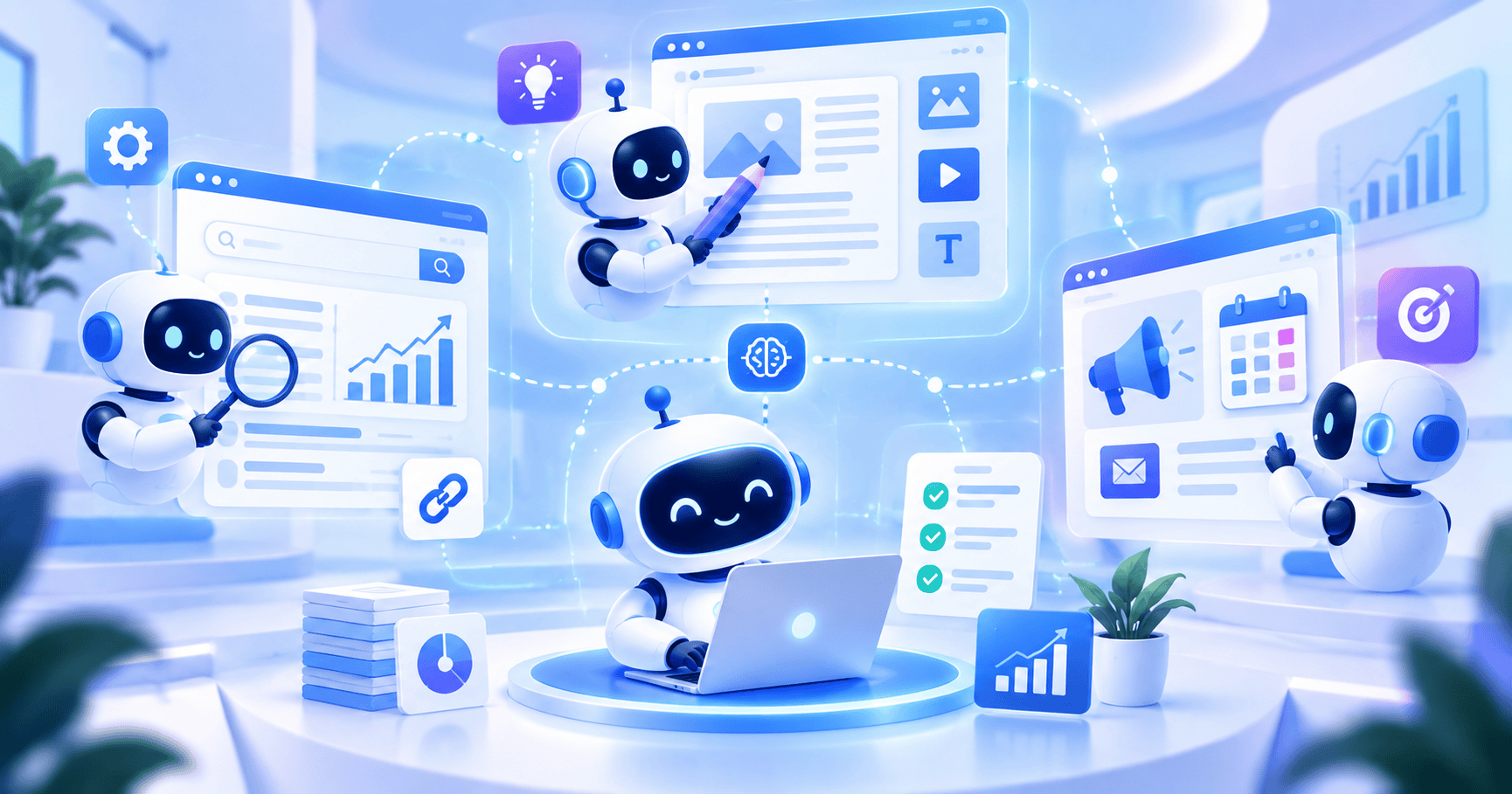
Marketing teams face a consistent and widening challenge. The volume and variety of output required has grown significantly faster than headcount. A modern marketing function is expected to produce SEO content at volume, email campaigns for multiple segments, paid advertising copy across multiple platforms, social content for multiple channels simultaneously, and overarching strategy to coordinate all of it at professional quality, consistently, week after week.
For a team of two to five people, this is an impossible workload without either systematically compromising output quality or burning out the people responsible.
AI agents for marketing are changing that equation. Not by replacing marketing teams, but by handling the systematic execution of specific disciplines so the humans on those teams can focus on the strategic decisions that actually require judgment.
This guide explains what AI marketing agents actually are, how they differ from the AI tools most teams are already using, and how forward-thinking teams are deploying them across SEO and content strategy right now.
What Are AI Agents for Marketing and How Are They Different From AI Tools?
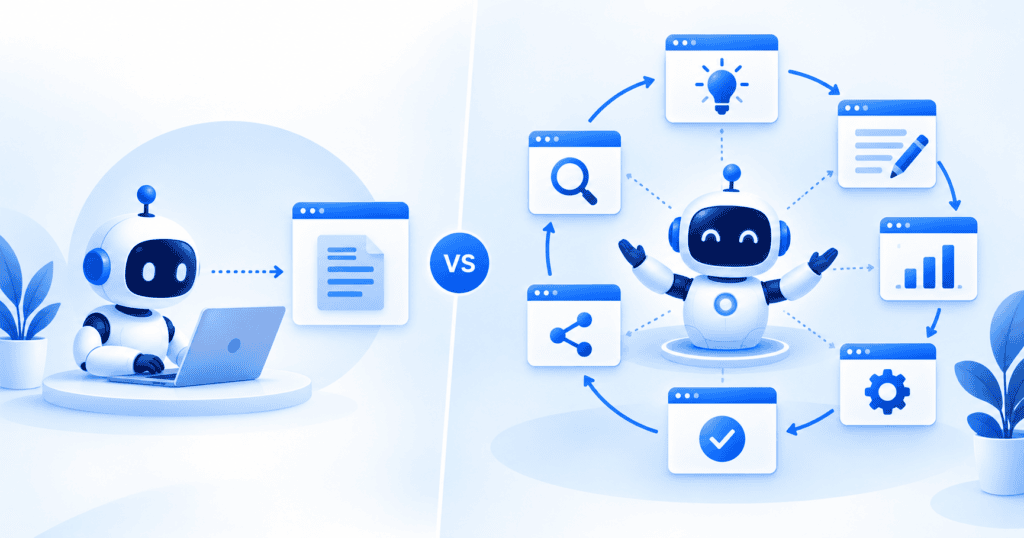
Most marketing teams are already using AI tools. ChatGPT for drafting copy. Midjourney for images. Grammarly for editing. These tools are valuable, but they share a common limitation: they wait for a prompt, execute a single task, and forget the result.
An AI marketing agent is fundamentally different.
An AI agent is given a goal, plans the work needed to achieve it, calls the tools required at each step, evaluates what comes back, and decides what to do next. Agents reason and adapt across multiple steps. Tools just execute one step and stop.
The practical difference is significant. An AI tool for SEO helps you write a brief when you ask it to. An AI agent for SEO takes a target keyword, runs a SERP analysis, identifies content gaps, generates a brief, produces a draft, checks it against quality criteria, and flags it for human review, all within a single workflow that the agent manages from start to finish.
This distinction matters because it changes what becomes possible. Teams that deploy AI agents are not just working faster on individual tasks. They are building systems that execute entire workflows autonomously, freeing the humans on those teams to focus on what AI cannot yet do: strategic judgment, creative direction, and relationship-driven work.
How AI Agents Are Being Used in SEO Today
SEO has historically been one of the highest-volume, most data-intensive disciplines in marketing. Keyword research, technical audits, competitor analysis, content brief generation, internal link mapping, and performance reporting all involve large amounts of repetitive, sequential work that consumes significant human time without necessarily requiring human judgment at every step.
AI agents are well suited to exactly this kind of work.
Keyword research automation. An AI agent connected to live SEO data can pull seed terms, expand them into variations, cluster them semantically, score each cluster against domain authority and competition profiles, and output a prioritized opportunity list. Work that takes hours manually can be completed in minutes.
Content brief generation. Agents that analyze top-ranking pages for a target keyword, identify content gaps, map entity requirements, and generate structured briefs with keyword targets, heading structures, and internal link plans are already operating in production environments for leading content teams.
Technical audit workflows. AI agents can run crawl analyses, flag technical issues by severity, cross-reference against known ranking factors, and generate prioritized fix lists without requiring a human to manually interpret raw crawl data.
Competitor analysis. Agents can monitor competitor content, identify new pages targeting priority keywords, and surface competitive moves that would otherwise go unnoticed until rankings shift.
Performance reporting. Rather than manually pulling metrics from multiple platforms and assembling reports, AI agents can gather data, identify anomalies, write narrative summaries, and surface the insights that need human attention.
The result is not just efficiency. It is the ability to maintain SEO work at a quality and frequency that would be impossible for a small team without agents handling the execution layer.
How AI Agents Are Transforming Content Strategy
Content strategy has the same fundamental tension as SEO: the work required to do it well far exceeds what most teams can realistically execute manually at consistent quality.
AI agents are addressing this tension across the entire content production pipeline.
Content calendar planning. Agents can analyze keyword opportunities, map content to the buyer journey, identify gaps in existing cluster coverage, and generate prioritized publishing calendars aligned to SEO and conversion goals.
AI-assisted drafting with human editorial review. The most effective content production model in 2026 is not fully autonomous AI generation. It is a human-AI collaboration where agents handle research, structuring, keyword integration, and first-draft production while human editors apply voice, perspective, and strategic judgment to the output. AI handles the 80 percent that does not require human creativity. Humans focus on the 20 percent that makes content worth reading.
Performance feedback loops. Content agents can monitor how published pieces perform, identify which articles are gaining citations or impressions, flag underperforming content for refresh, and feed performance data back into the brief and strategy layer. This makes the content system more effective over time rather than treating each piece as a one-time output.
Content refresh at scale. Keeping a large content library current is one of the most resource-intensive challenges in content marketing. AI agents can monitor topic developments, identify pages with outdated information, generate updated sections, and flag them for human review before republishing.
The teams that are winning content marketing right now are not the ones producing the most content. They are the ones that have built systems where every piece is produced intentionally, optimized for both search and AI visibility, and continuously improved based on performance data.
AI Agents and AIO: The Connection Most Marketers Are Missing
Most conversations about AI agents for marketing focus on traditional SEO and content production. What is being missed is the connection between AI agents and AI search visibility, which is increasingly where the battle for audience attention is being fought.
As Google AI Overviews, ChatGPT, Perplexity, and Gemini become primary research tools for more users, the brands that appear in AI-generated answers are capturing attention before a competitor’s organic result or paid ad is even seen. Getting your brand cited in those answers requires a different set of optimization signals than traditional SEO, and managing those signals at scale requires the kind of systematic, ongoing work that AI agents are built for.
AI agents are already being deployed to monitor AI citation presence across platforms, identify which queries trigger competitor citations instead of your brand, surface content gaps that are limiting AI inclusion, and systematically improve entity signals that help AI systems recognize and trust your brand.
This application of AI agents to AI search visibility, what Rise Peak Digital refers to as AIO, is the emerging frontier in marketing automation. The brands investing in it now are building advantages that will compound as AI search behavior continues to grow.
The Human-AI Collaboration Model That Actually Works
One of the most persistent misconceptions about AI agents for marketing is that deploying them means reducing the role of human marketers. The evidence points in the opposite direction.
The most effective marketing teams using AI agents in 2026 are not the ones that have removed humans from the process. They are the ones that have restructured the process so humans are focused exclusively on the work that requires human judgment.
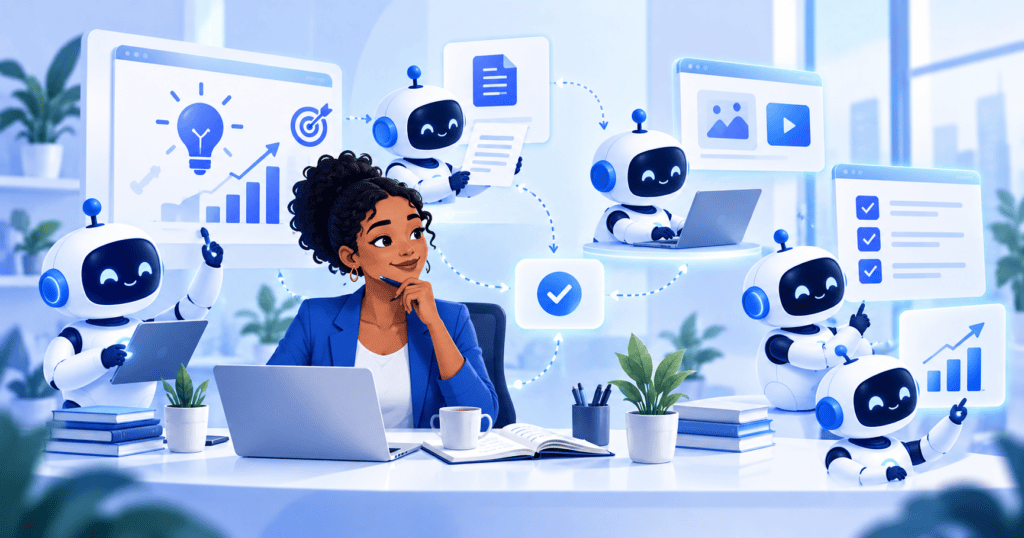
AI agents replace the routine, repetitive, and data-intensive parts of the job: keyword pulls, technical audits, content briefs, performance reporting, and competitor monitoring. The strategic parts remain human: what to target, how to frame it, what the brand voice sounds like, when to pivot, and how to interpret results in the context of broader business goals.
This redistribution of work is not just about efficiency. It is about quality. When human marketers are not spending their time on mechanical execution tasks, they can bring genuine strategic attention to the decisions that actually move the needle.
A useful frame: AI agents handle the work that should not require a human. Humans handle the work that only humans can do well. The best outcomes come from designing the system around that distinction clearly and deliberately.
What to Consider Before Deploying AI Marketing Agents
For teams evaluating AI agents for the first time, the most important insight from practitioners who have done this well is to fix your data foundation before building agents on top of it.
AI agents are only as good as the information they can access and the quality of the data they are working with. An agent that runs keyword research on outdated data produces outdated recommendations. An agent that generates content briefs without access to your existing content inventory risks recommending pages that cannibalize what you already have.
Before deploying AI marketing agents, consider these foundational questions:
What specific bottleneck are you solving? The teams that get the best results from AI agents start with one clearly defined problem, validate the agent against historical results, and expand from there. Trying to automate everything at once typically produces unreliable outputs and makes it hard to identify what is working.
What is your content volume requirement? If you need to produce twenty or more articles per month consistently, autonomous content agents become significantly more valuable. If your volume is lower, simpler AI assistance may be sufficient.
What is your current SEO maturity? If you have never built a keyword strategy or content cluster plan, deploying an AI agent on top of an absent foundation will not solve the underlying problem. Agents accelerate existing strategy. They do not replace the need for strategy.
Who will maintain human oversight? Even the most capable AI agents require human review at key checkpoints. Identifying who owns that oversight function before deployment prevents the quality drift that comes from treating agents as fully autonomous.
Frequently Asked Questions
What is the difference between an AI agent and an AI tool for marketing?
An AI tool waits for a prompt, executes a single task, and stops. An AI agent is given a goal, plans the steps needed to achieve it, executes those steps using the tools available to it, evaluates the results, and decides what to do next. Agents handle multi-step workflows autonomously. Tools handle individual tasks on demand.
Can AI agents replace SEO specialists or content writers?
Not yet, and probably not in the way the question implies. AI agents replace the routine, repetitive, and data-intensive parts of SEO and content work. The strategic parts, including what to target, how to frame a message, when to pivot, and how to exercise creative judgment, still require humans. The most effective teams use AI agents to handle execution so specialists can focus on strategy.
Which marketing tasks are best suited for AI agents?
AI agents perform best on tasks that are high-volume, sequential, and data-dependent. Keyword research, technical audits, content brief generation, performance reporting, and competitor monitoring are among the highest-value applications. Tasks that require original creative judgment, relationship management, or nuanced strategic thinking are better kept with humans.
How do I get started with AI agents for marketing?
Start with one clearly defined problem rather than trying to automate everything at once. Identify the specific bottleneck that costs your team the most time without requiring significant human judgment. Build or deploy an agent for that one task, validate its outputs against historical results, and expand from there once you have confidence in the outputs.
Do AI agents work for small marketing teams?
Yes, and they may deliver proportionally greater impact for small teams than for large ones. A two-person marketing team that deploys AI agents for keyword research, brief generation, and performance reporting can produce the output volume and quality of a much larger team. The constraint is not team size but the clarity of the strategy the agents are executing against.
AI agents for marketing are not a future consideration. They are operating in production environments for teams that are winning on search visibility, content output, and AI citation presence right now.
If you want to understand how AI agents can be integrated into your SEO and content strategy and how that connects to improving your visibility in AI-generated search results, we would be glad to walk through what that looks like for your specific situation.