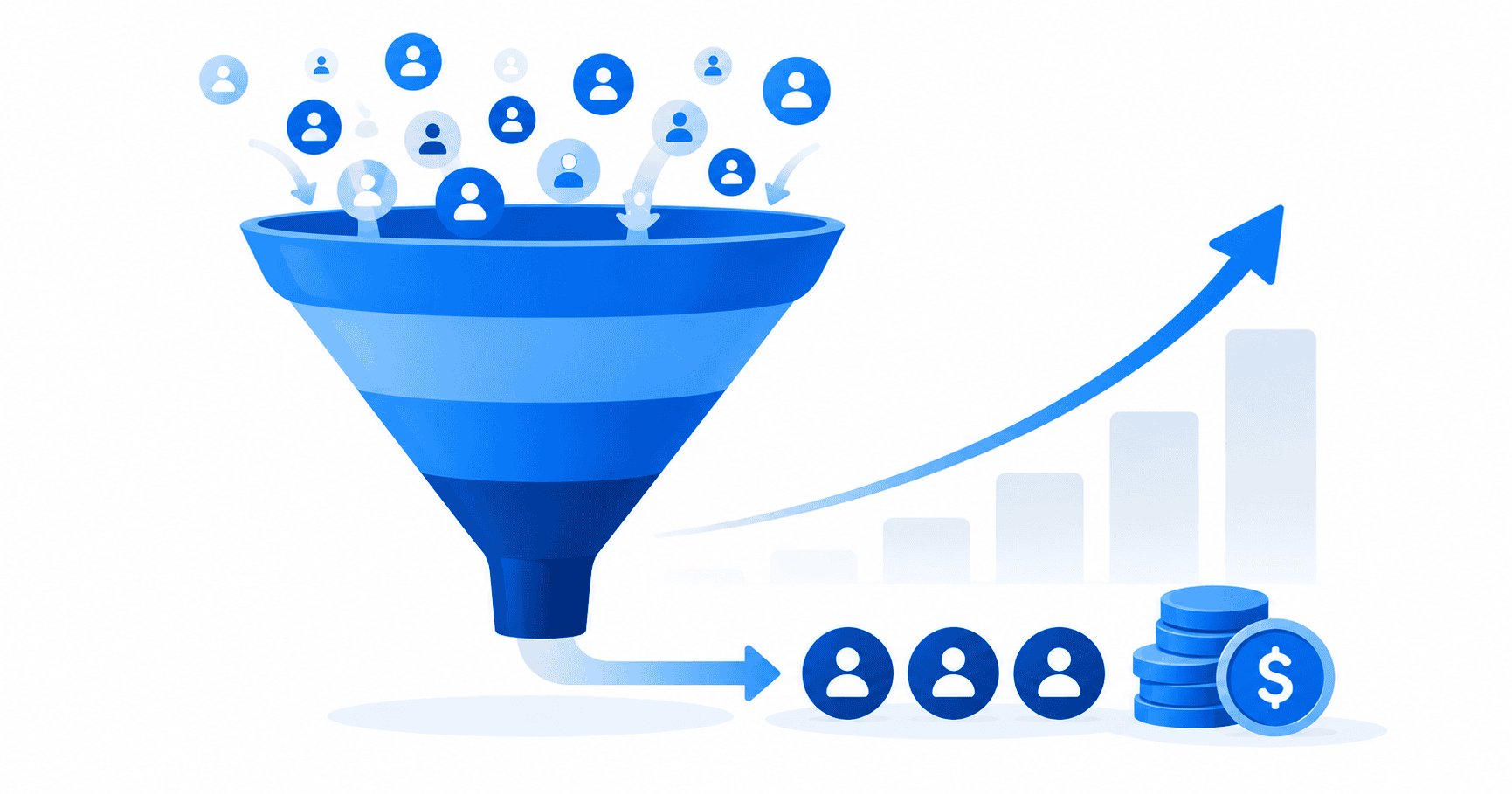
Conversion rate optimization (CRO) is the process of increasing the share of visitors who take a defined action on your website: a form submission, a demo request, or a booked call. It does not require more traffic. It gets more value from the traffic you already have.
This becomes increasingly relevant as AI-powered search changes how people discover businesses. Visitors arriving from ChatGPT or Perplexity may have already encountered information about a company, its services, or its competitors. However, their level of purchase intent can vary. CRO helps businesses turn that interest into meaningful actions, such as submitting a form, requesting a demo, or booking a consultation.
This article covers the CRO formula, B2B benchmarks, a five-step process, and how to convert visitors from AI search.
What is conversion rate optimization (CRO)?
Conversion rate optimization is the systematic process of increasing the percentage of website visitors who complete a target action. It applies to any defined conversion: a macro conversion such as a demo request, a contact form or a booked call, or a micro conversion such as a pricing page view, a case study download or a newsletter sign-up.
In B2B lead generation, the conversions that matter most are the ones that start a sales conversation: a completed contact form, a demo booking, an audit request, and a call scheduled through a calendar link. Micro conversions (case study views, pricing page visits) are useful as signals but are not the primary goal.
How to calculate conversion rate
The formula is straightforward:
(Conversions ÷ Visitors) × 100 = Conversion Rate
A page that received 1,000 visitors and produced 50 form submissions has a 5% conversion rate.
Before calculating conversion rate, decide whether you are measuring sessions or users. A session-based conversion rate measures the percentage of sessions that result in a defined conversion, while a user-based conversion rate measures the percentage of users who convert during the reporting period. Neither method is universally better for B2B lead generation. Choose the approach that matches your business objective and use it consistently when comparing results.
Conversion rate vs click-through rate. Conversion rate measures the share of visitors who complete an action on the page. Click-through rate measures the share of people who clicked through to the page from a search result or an email. They measure different things and should not be compared directly
What is a good conversion rate?
A good conversion rate depends on the industry, page type, traffic source, offer, and conversion being measured. For example, a contact form receiving visitors from informational searches may perform differently from a dedicated demo landing page targeting existing prospects. Rather than treating a single percentage as a universal B2B benchmark, establish a reliable baseline for each important page and measure improvements over time.
A 30% conversion rate may be achievable in certain high-intent scenarios, such as targeted campaigns, returning-audience offers, or narrowly focused landing pages. However, it would be unusually high for many general B2B lead-generation pages. Always evaluate the result in context, including the traffic source, audience, conversion event, and quality of the leads generated.
For B2B specifically: Moz cites a 1 to 2% benchmark for B2B sites as a rough reference, noting it is unsourced. No widely agreed source benchmark exists for B2B lead generation conversion rates across all page types and traffic sources. Treat any industry figure as illustrative rather than a target to chase. The more useful comparison is your own baseline: if your contact page is converting at 0.8% and you move it to 1.4%, that is a 75% improvement regardless of what the industry average says.
The point Contentsquare and CXL both make is worth repeating: beat your own baseline rather than someone else’s benchmark.
Why CRO matters: the revenue math
The arithmetic is straightforward. If your site converts 2% of visitors into leads and you improve that to 3%, you get 50% more leads from exactly the same traffic.
If traffic volume and acquisition costs remain unchanged, doubling the visitor-to-lead conversion rate from 2% to 4% doubles the number of leads and halves the acquisition cost per lead. However, this does not automatically double sales pipeline or revenue. Those outcomes also depend on lead quality, qualification rates, deal values, and sales performance.
For B2B businesses spending on paid search, content, or SEO, CRO is the multiplier that determines what those investments actually return. More traffic with a weak conversion rate produces fewer leads than less traffic with a strong one.
The CRO process in 5 steps
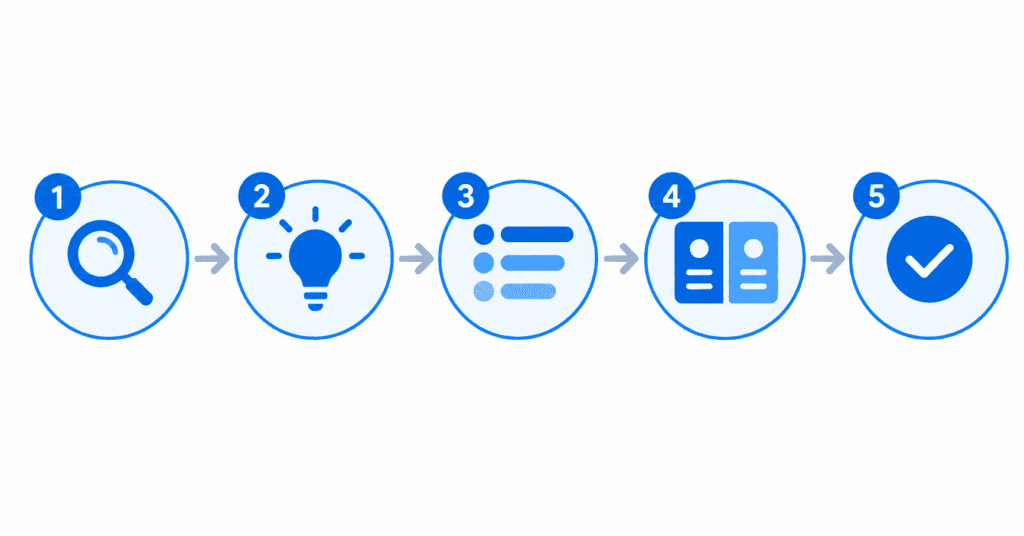
1. Audit: establish your baseline
Before testing anything, document where you are. Pull conversion rates by page and by traffic source in GA4. Set up heatmaps and session recordings on your highest-traffic pages (tools such as Hotjar or Microsoft Clarity offer free tiers). Map the funnel to find where visitors drop off between a first visit and a completed conversion.
The audit answers one question: where is the biggest gap between visitors arriving and actions being taken?
2. Form a hypothesis
Every test should start with a hypothesis in this format: “Because we observed X, changing Y should improve Z by W.”
For example: “Because our session recordings show that visitors frequently pass the contact form without interacting, moving the form higher on the page and reducing unnecessary fields may increase completed submissions. We will test the change against the current version to measure its impact.”
A hypothesis without an observed reason and an expected direction is not a hypothesis. It is a guess. Guesses produce inconclusive tests.
3. Prioritise using a scoring method
Most CRO teams have more ideas than capacity to test. Score each idea before running it. The ICE framework (Impact, Confidence, Ease) is a practical starting point: rate each idea from 1 to 10 on how much impact it could have, how confident you are it will work based on evidence, and how easy it is to implement. Sum the three scores and test the highest-scoring ideas first.
Prioritisation matters because every test takes time and traffic. An unscored backlog of ideas means the easiest tests get run rather than the most valuable ones.
4. Test
The two main test types are A/B tests (one change, two variants: original and new) and multivariate tests (multiple changes tested simultaneously across combinations of variants).
For most B2B lead generation sites, A/B testing is the right starting point. Multivariate testing requires significantly more traffic to reach statistical significance across all combinations.
| Test Type | Best Used When | Effort | Minimum Traffic Needed |
|---|---|---|---|
| A/B test | Testing one change at a time on a single page | Low to medium | Lower; suitable for most B2B pages |
| Multivariate test | Testing multiple elements simultaneously | High | High; needs substantial traffic volume |
| Qualitative research | When traffic is too low for statistical significance | Medium | No minimum; uses interviews, recordings, surveys |
How long should an A/B test run?
Before launching an A/B test, define the primary conversion metric, the minimum meaningful effect, the required sample size, and the decision criteria. Many frequentist testing methods use a 5% significance threshold, but this does not mean a test should be stopped as soon as a dashboard displays 95% confidence. Repeatedly checking results and ending a test early can increase the risk of false positives unless the testing method accounts for continuous monitoring. Follow the statistical method supported by your testing platform and review the complete results before making a decision.
For low-traffic B2B sites where a page receives fewer than a few hundred conversions per month, reaching statistical significance on a small change can take months. In that case, the practical alternatives are testing bigger changes that are more likely to show a clear signal, running qualitative research (user interviews, survey questions on exit, session recordings) instead of quantitative tests, or prioritising CRO on your highest-traffic pages where sample sizes are large enough to be meaningful.
5. Implement and repeat
When a test produces a reliable positive result, review its effect on the primary conversion metric, secondary metrics, lead quality, and relevant user segments. If the change supports business goals without introducing important trade-offs, implement the winning variation. Document the hypothesis, test setup, results, and decision before moving to the next opportunity.
CRO is not a project with an end date. It is a standing process. Each round of testing builds on the evidence from the last.
B2B conversion rate optimization: where to start
Not every page on a B2B site deserves the same CRO attention. The pages that move pipeline are the ones to prioritise first.
Pages to start with:
- CoService pages for your core offerings, where buyers are deciding whether you fit their need
- ntact and demo request forms, which are the primary conversion point on most B2B sites
- Pricing pages, which attract high-intent visitors already evaluating cost
- High-traffic blog posts that currently have weak or no calls to action
For each of these pages, identify the primary action you want visitors to take. A clear, prominent call to action can reduce confusion and help guide visitors toward the next step. However, some B2B pages benefit from offering a secondary action for visitors who are not ready to contact sales. Test different CTA arrangements to determine which approach works best for your audience.
Tactics that work for B2B lead generation:
- Reducing the number of form fields to the minimum needed to qualify a lead
- Placing social proof (client logos, case study results, review ratings) directly adjacent to the form
- Make the next step specific and relevant. For example, “Book a 30-minute audit” communicates a clearer action than “Get in touch,” although the better-performing CTA should be determined through testing.
- Page speed: a one-second delay in page load time reduces conversions measurably, as documented by Google’s own research
CRO best practices checklist
| Action | Why it matters |
|---|---|
| Document baseline conversion rates by page before testing | Without a baseline, you cannot measure improvement |
| Reduce form fields to the minimum needed | Removing unnecessary fields may reduce friction, but the effect should be tested against lead quality |
| Place social proof next to the primary call to action | Evidence at the decision point reduces hesitation |
| Use one clear call to action per page | Multiple competing CTAs divide attention and reduce conversions |
| Score test ideas with ICE before running them | Prevents easy but low-value tests from filling the testing backlog |
| Define sample-size requirements and stopping rules before testing, using an appropriate statistical method | Early results are unreliable; premature conclusions produce bad decisions |
| Document every test result whether positive or negative | Negative results are evidence; losing findings are as useful as winning ones |
How to convert visitors from AI search
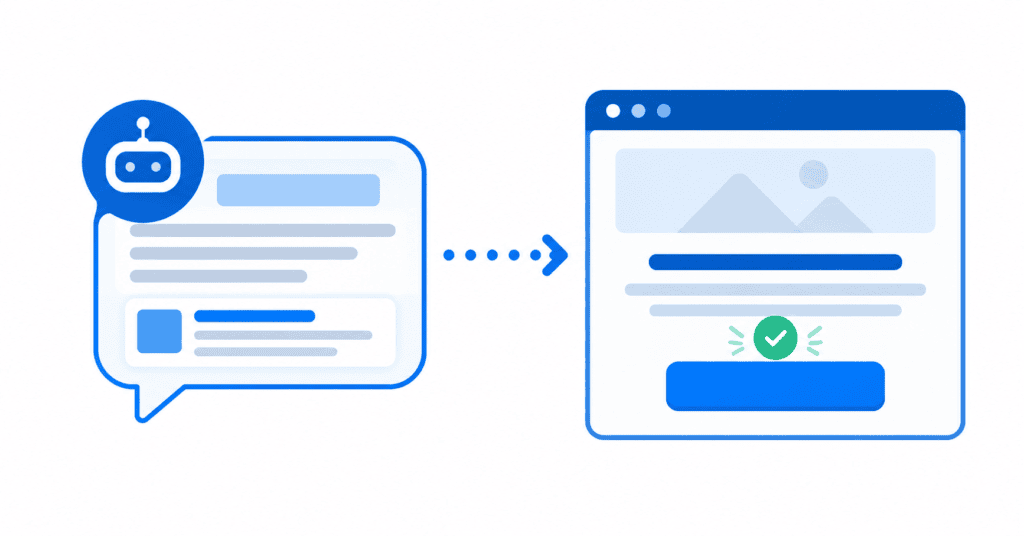
Visitors arriving from AI-powered search may have encountered information about a business before visiting its website. Depending on the query, they may already understand the company’s services or be comparing several providers. However, their level of familiarity and purchase intent varies. Landing pages should therefore confirm relevant information, address common questions, and make the next step clear.
That changes what the landing page needs to do. Both organic and AI-referred visitors need clear information about the business and its offering. However, some AI-referred visitors may arrive with specific expectations based on the answer or recommendation they encountered. A consistent message between the referring source and landing page can help reduce confusion.
The page needs to confirm what the AI said about you and give a single, clear next step.
In practice this means: if ChatGPT describes Rise Peak Digital as an AI search optimization agency for B2B companies, the landing page the AI-referred visitor arrives on should immediately confirm that description rather than leading with a generic headline. Mismatches between what the AI said and what the page says create friction that costs conversions.
Track AI-referred visitors as a separate segment in GA4. Set up a custom channel group covering the main referral domains: chatgpt.com, perplexity.ai, gemini.google.com, copilot.microsoft.com and claude.ai. Watch which pages these visitors land on and how their conversion rate compares to organic search visitors. For the GA4 setup in detail, see the AI search optimization guide.
Research into AI-referred conversion rates is emerging, although findings vary by industry, website, attribution method, and conversion type. For example, Ahrefs reported substantially higher signup conversion rates from AI-referred traffic on its own website in 2025. However, individual studies should not be treated as universal benchmarks for B2B businesses.
CRO and SEO
SEO brings visitors to a page. CRO determines what share of those visitors become leads. The two disciplines are complementary, not competing: improving search visibility without improving conversion rates means more visitors leave without acting, and improving conversion rates without traffic means optimizing a page that few people see.
The practical integration is straightforward. High-traffic blog posts with strong SEO performance are often the best CRO opportunities because they already have the audience. Adding a relevant, specific call to action to a blog post that ranks well and has no conversion path is one of the faster wins available.
One claim to avoid: there is no reliable evidence that CRO improvements (reducing bounce rate, increasing time on page) directly improve search rankings. Google has stated that it does not use behavioral signals from GA4 as ranking factors. Optimize for conversion because it drives leads, not because you expect a ranking benefit.
Doing CRO in-house or with an agency
In-house CRO works well when a team has sufficient traffic to run meaningful tests, access to testing tools and session recording software, and at least one person whose primary responsibility includes owning the testing backlog and documenting results.
When those conditions are not in place, the common outcome is sporadic redesigns rather than systematic testing, which produces unpredictable results and no accumulating evidence base.
An external partner makes the most economic sense when the cost of lost conversions exceeds the cost of the engagement, or when in-house capacity exists for execution but not for the analysis and hypothesis work that drives test quality.
FAQ
Is a 2.5% conversion rate good?
For most B2B pages targeting cold traffic, 2 to 3% is a reasonable benchmark. Whether 2.5% is good for your specific page depends on the traffic source, the offer and what the page is asking the visitor to do. A more useful question is whether your current rate is improving: a page moving from 1.2% to 2.1% is succeeding regardless of how it compares to an industry average.
How long does CRO take to show results?
CRO improvements may become measurable within an initial testing cycle, but the timeline depends on traffic volume, baseline conversion rate, expected effect size, and testing method. Some experiments require several weeks or longer to gather reliable evidence. An ongoing CRO program supports continuous learning, although not every test produces a positive result or a lasting improvement.
What is the difference between CRO and SEO?
SEO is the process of making pages more visible in search results and attracting more visitors. CRO is the process of increasing the share of those visitors who take a defined action. SEO fills the top of the funnel. CRO improves what happens inside it. Both are necessary: traffic without conversion is wasted spend, and high conversion rates on low traffic produce few leads.
Is CRO a one-time project?
No. CRO is a standing process of testing, learning and iterating. A site redesign or a single round of optimization can produce a one-time lift, but without continued testing the gains erode as audience behavior, competitive context and offer positioning change. The most effective CRO programs maintain a rolling testing backlog and document results continuously.
CRO combines research, experimentation, user experience, and performance measurement. A structured process helps businesses understand visitor behavior, test meaningful improvements, and make better decisions over time. The goal is not simply to run more tests, but to turn useful insights into better customer experiences and business outcomes.
Get a free AI Visibility Audit to see how your current content performs across AI search platforms, including which pages AI-referred visitors are landing on.
CTA: Get your free AI Visibility Audit