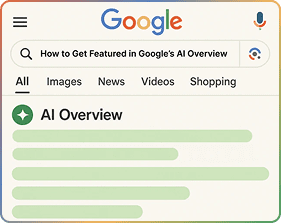
AI overview optimization has become essential as the way people find information online continues to evolve. Today, users often receive AI-generated answers before they ever see a single organic search result. Google AI Overviews appear at the top of many searches, while ChatGPT summarizes information, Perplexity cites trusted sources in real time, and Gemini delivers consolidated answers from across the web.
If your website is not being cited in those responses, you are losing AI search visibility, even when you rank on page one. A top organic position no longer guarantees you are part of the conversation.
This guide breaks down how AI Overviews and LLM search platforms select content, what that means for your website, and the practical steps you can take to improve your chances of being included.
What Are AI Overviews and How Do They Select Content?
Google AI Overviews are AI-generated summaries that appear at the top of search results for certain queries. They evolved from Google’s earlier Search Generative Experience (SGE), which introduced AI-generated answers directly within search results.
One of the most important things to understand about AI Overviews is that they do not use a separate index. They draw from the same pool of pages Google already crawls and ranks. If your page is not indexed and ranking in the top results for a query, it is unlikely to be cited in an AI Overview for that query.
As a result, this means AI overview optimization starts with the same foundation as traditional SEO. A successful AI overview optimization strategy still depends on strong technical SEO and high-quality content before any AI-specific tactics can make an impact.
How AI Overview Optimization Differs from Traditional SEO
Traditional SEO asks one core question: how do we rank higher on Google? The goal is to appear in the top results for a given keyword and earn clicks.
AI overview optimization asks a different question: how do we become the answer? The goal shifts from earning a position in a list of results to being extracted and cited as the source of a response that a user may never click through from.
That distinction changes how you write, structure, and present content. A page optimized purely for ranking might still perform well in traditional search while being invisible in AI-generated answers. AI platforms typically cite content that uses a clear structure, directly answers user intent, and is easy to extract.
Both goals matter. The good news is that optimizing for AI inclusion reinforces the same content quality signals that drive traditional rankings. This shift has also given rise to LLM SEO, which focuses on improving visibility across large language models like ChatGPT, Gemini, and Perplexity in addition to traditional search engines.

Start With SEO Fundamentals; They Still Apply
Before any AI-specific optimization strategy makes a difference, your technical SEO foundation needs to be solid. If you’re building that foundation, explore our Search Optimization Services for technical SEO and organic visibility improvements.
Google’s official AI optimization guidance confirms this: the same technical SEO and content quality best practices remain the foundation for appearing in AI-powered search experiences.
That means your pages need to be crawlable and indexable. Robots.txt files, noindex tags, and crawl budget issues that prevent Googlebot from accessing your content will also prevent it from being considered for AI Overviews.
It also means content quality and E-E-A-T signals are foundational, not optional. AI systems prioritize content that demonstrates real experience, genuine expertise, recognized authority, and verifiable trustworthiness. These are not new requirements. They are the same signals Google has been refining for years, now applied to a higher standard because AI-generated answers carry implicit endorsement.
AI Overview Optimization: Structure Your Content for Easy AI Extraction
AI systems do not read pages the way humans do. They look for content that is easy to extract, clearly structured, and directly responsive to the query that triggered the search. The harder your content is to parse and summarize, the less likely it is to be included.
These are the structural approaches that consistently improve AI citation likelihood:
Lead with the direct answer. Do not bury your main point in a lengthy introduction. If your page is about how to do something, say what it is in the first paragraph. AI systems favor pages where the main answer is immediately clear and self-contained.
Use question-based headings. Structure H2s and H3s as the questions your audience is actually asking. This mirrors the conversational queries that trigger AI Overviews and makes it easier for AI systems to match your content to specific search intents.
Write concise, scannable paragraphs. Walls of text are harder for AI systems to extract cleanly. Short paragraphs of two to four sentences, with clear topic sentences, are easier to process and cite.
Use bullet points and numbered lists. Lists are one of the most cited content formats in AI Overviews. When you have a set of steps, features, or recommendations, structure them as a list rather than embedding them in prose.
Include FAQ sections. FAQ sections directly mirror the question-and-answer format that AI systems prefer. They also align with People Also Ask boxes in traditional search results, compounding your visibility across both formats.
Optimize for E-E-A-T Signals AI Systems Trust
Experience, Expertise, Authoritativeness, and Trustworthiness are not just Google quality rater guidelines. They are the framework AI systems use to evaluate whether a source is worth citing. Content that scores well on E-E-A-T signals is more likely to be extracted and referenced in AI-generated answers.
Experience means your content reflects genuine first-hand knowledge rather than aggregated information anyone could find. This includes original insights, real-world examples, case study data, and practical guidance that comes from doing, not just researching. AI platforms are increasingly able to distinguish between content that demonstrates lived experience and content that synthesizes what others have said.
Expertise means your explanations are accurate, technically sound, and appropriately detailed for the topic. Vague generalizations and surface-level advice are less likely to be cited than content that demonstrates genuine subject matter knowledge.
Authoritativeness means your brand is recognized as a credible source on the topic you are covering. This is built through consistent publishing on core topics, external mentions and citations, and clear association between your brand and specific areas of expertise.
Trustworthiness means your content is accurate, verifiable, and free from unsupported claims. AI systems prioritize sources that reduce interpretation risk. Every statistic you include should be verifiable. Every claim should be grounded in something real.
At Rise Peak Digital, our work with Rafferty Weiss demonstrates what happens when these signals are strengthened deliberately. Through technical cleanup, AIO-led page restructuring, and intent-focused content optimization, the site went from zero AI citations to 69 in two months while also gaining 51 new page one keyword rankings. The E-E-A-T improvements and AI visibility gains moved in parallel because they draw from the same underlying signals.
Go Beyond Google: Optimizing for ChatGPT, Perplexity, and Gemini
Most AI overview optimization guides focus exclusively on Google. That is understandable since Google remains the dominant search platform, but it is also a significant blind spot. Your potential buyers are increasingly using ChatGPT, Perplexity, and Gemini as research and discovery tools, and each platform has its own signals for determining which brands and sources to cite.
The common thread across all LLM search platforms is entity clarity. AI systems are not matching keywords. They are building models of the world from entities (brands, people, products, concepts) and the relationships between them. Brands that are clearly defined, consistently represented across the web, and associated with specific topic areas are more likely to be recognized and cited regardless of which platform a user is searching from.
Across our client work, this connection between entity clarity and AI citation is consistent. With Axim Mica, entity-focused optimization and structured content initiatives drove 197 AI citations and top rankings for highly competitive technical queries. The content did not just rank. It became a cited source across multiple AI platforms simultaneously.
The practical steps for multi-platform AI visibility include:
Businesses looking for a complete strategy can also explore our Artificial Intelligence Optimization (AIO) Services, which combine entity SEO, technical optimization, and AI citation strategies.
Strengthen your entity signals. Consistent brand information across your website, Google Business Profile, LinkedIn, Wikipedia where applicable, and industry publications helps AI systems recognize and categorize your brand with confidence.
Build topical authority through content clusters. AI platforms favor sources that demonstrate depth across a topic area, not just a single well-optimized page. A cluster of interlinked content around your core service areas signals that your brand is a genuine authority rather than a one-time answer.
Earn external citations and brand mentions. The more your brand is mentioned and cited across trusted external sources, the more evidence AI systems have that you are a credible reference. This overlaps with traditional link building but extends to unlinked mentions, PR coverage, podcast appearances, and industry publications.
Use structured data. Schema markup helps AI systems understand what your content is about, who produced it, and how it relates to other entities. Organization schema, FAQ schema, and Article schema are particularly useful for AI citation visibility.
Build Topic Authority Through Content Clusters
A single well-optimized page is unlikely to establish your brand as an AI-cited authority on its own. AI systems evaluate the breadth and depth of your coverage across a topic area, not just the quality of one page in isolation.
For example, topic clusters are the most effective structural approach to building this authority. The model is straightforward: a central pillar page covers a broad topic comprehensively, and a set of supporting cluster pages cover specific subtopics in depth, all interlinked with each other.
This structure communicates to both traditional search algorithms and AI systems that your website has genuine expertise across a topic rather than isolated coverage of individual keywords. Internal linking patterns, consistent terminology, and thematic coherence across related pages all contribute to how AI systems categorize your brand’s areas of knowledge.
The implication for AI overview optimization is that a content gap in your cluster creates a visibility gap in AI-generated answers. If a query falls within your topic area but you have no content addressing it, a competitor who does is more likely to be cited in response to that query.

Track and Improve Your AI Visibility Over Time
AI overview optimization is not a one-time task. Instead, it should become an ongoing part of your long-term SEO strategy. AI platforms update their models, content quality degrades relative to newer sources over time, and competitors improve their own visibility. Monitoring your AI citation presence is one of the best ways to improve your long-term AI search visibility across Google AI Overviews and LLM-powered search platforms.
The tools and approaches most useful for tracking AI visibility include:
Google Search Console for monitoring impressions and clicks from AI Overview-influenced queries. Changes in click-through rates on queries where you rank well can sometimes signal increased AI Overview activity for those terms.
Manual prompt testing across ChatGPT, Perplexity, and Gemini. Regularly search for your target keywords and brand-adjacent queries across platforms to see whether your content is being cited, how competitors are appearing, and where gaps exist.
AI brand monitoring services that track citation patterns, mention frequency, and competitive visibility across AI platforms systematically. This is the most scalable approach for brands that need ongoing visibility data across multiple platforms and query types.
Content freshness audits to ensure that pages being cited or targeted for citation remain accurate, current, and competitive relative to newer content on the same topics. AI systems deprioritize outdated information, and a page that earned citations six months ago may lose them if the content has not been maintained.
The brands that build durable AI visibility are the ones that treat it as an ongoing discipline rather than a project with a finish line.
Want to learn more about AI search, SEO, and entity optimization? Visit our Blog for the latest insights, expert tips, and actionable strategies to improve your online visibility.
Frequently Asked Questions About AI Overview Optimization
Does ranking on page one guarantee inclusion in AI Overviews?
Not automatically. Research consistently shows that 40 to 76 percent of AI Overview citations also appear in the top ten organic results, so strong rankings are a prerequisite. However, ranking alone does not guarantee citation. Content structure, E-E-A-T signals, and how clearly your content responds to the query all influence whether a ranking page gets extracted and included.
Do I need to completely change my SEO strategy to optimize for AI Overviews?
No. AI overview optimization builds on the same foundation as traditional SEO. Technical health, content quality, and E-E-A-T signals matter for both. The additions are mostly structural and represent the next evolution of AI Overviews SEO: clearer content organization, question-based headings, concise paragraph formatting, and more deliberate entity signal building. Think of it as an extension of good SEO practice, not a replacement for it.
How long does it take to see results in AI Overviews?
It depends on your starting point. Sites with strong existing SEO foundations can see AI citation improvements within weeks of targeted content optimization. Brands building from scratch typically see meaningful results within two to four months of consistent effort across content, entity signals, and technical health. Our work with Rafferty Weiss produced 69 AI citations within two months of targeted AIO optimization.
What content types work best for AI citation?
Informational content that directly answers specific questions performs best. Structured how-to guides, FAQ pages, comparison content, and definition-based explanations consistently appear in AI Overviews. Service and product pages can also be cited when they clearly explain what a service does and who it is for, particularly when supported by strong E-E-A-T signals.
Does structured data help with AI Overview inclusion?
Yes, with context. Structured data does not directly cause AI inclusion, but it significantly improves how clearly AI systems can interpret your content. FAQ schema, Article schema, and Organization schema all help AI platforms understand what your content is about and who produced it, which reduces the friction between having good content and being recognized as a credible source by AI systems.