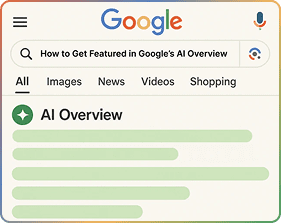
Something has shifted in how people find information online. Roughly 80 percent of consumers now rely on AI-generated results for at least 40 percent of their searches. ChatGPT alone receives 2.5 billion prompts from global users every day. Google AI Overviews coverage grew by 58 percent in a single twelve-month period.
The brands appearing in those AI-generated answers are not simply the ones that rank highest in traditional search. They are the brands that AI systems have learned to recognize, trust, and cite.
If your brand is not showing up in AI-generated answers, you are losing visibility even when you rank on page one of Google. A top organic position no longer guarantees you are part of the conversation that happens before a user ever clicks a link.
This guide explains how to improve brand visibility in AI search engines using proven strategies
that are working for brands right now, with specific tactics you can apply to each one.
Why AI Search Visibility Is Different From Traditional SEO
Traditional SEO asks one core question: how do we rank higher for a keyword? The goal is to appear in the top results for a given search and earn clicks.
AI search visibility asks a fundamentally different question: how do we become the answer? The goal shifts from earning a position in a list of results to being extracted and cited as a trusted source in an AI-generated response.
That distinction changes everything about how you approach content, brand presence, and authority signals. Traditional SEO is built around keywords and links. AI search visibility is built around entities, trust signals, and the degree to which AI systems can confidently categorize and cite your brand.
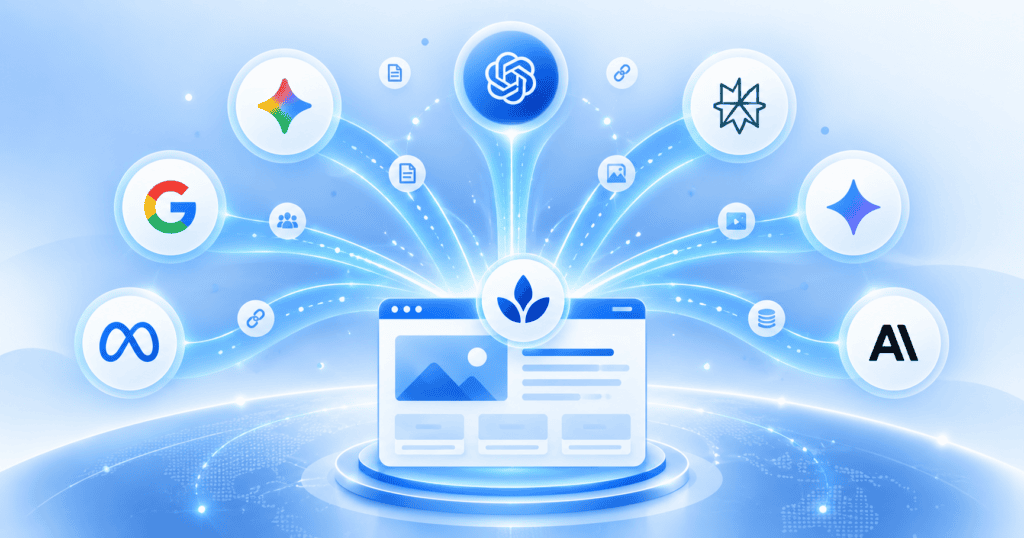
AI platforms like ChatGPT, Perplexity, Gemini, and Google AI Overviews do not retrieve results the way traditional search does. They build responses by drawing on their understanding of entities and the relationships between them. When a user asks a question, AI systems look for sources they recognize as authoritative entities on the relevant topic.
Brands that are clearly defined, consistently represented, and associated with specific areas of expertise are far more likely to be cited. Brands that are ambiguous, inconsistently described, or associated with too many unrelated topics are far less likely to appear.
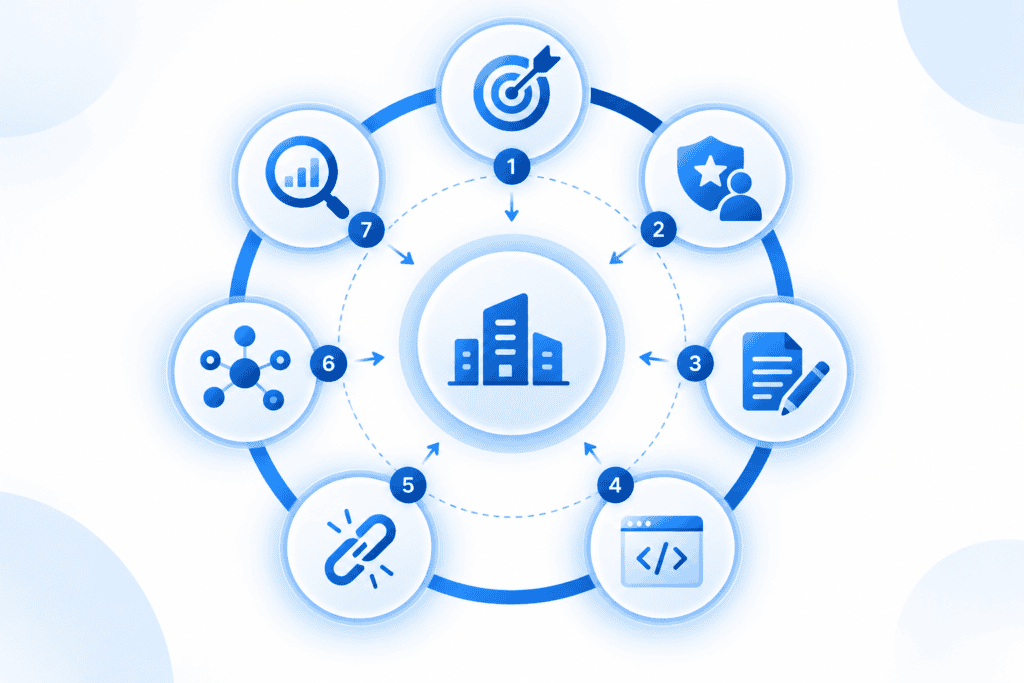
Strategy 1: Build and Clarify Your Brand Entity
An entity is any clearly identifiable thing that AI systems can recognize and categorize: a person, a brand, a product, a place, or a concept. Unlike keywords, which are just strings of text, entities have identities. They have consistent meanings that do not change based on how they are phrased.
The first step to improving AI search visibility is making sure your brand is clearly and consistently defined as an entity across every digital touchpoint that AI systems evaluate.
This means your website, Google Business Profile, LinkedIn, Wikipedia or Wikidata, where applicable, and industry directories should all describe your brand using consistent language, consistent category associations, and consistent contact information.
Schema markup is one of the most direct tools available for entity building. The organization schema defines your brand as a recognized entity with a name, URL, logo, contact information, and social profiles. The sameAs property in JSON-LD is particularly powerful because it explicitly connects your website to your profiles on LinkedIn, Wikipedia, Wikidata, and other authoritative sources, telling AI systems in machine-readable language that these are all representations of the same entity.
The more consistent and interconnected your brand signals are across the web, the more confidently AI systems can categorize your brand and the more likely they are to surface it for relevant queries.
Strategy 2: Strengthen E-E-A-T Signals Across All Content
Experience, Expertise, Authoritativeness, and Trustworthiness are not just Google quality rater guidelines. They are the framework AI systems use to evaluate whether a source is worth citing. Content that scores well on E-E-A-T signals is more likely to be extracted and referenced in AI-generated answers.
Experience means your content reflects genuine first-hand knowledge rather than aggregated information anyone could find. This includes original insights, real-world examples, case study data, and practical guidance that comes from doing rather than just researching.
Expertise means your explanations are accurate, technically sound, and appropriately detailed for the topic. Vague generalizations and surface-level advice are less likely to be cited than content that demonstrates genuine subject matter knowledge.
Authoritativeness means your brand is recognized as a credible source on the topic you are covering. This is built through consistent publishing on core topics, external mentions and citations, and clear association between your brand and specific areas of expertise.
Trustworthiness means your content is accurate, verifiable, and free from unsupported claims. AI systems prioritize sources that reduce interpretation risk.
The connection between strong E-E-A-T signals and improved AI citation is consistent across client work. Through technical cleanup, AIO-led page restructuring and intent-focused content optimization; brands that strengthen these signals see movement in both traditional rankings and AI citation frequency. Because the underlying signals drive both outcomes.
Strategy 3: Structure Content for Easy AI Extraction
AI systems do not read pages the way humans do. They look for content that is easy to extract, clearly structured, and directly responsive to the query that triggered the search. The harder your content is to parse and summarize, the less likely it is to be included in AI-generated answers.
These structural approaches consistently improve AI citation likelihood:
Lead with the direct answer. Do not bury your main point in a lengthy introduction. If your page is about how to do something, say what it is in the first paragraph. AI systems favor pages where the main answer is immediately clear and self-contained.
Use question-based headings. Structure H2s and H3s as the questions your audience is actually asking. This mirrors the conversational queries that trigger AI Overviews and makes it easier for AI systems to match your content to specific search intents.
Write concise, scannable paragraphs. Short paragraphs of two to four sentences with clear topic sentences are easier for AI systems to process and cite than dense walls of text.
Use bullet points and numbered lists. Lists are one of the most cited content formats in AI Overviews. When you have a set of steps, features, or recommendations, structure them as a list rather than embedding them in prose.
Include FAQ sections. FAQ sections directly mirror the question-and-answer format that AI systems prefer. They also align with People Also Ask boxes in traditional search results, compounding visibility across both formats.
Keep important content visible. Do not hide key information inside expandable sections, tabs, or JavaScript-dependent elements that require a click to open. If AI systems cannot read it, they cannot cite it.
Strategy 4: Implement Structured Data and Schema Markup
Structured data is one of the most direct tools available for improving AI search visibility because it translates your brand information and content into explicit, machine-readable definitions that AI systems can process without interpretation.
The most useful schema types for AI visibility include Organization schema, which defines your brand as a recognized entity with consistent attributes. FAQ schema formats question and answer pairs in a way that AI systems can extract directly. Article schema associates authorship, publication date, and topic with your brand entity, helping AI systems understand not just what the content says but who produced it.
The sameAs property deserves particular attention. By explicitly linking your schema to your Wikipedia URL, Wikidata identifier, and official profiles on established platforms, you are telling AI systems in machine-readable language that these sources all refer to the same entity. This dramatically reduces the risk of your brand being misidentified or conflated with another entity, which is a common problem for brands with names that could be interpreted in multiple ways.
Strategy 5: Earn Consistent External Citations and Brand Mentions
AI systems do not build their understanding of a brand from your website alone. They collect signals from multiple sources across the web and use them to construct an entity profile. The more consistent and interconnected those signals are, the more confidently AI systems can categorize your brand.
Every time your brand is mentioned on a trusted external site, it adds to the network of signals AI systems use to build your entity profile. Authoritative industry publications, expert roundups, partner websites, podcast appearances, and directory listings all contribute.
Independent reviews are a particularly underutilized lever for AI visibility. Research shows that AI platforms reference reviews consistently when building responses about businesses and service providers. Reviews that are crawlable, visible on your website and third-party platforms, and structured in formats AI systems can parse carry significantly more weight than reviews locked inside proprietary platforms.
Prioritize placements in industry publications relevant to your category. Participate in indexed community discussions. Publish original research that other credible sources will cite. The compounding nature of earned credibility signals means that early progress accelerates over time.
Strategy 6: Build Topical Authority Through Content Clusters
A single well-optimized page is unlikely to establish your brand as an AI-cited authority on its own. AI systems evaluate the breadth and depth of your coverage across a topic area, not just the quality of one page in isolation.
Topic clusters are the most effective structural approach to building this authority. The model is straightforward: a central pillar page covers a broad topic comprehensively, and a set of supporting cluster pages cover specific subtopics in depth, all interlinked with each other.
This structure communicates to both traditional search algorithms and AI systems that your website has genuine expertise across a topic rather than isolated coverage of individual keywords. Internal linking patterns, consistent terminology, and thematic coherence across related pages all contribute to how AI systems categorize your brand’s areas of knowledge.
The implication for AI search visibility is that a content gap in your cluster creates a visibility gap in AI-generated answers.
Working with Rafferty Weiss, a structured approach to topical authority and AIO-led content optimization produced 69 AI citations and 51 new page one keyword rankings within two months. With Axim Mica, entity-focused content restructuring and semantic optimization drove 197 total AI citations. These results reflect the compounding effect of building genuine topical authority rather than targeting individual keywords in isolation.
Strategy 7: Monitor and Measure AI Visibility Over Time
AI search visibility is not a one-time project. AI platforms update their models, content quality degrades relative to newer sources, and competitors improve their own visibility. Monitoring your AI citation presence is as important as building it.
The most useful approaches for tracking AI visibility include manual prompt testing across ChatGPT, Perplexity, Gemini, and Google AI Overviews. Regularly search for your target keywords and brand-adjacent queries across platforms to see whether your content is being cited, how competitors are appearing, and where gaps exist.
Monitor branded search volume in Google Search Console. As your entity authority grows, more people will search for your brand name directly. Rising branded search volume is one of the clearest signals that your brand is becoming a recognized entity rather than an anonymous website.
Track impression growth on topic-adjacent queries. As entity authority develops, your pages will often begin earning impressions for semantically related queries you have not directly targeted. This expansion of topical visibility is a reliable indicator of growing entity recognition.
AI share of voice is a leading indicator worth tracking. It moves before traffic does, so a rising AI share of voice today often means rising AI-referred sessions in 30 to 60 days. Falling AI share of voice means competitors are gaining ground in the answer set you care about.
Frequently Asked Questions
How long does it take to improve brand visibility in AI search?
Initial improvements from schema implementation and structured entity signals can show results within weeks. Significant and consistent AI citation visibility typically takes two to four months of sustained effort across content, entity signals, and technical health. Brands that invest early build a compounding advantage because credibility signals grow stronger over time rather than decaying.
Does traditional SEO still matter for AI search visibility?
Yes. AI Overview research consistently shows that 40 to 76 percent of AI Overview citations also appear in the top ten organic results. Strong traditional SEO is a prerequisite for AI visibility, not a replacement for it. AI-specific optimization builds on the same foundation of technical health, content quality, and E-E-A-T signals that drive traditional rankings.
What is the difference between AI search visibility and regular SEO?
Traditional SEO focuses on ranking for keywords and earning clicks. The underlying signals overlap significantly, but AI visibility additionally requires entity clarity, consistent cross-platform brand signals, and content structured for easy AI extraction.
How do I know if my brand is being cited by AI?
The most practical starting point is manual prompt testing. Search for your target keywords and brand-adjacent queries across ChatGPT, Perplexity, Gemini, and Google AI Overviews and note whether your brand appears. AI citation tracking tools can systematize this process and provide share-of-voice data across platforms and query types.
Can smaller brands realistically compete for AI search visibility?
Yes. AI search visibility does not require the budget or domain authority that dominates traditional search competition. Smaller brands that clearly define their entity, build genuine topical authority in a focused area, implement structured data early, and earn consistent external citations can develop meaningful AI recognition faster than competitors who have been online longer but have fragmented or inconsistent brand signals.
The brands that build genuine entity authority and topical depth now will have a compounding advantage as AI search behavior continues to grow.
If you want to understand where your brand currently stands across AI search platforms and what the clearest opportunities are to improve, start with a visibility audit. We will map your entity signals, identify content gaps, and outline a plan built around your specific situation.
Explore more on the Rise Peak Digital blog.