
Mastering Search Infrastructure for the Era of Answer Engines
Quick Summary / Key Takeaways
- AI Optimization (AIO) shifts the focus from keyword targeting to clear entity definition, structured content, and consistent context across your site. This is how AI systems interpret and connect your brand to specific topics and queries.
- Visibility now depends on whether your content is cited and used in AI-generated answers. That requires credible third-party mentions, consistent positioning, and content that can be validated across multiple sources.
- Search behavior has changed. High-intent users are getting answers directly from AI systems instead of clicking through multiple links. If your content is not part of those answers, you are not part of early-stage decision making.
- A well-structured AIO strategy improves efficiency by capturing demand earlier in the buying process. This can reduce reliance on paid channels and improve conversion quality over time.
- AIO is not a short-term tactic. It is a long-term approach to building structured authority, maintaining visibility, and competing in an AI-first search environment.
Introduction
The way buyers find information has changed. Instead of scanning pages of blue links, they ask systems like ChatGPT, Perplexity, and Google’s AI Overviews for direct answers. These systems summarize, compare, and recommend before a user ever visits a website. If your content is not structured clearly enough to be selected, you are excluded from early-stage decision making where high-intent demand begins.
AI Optimization (AIO) is the process of making your content understandable, verifiable, and usable by these systems. It focuses on clear entity definition, structured content, and consistent authority signals across your site and external sources. This is not about manipulating rankings. It is about building search infrastructure that allows AI systems to interpret your expertise accurately and surface it in response to real queries. For B2B and SaaS companies, this directly impacts pipeline by positioning the brand at the point where buyers are forming decisions.
This guide breaks down how AIO works, what has changed in modern search, and how to structure your content so it can be cited, trusted, and surfaced. If your current strategy is built around rankings alone, it is incomplete. Rise Peak Digital focuses on building AI-ready search systems that align content, structure, and authority so brands remain visible where decisions now begin.
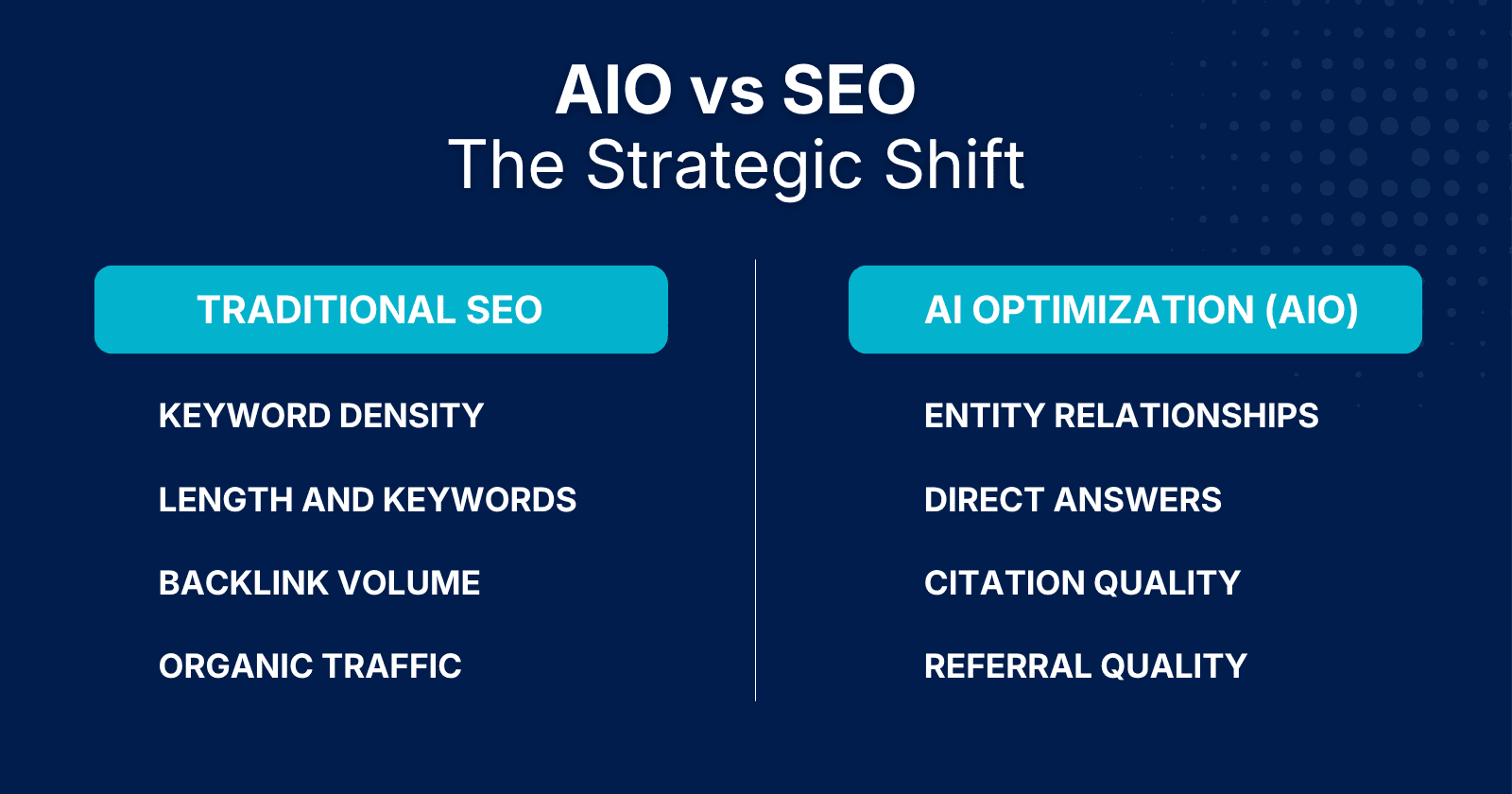
AI Optimization (AIO) vs Traditional SEO: How Visibility Has Shifted
| Feature | Traditional SEO | AI Optimization (AIO) | Primary Outcome |
|---|---|---|---|
| Focus | Keyword targeting and rankings | Entity clarity and topic relationships | Discoverability in AI answers |
| Content | Length, keywords, and coverage | Structured context, clarity, and authority | Selection for direct answers |
| Links | Backlink quantity and authority | Citation relevance and source consistency | Trust and validation |
| Metrics | Organic traffic and rankings | Citation presence and share of voice | Qualified lead visibility |
AIO Performance Metrics: Measuring Visibility in AI Search
| Metric | Definition | What to Look For | Strategic Impact |
|---|---|---|---|
| Citation Presence | How often your brand appears in AI-generated answers | Consistent inclusion across relevant queries | Authority and visibility |
| Share of Voice | Frequency of brand mentions compared to competitors | Increasing presence in high-intent queries | Competitive positioning |
| Sentiment Alignment | How your brand is described across sources | Accurate and consistent positioning | Trust and conversion readiness |
| Answer Accuracy | How closely AI-generated responses reflect your actual offering | Clear alignment with your messaging | Reduced friction in decision-making |
| Referral Quality | Intent level of traffic influenced by AI visibility | Higher-quality leads and engagement | Improved conversion efficiency |
What Does AIO Stand For?
AIO stands for AI Optimization, also called artificial intelligence optimization.
AIO is the process of structuring your content so AI systems can understand it, evaluate it, and include it in their answers. This includes improving clarity, organization, and how your expertise is presented across your pages.
AIO is not the same as Google’s AI Overviews. AI Overviews is a feature inside Google search. AIO is the broader strategy used to improve visibility across AI tools like ChatGPT, Gemini, and Perplexity.
When people ask what is AIO in marketing, they are asking how brands become visible inside AI-generated answers. AIO focuses on making your content clear and usable so AI systems can trust it and surface it during decision-making.
What Is AI Optimization in Marketing?
In marketing, AI optimization means making your brand discoverable inside AI-generated answers.
Instead of optimizing for rankings, you are optimizing for inclusion and recommendation.
That requires structuring your content and presence so platforms like ChatGPT, Google AI Overviews, and Perplexity AI can:
- Understand what your business does
- Recognize your expertise
- Recommend you when relevant questions are asked
For example, when someone asks, “What’s the best B2B SEO agency?”, AIO influences which brands are included in that answer.
That’s the core of AIO marketing. Not just generating traffic, but shaping how your brand is presented during decision-making.
If you’re evaluating what is AI optimization, the key shift is simple: your content is no longer just competing for clicks. It is competing to be selected.
How Is AIO Different From SEO?
To understand where AIO fits, it helps to compare it directly to SEO.
SEO focuses on ranking pages. AIO focuses on being recommended inside answers.
They are not replacements. They work together.
Traditional SEO determines whether you appear in search results.
AI optimization determines whether your brand is included in the response itself.
That shift, from links to synthesized answers, is why understanding what is AIO matters now.
How Does AI Optimization Work?
Once you understand the difference, the next question is how AIO works in practice.
It comes down to five core signals.
Structured Content
AI tools rely on clarity.
Content that includes clear definitions, FAQ sections, and schema markup is easier to interpret and reuse. Well-organized formatting, such as headings, lists, and logical flow, helps models identify what your page is about.
Pages that directly answer questions in natural language and follow clear question and answer structures tend to be surfaced more often in AI-generated responses.
Topical Authority
Depth matters more than isolated pages.
AI systems favor brands that consistently publish across related topics. This builds a stronger signal that your business understands the subject at a deeper level.
Covering a topic from multiple angles, including supporting questions and subtopics, helps reinforce this signal. This is a core part of modern AI optimization techniques.
Trust and E-E-A-T Signals
Relevance alone is not enough. Credibility matters.
AI tools evaluate:
- Expertise
- Consistency
- External validation
Signals such as real experience, clear authorship, and credible references help reinforce trust.
Your brand needs to be recognized as a reliable source, not just one that mentions the right keywords.
Brand Consistency Across the Web
AI models do not rely on a single source.
They evaluate how your brand appears across:
- Your website
- Third-party mentions
- Directories and profiles
Consistent positioning, messaging, and descriptions reinforce recognition. If your messaging varies across platforms, it weakens your presence in AI-generated answers.
Natural Language Answers
AI tools are trained on how people ask questions.
Content that directly answers those questions, clearly and conversationally, performs better than content written purely for keyword targeting.
Using simple language, complete answers, and direct responses improves how AI systems interpret and reuse your content.
If you’re thinking about how to optimize content for AI, this is one of the most practical shifts you can make.
What Does an AIO Agency Do?
An AIO agency builds the systems required for AI-driven visibility.
This goes beyond content creation. It involves aligning structure, authority, and technical signals so your brand can be surfaced and recommended.
A strong AIO digital marketing agency typically delivers:
- Content systems designed for AI extraction and citation
- Technical optimization, including schema and structured data
- Authority development across relevant platforms
- Alignment with broader frameworks like GEO and AEO
- Content clarity improvements so AI systems can understand and trust your pages
- Ongoing optimization of existing content, not just new content creation
The outcome is not just more exposure, but increased inclusion in AI-generated answers. This can lead to higher-quality inbound pipelines.
If you want to see how this works in practice, explore our approach to AI optimization services.
Why AIO Matters in 2026?
Search is no longer the starting point for many buyers.
AI tools are.
Today, buyers use platforms like ChatGPT and Perplexity to research vendors, compare services, and evaluate options, often before visiting any website.
At the same time, many companies are still focused only on SEO.
This creates a gap.
Many AIO-related search queries still show low competition, with keyword difficulty scores as low as 1 to 25. This creates a real early-mover opportunity.
Understanding what is AIO now is less about keeping up, and more about getting ahead while the space is still open.
Pre-Implementation Checklist: Building a Strong AIO Foundation
- Define and map your core brand entities. This includes your company, services, products, and key topics. Ensure naming is consistent across all pages so AI systems can clearly associate your brand with specific concepts.
- Implement structured data using JSON-LD. Mark up key elements such as organization, services, and content so search engines and AI systems can interpret your information without ambiguity.
- Audit third-party mentions and reviews. Check how your brand appears across directories, publications, and review platforms. Inconsistent or missing information weakens trust signals.
- Review your technical site structure. Ensure your sitemap, internal linking, and page hierarchy clearly reflect your main topics and service areas.
Post-Implementation Checklist: Measuring and Improving AIO Performance
- Track how often your brand is cited or referenced in AI-generated answers across platforms like ChatGPT, Perplexity, and Google’s AI Overviews. This shows whether your content is being selected as a source.
- Monitor how your brand is represented. Look for accuracy in descriptions, positioning, and context across AI responses and third-party sources.
- Analyze conversion quality and pipeline impact. Measure whether AI-driven visibility is contributing to qualified leads and meaningful engagement.
- Continuously refine your structured content and entity signals. Update pages, schema, and supporting context to maintain clarity and improve how AI systems interpret and surface your content.
Table of Contents
Section 1: DEFINING AIO IN THE NEW SEARCH LANDSCAPE
Section 2: HOW AIO BUILDS VISIBILITY AND AUTHORITY
Section 3: EXECUTING AN EFFECTIVE AIO STRATEGY
Section 4: AIO AND THE FUTURE OF SEARCH STRATEGY
Frequently Asked Questions
Section 1: DEFINING AIO IN THE NEW SEARCH LANDSCAPE
FAQ 1: What is AIO in the context of modern digital marketing?
AI Optimization (AIO) is the process of structuring your website and content so AI systems like ChatGPT, Perplexity, and Google’s AI Overviews can clearly interpret, validate, and surface your brand in generated answers. These systems do not rely on keyword matching alone. They evaluate how well your content explains a topic, how clearly entities are defined, and whether the information is supported by consistent context across your site and external sources. If your content lacks clarity or structure, it is less likely to be selected as a source.
AIO focuses on improving how your content is understood at a structural level. This includes aligning site architecture, strengthening internal linking, clarifying entity relationships, and reinforcing authority signals such as citations and consistent topic coverage. At Rise Peak Digital, this is approached as search infrastructure, not content volume. The goal is to make your expertise usable by AI systems so it can be cited, trusted, and surfaced where early-stage decisions are made.
FAQ 2: How does artificial intelligence optimization differ from traditional SEO?
Artificial Intelligence Optimization (AIO) differs from traditional SEO in how visibility is earned and measured. Traditional SEO focuses on improving rankings and driving clicks through keyword targeting, backlinks, and on-page optimization. AIO focuses on whether your content is clear, structured, and authoritative enough to be selected and cited inside AI-generated answers from systems like ChatGPT, Perplexity, and Google’s AI Overviews. Visibility is no longer limited to blue links. It depends on how well your content can be interpreted and reused by these systems.
This shift changes what matters. Instead of prioritizing keyword density or volume, AIO requires strong entity definition, consistent topic coverage, clean site architecture, and credible supporting signals such as external mentions and citations. This is typically addressed through structured content systems, authority signal mapping, and technical SEO alignment so AI models can reliably interpret and surface the content. The goal is not just to rank. It is to become a trusted source that AI systems reference when generating answers.
Section 2: HOW AIO BUILDS VISIBILITY AND AUTHORITY
FAQ 3: Why is entity-based content structure critical for AI visibility?
Entity-based content structure is critical because AI systems organize information around clearly defined concepts such as companies, services, locations, and topics, not just keywords. Systems like ChatGPT, Perplexity, and Google’s AI Overviews evaluate how consistently these entities are defined and connected across your site. If those relationships are unclear or fragmented, your content may be indexed but not selected as a reliable source in generated answers.
Strong entity clarity comes from structured page hierarchies, consistent terminology, internal linking, and clear topic coverage across related pages. This is often reinforced through content audits, authority signal mapping, and structured rewrites that remove ambiguity and strengthen context. When your services, expertise, and use cases are clearly defined and connected, AI systems can accurately associate your brand with specific queries and surface it in relevant responses.
FAQ 4: What role do third-party citations play in AI-generated answers?
Third-party citations help AI systems validate whether your brand is credible enough to be included in generated answers. ChatGPT, Perplexity, and Google’s AI Overviews do not rely on a single source. They compare information across multiple trusted domains and prioritize content that is consistently supported by external references. If your brand is mentioned across reputable industry sites, publications, or directories, it strengthens the likelihood of being selected as a source.
This is why external validation often carries more weight than on-site claims. Consistent mentions, aligned messaging, and clear positioning across third-party platforms help reinforce your authority. Strengthening these signals usually involves authority signal mapping and identifying where your brand is referenced or missing across the web. When those signals are in place, your content becomes easier for AI systems to trust, verify, and surface in response to real queries.
Section 3: EXECUTING AN EFFECTIVE AIO STRATEGY
FAQ 5: Which technical elements are most important for AI optimization?
Technical clarity determines whether AI systems can interpret your content correctly. Structured data using formats like JSON-LD helps define entities such as your organization, services, products, and authors in a way machines can process consistently. Clean site architecture also matters. This includes logical URL structures, clear page hierarchies, internal linking, and proper indexing. These elements allow crawlers and AI systems to understand how your content is organized and how different topics relate to each other.
Other critical components include page speed, mobile usability, and accurate metadata. These are standard SEO factors, but they directly affect how reliably your content can be accessed and evaluated. Structured content formatting also plays a role. Clear headings, concise sections, and consistent terminology reduce ambiguity. Technical SEO alignment combined with structured content systems ensures your information can be retrieved, interpreted, and used in AI-generated answers without confusion.
FAQ 6: How can brands measure the success of their AIO efforts?
Brands measure AIO success by tracking how often their content is selected, cited, and surfaced in AI-generated answers, not just how it ranks or how much traffic it receives. This includes monitoring visibility across platforms like ChatGPT, Perplexity, and Google’s AI Overviews, along with share of voice for high-intent queries and how frequently the brand appears alongside or instead of key competitors.
Traditional metrics still apply, but they need context. Conversion rate, lead quality, and engagement signals show whether that visibility is driving real outcomes. This is typically supported by ongoing visibility audits, content performance tracking, and analysis of where AI systems choose other sources instead. When citation presence and conversion quality improve together, it confirms that your content is being understood, trusted, and used at the point where decisions begin.
Section 4: AIO AND THE FUTURE OF SEARCH STRATEGY
FAQ 7: Will AI optimization eventually replace traditional search engine marketing?
AI Optimization (AIO) will not replace traditional search engine marketing, but it is becoming a core layer of how visibility is earned. Search engines like Google are already integrating AI-generated summaries through features such as AI Overviews, which change how users interact with results. Instead of choosing from a list of links, users often rely on summarized answers. That shift means visibility now depends on whether your content is selected and used in those responses, not just where it ranks.
Traditional SEO still supports indexing, crawlability, and site performance. Those fundamentals remain necessary. The difference is how that foundation is used. Your website now acts as a structured, verifiable source that AI systems reference when generating answers. This is where structured content, entity clarity, and authority signals become critical. Search strategy is no longer just about competing for clicks. It is about being included in the answer layer where early decisions are made.
FAQ 8: How should B2B companies prioritize their AIO roadmap this year?
B2B companies should start their AIO roadmap by auditing how their brand is currently understood across both their website and external sources. This includes reviewing entity consistency, structured data, internal linking, and how services, products, and expertise are defined across pages. Gaps often appear in inconsistent naming, weak topic coverage, or missing connections between related content. These issues limit how AI systems interpret and trust the brand.
At Rise Peak Digital, this process typically begins with a visibility and content audit that identifies where AI systems get confused and where authority signals are missing. From there, the focus shifts to building structured, intent-driven content that answers real buyer questions and aligns with how answer engines retrieve information. The goal is not more content, but clearer systems that support consistent visibility and qualified pipeline growth.