

Turning Strategic Assets Into a Predictable Revenue Engine
Quick Summary / Key Takeaways
- Content marketing lead generation depends on intent alignment, not traffic volume. High-intent content paired with clear conversion paths drives qualified pipeline, not just visits.
- Gated assets must deliver real utility. Buyers will only exchange contact information for content that helps them make a decision or solve a defined problem.
- B2B lead generation requires mapping content to the full buyer journey. Each asset should support a specific stage, from problem awareness to vendor evaluation.
- Consistency builds authority. Regular publishing across core topics strengthens trust and improves conversion performance over time.
- Performance should be measured in pipeline impact. Data-driven iteration improves conversion rates, reduces customer acquisition costs, and increases sales velocity.
Introduction
Content marketing is often treated as a traffic channel, but traffic alone does not create revenue. Page views and impressions have limited value if they do not convert into qualified opportunities. Content marketing lead generation focuses on capturing demand and turning it into pipeline. That requires aligning topics with buyer intent and building clear paths from content to conversion.
For B2B and SaaS, this shift is structural. Buyers research independently, compare options, and look for credible answers before engaging sales. Content must do more than educate. It must qualify, position, and move prospects forward. High-value assets tied to specific problems outperform generic publishing. When executed correctly, content becomes a system that supports pipeline growth and reduces reliance on outbound or paid acquisition.
This guide breaks down how to build that system, from strategy and content formats to conversion optimization and measurement. It focuses on how content marketing generates leads that translate into real pipeline impact. For teams looking to connect content performance directly to pipeline outcomes, Rise Peak Digital builds structured content and search systems that align content production, intent mapping, and conversion pathways into a single, measurable growth engine.
Content Performance by Funnel Stage and Lead Impact
| Content Format | Buyer Stage | Typical Conversion Range | Primary Success Metric |
|---|---|---|---|
| White Papers | Middle of Funnel | Moderate to High | Qualified Lead Downloads |
| Webinars | Bottom of Funnel | High | Attendee-to-Demo Rate |
| Blog Posts | Top of Funnel | Low | Email or Newsletter Signups |
| Case Studies | Bottom of Funnel | High | Demo Requests / Sales Calls |
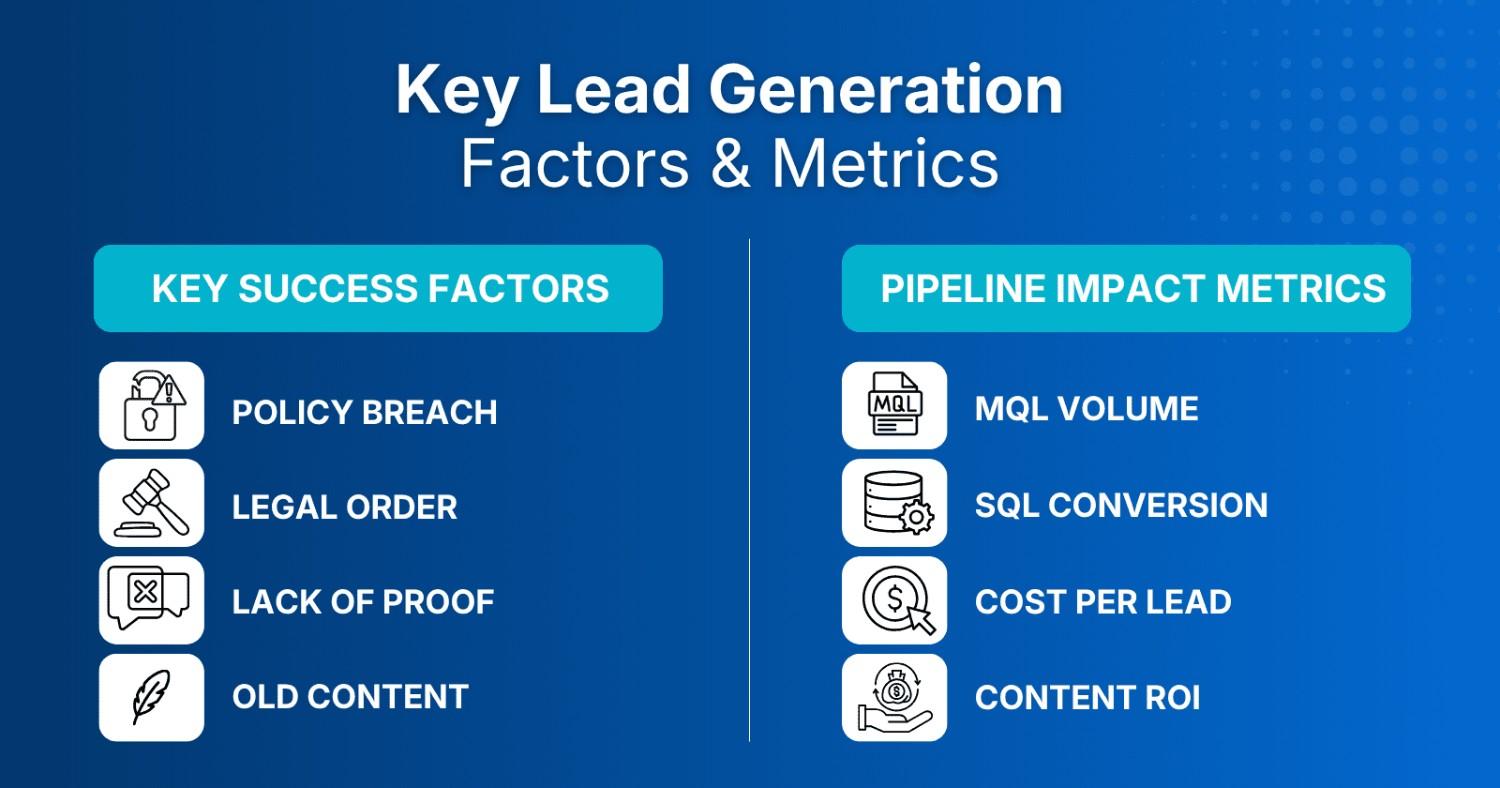
Core Metrics That Drive Content-Led Pipeline
| Metric | Focus Area | Benchmark Direction | Business Impact |
|---|---|---|---|
| MQL Volume | Quantity | Consistent monthly growth | Pipeline Expansion |
| SQL Conversion | Quality | Strong MQL to SQL ratio | Sales Efficiency |
| Cost Per Lead | Efficiency | Decreasing over time | CAC Reduction |
| Content ROI | Revenue | Positive return on spend | Scalable Budget Allocation |
Pre-Launch Checklist for Content-Led Lead Generation Systems
- Define clear lead generation goals tied to pipeline outcomes, not just traffic targets.
- Map buyer personas and intent stages to ensure each asset aligns with a specific decision point.Create high-value gated assets for each stage.
- Develop high-value gated assets that justify data exchange and support mid to bottom funnel conversion.
- Build conversion-focused landing pages with a single objective and clear value proposition.
- Set up tracking infrastructure, including CRM integration and conversion tracking, to capture lead data accurately.
Post-Launch Optimization Checklist for Pipeline Growth
- Analyze lead quality, not just volume, by tracking progression from MQL to SQL.
- Test and refine headlines, offers, and calls to action to improve conversion efficiency.
- Distribute content across both organic and paid channels to maximize qualified reach.
- Implement structured email nurture sequences to move leads through the funnel.
- Continuously optimize based on performance data to improve conversion rates and reduce acquisition costs.
Table of Contents
Section 1: FOUNDATIONS OF CONTENT-DRIVEN LEAD GENERATION
Section 2: CONTENT MARKETING FOR B2B AND SAAS PIPELINE
Section 3: BUILDING CONTENT THAT CONVERTS INTO LEADS
Section 4: MEASURING LEAD GENERATION PERFORMANCE
Section 5: NURTURING AND CONVERTING LEADS THROUGH CONTENT
Section 6: SCALING A CONTENT-LED LEAD GENERATION SYSTEM
Frequently Asked Questions
Section 1: FOUNDATIONS OF CONTENT-DRIVEN LEAD GENERATION
FAQ 1: What is content marketing lead generation?
Content marketing lead generation is the process of attracting qualified prospects by publishing useful, problem-focused content and converting that attention into a measurable pipeline. It works by aligning content with real buyer intent, then guiding users toward a clear next step such as a demo, download, or consultation. The goal is not just traffic. It is capturing demand from people already researching solutions.
For B2B and SaaS companies, this requires structured content tied to search behavior, clear messaging, and conversion-focused UX. That includes aligning topics with high-intent queries, building authority through consistent coverage, and reducing friction on landing pages. When executed correctly, content becomes a compounding acquisition channel that lowers cost per lead over time and improves lead quality.
FAQ 2: How does content marketing for lead generation differ from SEO?
Content marketing for lead generation is built to convert attention into pipeline, while SEO is built to capture visibility in search results. SEO focuses on improving rankings, technical structure, and discoverability so users can find your content. Content marketing focuses on delivering value, building trust, and guiding users toward a defined action such as a form fill or demo request.
The highest-performing systems connect both. Search brings in high-intent traffic, but conversion happens through structured content, clear positioning, and dedicated landing pages. This is where conversion strategy, UX flow, and intent mapping matter. Without that layer, traffic does not translate into leads. Strong content-led strategies are also proven to generate up to three times more leads at a lower cost compared to outbound approaches, which reinforces why conversion-focused content is critical, not optional.
Section 2: CONTENT MARKETING FOR B2B AND SAAS PIPELINE
FAQ 3: Why is content marketing b2b lead generation essential for SaaS?
Content marketing is essential for SaaS because most B2B buyers complete the majority of their research before speaking to sales. That means your content is not supporting the sales process. It is the early-stage sales process. If your brand is not present when buyers are researching problems, comparing solutions, and validating options, you are not part of the shortlist.
For SaaS, this directly impacts pipeline velocity and CAC efficiency. Structured, intent-driven content answers real buying questions, builds trust, and pre-qualifies leads before they reach your team. When content is mapped to each stage of the funnel and supported by strong information architecture and conversion-focused pages, it reduces friction, shortens sales cycles, and improves close rates. This is not content for awareness. It is a system for capturing and converting demand.
Section 3: BUILDING CONTENT THAT CONVERTS INTO LEADS
FAQ 4: What content types drive the most leads?
Content that drives the most leads is tied to high-intent decision stages and helps buyers evaluate solutions. This includes original research, white papers, case studies, product comparisons, and detailed implementation guides. These formats work because they reduce uncertainty and support internal decision-making. Data from Content Marketing Institute consistently shows that case studies, in particular, are among the most effective formats for converting B2B buyers because they provide proof of outcomes and real-world application.
Performance comes from alignment, not just format. High-converting content is mapped to specific queries, structured around clear problems, and paired with focused landing pages. This is where technical SEO, intent-driven content strategy, and conversion-focused UX intersect. When these elements are aligned, content does not just attract traffic. It captures qualified demand and moves it into pipeline.
FAQ 5: How can you optimize landing pages for better conversions?
You measure lead generation success by how effectively content converts into qualified pipeline and revenue. Key metrics include conversion rate, cost per lead, and the percentage of leads that progress into sales-qualified opportunities. These metrics show whether your content is attracting the right audience and moving them toward a buying decision.
A strong system connects performance back to search intent, content structure, and conversion flow. This means identifying which pages and assets generate high-intent leads, how those leads move through the funnel, and where drop-offs occur. When aligned with technical SEO, intent-driven content, and conversion-focused UX, measurement becomes a feedback loop that improves acquisition efficiency over time.
Section 4: MEASURING LEAD GENERATION PERFORMANCE
FAQ 6: How do you measure the success of a lead gen campaign?
Landing pages convert when they remove friction and align directly with user intent. That means one clear objective, a focused headline, and a call to action that matches what the user is trying to achieve. Any unnecessary navigation, competing links, or unclear messaging reduces conversion rates. The page should immediately communicate value and guide the user toward a single action such as downloading a resource or requesting a demo.
High-performing pages are built on structure, not design alone. This includes clear information hierarchy, fast load speed, mobile responsiveness, and trust signals such as testimonials or case proof. When paired with intent-driven content and clean site architecture, landing pages become a critical conversion layer within the broader search system. The goal is not just capturing traffic. It is converting qualified demand into measurable pipeline.
Section 5: NURTURING AND CONVERTING LEADS THROUGH CONTENT
FAQ 7: What role does email play in content marketing lead generation?
Email is the primary channel used to convert captured leads into sales-ready opportunities by delivering relevant, staged content over time. Once a prospect enters your funnel, email sequences guide them through key decision points using educational assets, product context, and proof signals that align with their intent.
For B2B and SaaS, this is where pipeline is built. Structured email flows support lead qualification, reinforce positioning, and move prospects closer to conversion without increasing acquisition costs. When paired with strong content and clear segmentation, email becomes an extension of your search and content system. It ensures that the attention you capture turns into measurable pipeline, not just one-time engagement.
Section 6: SCALING A CONTENT-LED LEAD GENERATION SYSTEM
FAQ 8: How do you scale a content lead generation system?
You scale a content lead generation system by building repeatable workflows around distribution, content repurposing, and performance feedback. High-performing assets should not remain isolated. A single white paper can be expanded into blog content, segmented into email sequences, and adapted into sales enablement materials. This approach increases reach without increasing production cost per asset.
At Rise Peak Digital, scaling is approached as a systems problem, not a volume problem. That means building structured content architectures, aligning topics to buyer intent, and connecting every asset to a clear conversion path. When paired with AI Optimization (AIO) and conversion-focused UX, this ensures that growth in content output leads to measurable pipeline expansion, not just increased traffic.