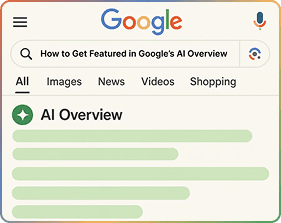

Mastering Search Visibility in the Era of Generative AI
Quick Summary / Key Takeaways
- LLM SEO focuses on entity clarity and structured information so AI systems can interpret your content and associate your brand with specific topics.
- Content that directly answers complex questions performs better in AI-driven discovery than pages built solely around keyword targeting.
- Being cited in AI-generated answers is becoming an important visibility signal, similar to how backlinks historically signaled authority in traditional search.
- Technical foundations such as schema markup, crawlability, and clear site architecture remain critical, because AI systems rely on well-structured web content as source material.
- Effective LLM search optimization prioritizes clear explanations and credible information so AI systems can confidently summarize and reference your content.
Introduction

Search behavior is evolving as users increasingly rely on AI systems to answer questions directly rather than scanning a list of links. Platforms powered by large language models are designed to interpret information, synthesize multiple sources, and present a clear response. This shift is why LLM SEO has become an important focus for organizations that want to remain visible during early-stage research. Instead of optimizing only for keyword rankings, content must now be structured so AI systems can interpret it, verify its context, and reference it when generating answers.
Optimizing for large language models requires greater clarity in how information is presented. Content must explain topics directly, reinforce entity relationships, and support claims with credible context so AI systems can interpret the information with confidence. When explanations are structured logically and supported by verifiable signals across the web, it becomes easier for AI systems to treat that content as a reliable reference during response generation. In practical terms, modern buyers increasingly consult AI systems when evaluating solutions. If your brand is not present in those answers, it is unlikely to be considered.
In this guide, we explain how LLM SEO works and how organizations can structure content to improve visibility in AI-generated responses. The sections ahead outline the content architecture, technical signals, and authority indicators that influence whether AI systems reference your information. Companies adapting to LLM-driven search often partner with specialists such as Rise Peak Digital, whose approach focuses on building AI-readable content systems that improve how large language models interpret and surface brand expertise.
Traditional SEO vs. LLM SEO: Key Optimization Differences
| Optimization Element | Traditional SEO Focus | LLM SEO Focus | Primary Outcome |
|---|---|---|---|
| Primary Objective | Rank webpages in search engine results | Be referenced or summarized in AI-generated answers | AI citation visibility |
| Content Structure | Keyword-optimized pages | Clear explanations, entity context, and structured answers | Higher information clarity |
| Authority Signals | Backlinks from external sites | Brand authority, entity signals, and credible references | Increased AI trust |
| User Intent Alignment | Navigational and informational search queries | Conversational and research-driven questions | Accurate answer generation |
Major AI Platforms Influencing LLM SEO
| Platform | Core Model | Optimization Consideration | Primary Data Source |
|---|---|---|---|
| ChatGPT | GPT-4 family models | Clear answers and structured explanations improve reference potential | Trained models with browsing and indexed web sources |
| Perplexity | Mix of LLMs including Sonar and external models | Strong citation signals and authoritative sources increase visibility | Real-time web retrieval |
| Google AI Overviews | Gemini models | Structured content and entity clarity improve summarization potential | Google Search index |
| Claude | Claude 3 family models | Detailed explanations and credible context improve reasoning-based answers | Model training data and retrieved sources |
LLM SEO implementation preparation checklist
- Audit existing content for entity clarity, factual accuracy, and clear topic definitions so AI systems can interpret and summarize your information reliably.
- Implement Schema.org structured data to define organizations, products, services, and other key entities in a machine-readable format.
- Create a knowledge graph of your primary topical clusters.
- Test how your content appears when summarized by AI tools to verify that explanations remain accurate, clear, and contextually correct
LLM SEO performance monitoring checklist
- Monitor how often your brand is referenced or summarized in AI-generated responses, especially for important industry queries.
- Update statistics, examples, and supporting information regularly to maintain accuracy and topical relevance.
- Analyze AI-generated summaries for brand message alignment.
- Expand content coverage around related questions and supporting topics to strengthen topical authority and improve AI discovery.
Table of Contents
Section 1: UNDERSTANDING LLM SEO AND AI SEARCH SYSTEMS
Section 2: IMPLEMENTING LLM SEO FOR AI VISIBILITY
Section 3: PREPARING FOR THE FUTURE OF AI-DRIVEN SEARCH
Frequently Asked Questions
Section 1: UNDERSTANDING LLM SEO AND AI SEARCH SYSTEMS
FAQ 1: What exactly is llm seo and why does it matter?
LLM SEO is the practice of structuring digital content so large language models can interpret, summarize, and reference it when generating answers. Instead of relying primarily on keyword targeting, LLM SEO focuses on clear explanations, entity relationships, and factual accuracy that AI systems can process reliably. Models such as GPT-4 or Google Gemini evaluate how well a page explains a topic, connects related concepts, and presents information in a format that can be extracted without losing meaning.
This approach matters because search behavior is shifting toward AI-generated responses rather than lists of links. When users ask complex questions, AI systems synthesize information from sources they consider credible and easy to interpret. Content that provides structured explanations, verifiable facts, and clear topical context is more likely to be cited during these responses, improving visibility during early-stage research.
FAQ 2: How do AI models choose which sources to cite?
AI models select sources by evaluating relevance, clarity, and credibility. When a user asks a question, the system identifies content that directly explains the topic and provides verifiable information. Pages that clearly define concepts, present factual explanations, and organize information with logical headings are easier for AI systems to interpret and summarize. These signals help the model determine which sources it can reference with confidence.
Topical authority also influences citation selection. AI systems are more likely to reference sites that demonstrate consistent expertise across related subjects rather than isolated articles with limited context. Content that includes clear entity relationships, structured formatting, and accurate supporting data improves the likelihood that it will be cited when an AI generates a response to a user query.
FAQ 3: How does seo for llms differ from traditional search?
SEO for LLMs differs from traditional search optimization because the objective is to be cited within AI-generated answers, not simply to rank for keywords in a list of links. Traditional SEO often targets specific phrases and ranking positions. With LLM-driven search the system evaluates whether your content clearly explains a topic and can be confidently referenced when answering a user’s question. For example, you might optimize for a phrase like “best CRM,” but in an AI-driven environment the goal is for the system to explain why your CRM is the best choice for a specific industry and reference your content as the supporting source.
This shift places greater emphasis on clear explanations, entity relationships, and verifiable information rather than keyword placement alone. AI systems analyze whether a page provides structured, credible context that helps them generate accurate responses. Content that demonstrates expertise across related topics and presents information in a clear, extractable format is more likely to be cited when AI models generate answers.
Section 2: IMPLEMENTING LLM SEO FOR AI VISIBILITY
FAQ 4: What role does structured data play in llm search optimization?
Structured data helps search systems clearly interpret the entities, relationships, and attributes within your content. By implementing Schema.org markup, you explicitly define elements such as organizations, products, reviews, and FAQs in a machine-readable format. This reduces ambiguity and makes it easier for AI systems to connect your content to specific topics when generating answers. While large language models can interpret natural language, structured data provides additional clarity that improves how reliably your information can be understood and referenced.
In LLM search optimization, structured data strengthens the technical signals that support entity recognition and factual interpretation. When schema markup aligns with clear explanations and well-organized content, search systems can process your information with greater confidence. This increases the likelihood that your content will be selected as a reference when AI-generated responses or search features summarize relevant information.
FAQ 5: How can I measure my visibility in AI responses?
You can measure visibility in AI responses by tracking how often your brand appears as a cited or referenced source when AI systems answer industry-related questions. This typically involves a combination of search analytics, brand monitoring, and controlled query testing across conversational AI platforms. Running consistent prompts related to your core topics allows you to observe whether your content is referenced, summarized, or mentioned as a supporting source. Over time, this testing helps identify patterns in how AI systems surface information and which topics generate the strongest visibility.
Another useful signal is monitoring what some teams refer to as “share of model,” which evaluates how frequently your brand appears in AI-generated answers compared with competitors. When your content consistently explains a topic clearly and demonstrates strong topical authority, it becomes more likely to be cited for non-branded queries. Measuring these signals together provides a practical way to evaluate the impact of LLM SEO and answer engine optimization strategies.
FAQ 6: Does content length impact LLM discovery?
Content length alone does not determine whether AI systems discover or cite your content. What matters more is information density, clarity, and the presence of verifiable insights that help answer a user’s question. Large language models evaluate whether a page provides clear explanations, factual context, and structured information that can be extracted when generating responses. In many cases, a concise article that directly solves a specific problem is more useful to an AI system than a long page filled with repetitive or unfocused content.
Longer content can still perform well when it provides comprehensive coverage of a topic, including definitions, supporting context, and related concepts that help AI systems interpret the subject accurately. The objective is not simply to increase word count but to ensure that each section contributes meaningful information. When content delivers clear explanations and credible context, it becomes easier for AI systems to reference it during answer generation.
Section 3: PREPARING FOR THE FUTURE OF AI-DRIVEN SEARCH
FAQ 7: Will traditional SEO become obsolete because of AI?
Traditional SEO will not become obsolete, but it is evolving as search platforms integrate AI-generated responses into their results. Search engines such as Google now surface AI-generated summaries alongside traditional listings, which means visibility depends on both ranking signals and whether your content can be interpreted and cited by AI systems. Core SEO fundamentals such as crawlability, site speed, structured content, and credible information remain essential because AI systems still rely on the web as their primary source of information.
What is changing is how visibility is earned during early-stage research. Modern buyers increasingly consult AI systems when evaluating solutions. If your brand is not present in those answers, it is unlikely to be considered during that stage of decision making. Organizations that combine strong technical SEO with structured, authoritative content are better positioned to appear both in traditional search results and in AI-generated responses.

FAQ 8: How do I optimize for real-time AI search engines?
To optimize for real-time AI search engines, you need to ensure your content is frequently updated, technically accessible, and consistently referenced across credible sources. Perplexity and emerging tools like SearchGPT rely on recent web crawls and indexed sources when generating answers. If your content provides clear explanations and current information, it is more likely to be surfaced when these systems assemble responses to user questions.
Real-time AI systems also evaluate how consistently your brand appears across the web. Mentions from reputable publications, industry databases, and authoritative websites help reinforce credibility signals that AI systems use when selecting sources. Maintaining crawlable pages, updating key content regularly, and reinforcing entity signals across trusted platforms improves the likelihood that your information is referenced during real-time AI responses.