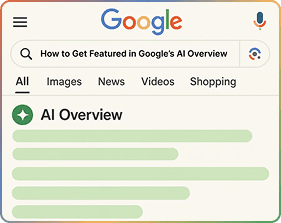

Mastering Search Visibility in the Era of Generative AI Results
Quick Summary / Key Takeaways
- Focus on entity clarity and structured content architecture so Google can clearly interpret how your brand connects to specific topics and queries.
- Provide direct, authoritative answers early in your content. AI systems prioritize sources that clearly explain the question without requiring additional interpretation.
- Build topical authority through structured content clusters that demonstrate consistent expertise across a subject area rather than isolated articles.
- Write with clear, precise language and logical structure so AI systems can interpret and summarize your information without losing context.
- Maintain strong technical SEO foundations such as site speed, crawlability, and mobile performance, since generative search systems still rely on reliable and accessible web sources.
Introduction

Search is evolving again. Google now generates AI Overviews, which provide synthesized answers directly on the results page rather than simply listing links. This shift changes how visibility is earned in search. Traditional ranking signals still matter, but content must now be structured so Google’s generative systems can interpret, summarize, and reference it confidently. Many sites lose traffic when they rely only on older SEO tactics, because modern search systems increasingly prioritize sources that deliver clear explanations, strong entity signals, and credible expertise.
Ranking in AI Overviews requires a different approach to content architecture. Instead of focusing only on keywords, your content must present direct answers, logical structure, and verifiable information that can be extracted into a generated summary. Google’s systems evaluate whether a page explains a topic clearly enough to be summarized without losing meaning. When content demonstrates topical authority, structured formatting, and technical reliability, it becomes more likely to be referenced as a source when AI-generated responses are produced.
In this guide, we break down how to rank in Google AI Overviews step by step, including the structural, technical, and authority signals that influence whether content appears in AI-generated search results. Understanding these principles helps organizations design search strategies that align with how modern discovery works. Teams working to strengthen AI search visibility often apply structured optimization frameworks developed by specialists such as Rise Peak Digital, whose approach focuses on building search systems designed for AI-generated answers and high-intent discovery.
Traditional SEO vs. AI Overviews Optimization
| Search Strategy Element | Traditional SEO Focus | AI Overviews Optimization Focus | Visibility Impact |
|---|---|---|---|
| Query Targeting | Keyword matching and ranking positions | User intent, entity relationships, and contextual relevance | High |
| Content Structure | Long-form narrative content | Modular answer blocks, definitions, and structured explanations | High |
| Primary Success Signal | Position in organic results (Top 10 rankings) | Citation and reference within AI-generated summaries | Very High |
| Technical Signals | Crawlability, indexing, and page performance | Structured data, entity clarity, and machine-readable content | Medium |
Content Formats Most Likely To Appear In AI Overviews
| Content Format | Likelihood of AI Citation | Why It Performs Well | Optimization Priority |
|---|---|---|---|
| Definition Blocks | High | Provides direct explanations that can anchor AI-generated summaries | Priority 1 |
| Step-by-Step Guides | High | Clear procedural answers are frequently summarized for instructional queries | Priority 1 |
| Comparison Tables | Medium–High | Structured data helps AI systems synthesize differences between options | Priority 2 |
| Structured Lists | Medium | Bullet-based formats allow quick extraction of key points | Priority 3 |
AI Overviews Optimization Preparation Checklist
- Monitor Google Search Console to track changes in impressions, click-through rates, and query visibility for pages associated with AI Overview-triggering searches.
- Update content regularly to maintain accuracy, topical depth, and relevance, which improves the likelihood of being referenced as a trusted source.
- Analyze which domains are cited within AI Overviews for important queries to identify content gaps and authority opportunities.
- Test different answer structures such as concise definitions, step-by-step sections, and comparison tables to determine which formats are most consistently surfaced in AI-generated summaries.
Table of Contents
Section 1: UNDERSTANDING GOOGLE AI OVERVIEWS
Section 2: STRUCTURING CONTENT FOR AI OVERVIEWS
Section 3: UNDERSTANDING QUERY TYPES THAT TRIGGER AI OVERVIEWS
Section 4: TECHNICAL SEO FOUNDATIONS FOR AI OVERVIEWS
Section 5: MEASURING AI OVERVIEWS PERFORMANCE
Section 6: BUILDING AUTHORITY FOR AI OVERVIEWS
Section 7: CONTENT FRESHNESS AND SOURCE UPDATES
Section 8: CONTROL AND OPT-OUT OPTIONS
Frequently Asked Questions
Section 1: UNDERSTANDING GOOGLE AI OVERVIEWS
FAQ 1: What is AI overviews optimization and why does it matter?
AI Overviews optimization focuses on structuring your content so it can be interpreted and cited inside Google’s AI-generated answers. Search is no longer limited to blue links. When users ask complex questions, Google now synthesizes information from multiple sources and presents a summarized response at the top of the page. If your content is not structured in a way the AI system can interpret, it will not be considered as a source. Research from multiple SEO data providers shows AI Overviews already appear in roughly 13–19% of Google searches, and that percentage continues to grow as Google expands the feature across more query types.
This shift changes how search visibility works. Modern buyers increasingly consult AI-generated answers before visiting websites. Content that presents clear reasoning, structured explanations, and credible expertise is more likely to be referenced when those summaries are generated. Instead of optimizing only for rankings, the objective becomes building content that AI systems can interpret confidently and surface during research-driven queries.
Section 2: STRUCTURING CONTENT FOR AI OVERVIEWS
FAQ 2: How do you structure content to rank in AI overviews?
To improve the chances of appearing in Google AI Overviews, your content should be structured so the answer is immediately clear and easy to extract. Place the direct response near the top of the section, supported by descriptive headings that reflect the user’s question. AI systems prioritize sources that present information in a logical hierarchy, where each section clearly explains a single idea. Formats such as question-and-answer sections, concise definitions, bulleted lists, and structured tables help Google’s systems interpret key points quickly when generating summaries.
This approach aligns with how modern search works. AI systems evaluate whether your content explains a topic clearly enough to be summarized without losing meaning. That is why many AI Optimization (AIO) strategies focus on modular content blocks, entity clarity, and structured explanations rather than long, unstructured paragraphs. When information is organized in this way, it becomes easier for Google’s generative systems to extract relevant points and include them as cited sources in AI-generated answers.
Section 3: UNDERSTANDING QUERY TYPES THAT TRIGGER AI OVERVIEWS
FAQ 3: Which types of queries most often trigger AI overviews?
AI Overviews most commonly appear on informational and “how-to” queries where users expect a synthesized explanation rather than a single webpage. Topics that require summarizing multiple sources, such as definitions, step-by-step processes, comparisons, and strategic questions, are strong candidates for AI-generated summaries. These searches usually reflect early-stage research where users want a clear explanation before evaluating specific solutions. Queries that ask for comparisons, benefits, risks, or best practices also frequently trigger AI Overviews because Google can combine insights from several sources into a single structured response.
Highly transactional queries such as searches for a specific product model or purchase page are less likely to trigger AI summaries at this stage. Those searches typically prioritize direct listings instead of synthesized explanations. For teams building AI search visibility, the practical strategy is to develop content around research-driven questions, educational topics, and structured comparisons where generative search systems are more likely to surface summarized answers.
Section 4: TECHNICAL SEO FOUNDATIONS FOR AI OVERVIEWS
FAQ 4: Does schema markup help with how to rank in ai overview results?
Yes. Schema markup helps Google interpret the entities, relationships, and context on your page, which improves how your content is processed by generative search systems. Structured data such as Organization schema, FAQ schema, and Article schema provides machine-readable signals that clarify who created the content, what the page explains, and how different topics relate to each other. When these signals are implemented correctly, Google can interpret the content with greater confidence and extract key information more accurately when generating AI Overviews.
Schema markup does not guarantee inclusion in AI-generated summaries, but it reduces ambiguity for Google’s systems. In practice, structured data works alongside clear explanations, entity-focused content, and strong technical SEO foundations. When these elements work together, it becomes easier for Google to interpret your expertise and reference your content as a reliable source in AI-generated answers.

Section 5: MEASURING AI OVERVIEWS PERFORMANCE
FAQ 5: How can you measure the success of your AI overviews strategy?
You measure AI Overviews performance by tracking how often your content is referenced, surfaced, or cited within AI-generated search summaries and whether that visibility translates into qualified traffic. One practical signal is monitoring Google Search Console data to identify queries that trigger AI Overviews and evaluating how your pages perform for those searches. Improvements in click-through rates, impressions, and engagement on informational queries can indicate that your content is being considered during AI-generated responses.
Another indicator is citation presence and referral traffic from AI-assisted search experiences. When your content appears consistently as a referenced source in AI summaries, it signals that your explanations, entity clarity, and topical authority align with how Google’s generative systems interpret trustworthy sources. In practice, measuring AI visibility alongside traditional SEO metrics provides a clearer picture of whether your content strategy is improving discovery during early-stage research.
Section 6: BUILDING AUTHORITY FOR AI OVERVIEWS
FAQ 6: What role does brand authority play in how to optimize for ai overviews?
Brand authority plays a significant role in whether your content is considered a reliable source for AI-generated answers. Google’s systems evaluate signals such as consistent topical expertise, credible references from other authoritative websites, and a history of publishing accurate information. When a brand demonstrates clear expertise within a specific topic area, its content is more likely to be interpreted as a trustworthy reference when Google generates AI summaries.
Building this level of authority requires structured expertise over time. Content should clearly explain complex topics, reinforce entity relationships, and demonstrate real knowledge within the subject area. Many organizations approach this through AI Optimization (AIO) strategies that combine technical SEO architecture, entity-focused content, and strong topical depth. When these elements are aligned, it becomes easier for Google’s systems to interpret your expertise and reference your content when generating AI Overviews.
Section 7: CONTENT FRESHNESS AND SOURCE UPDATES
FAQ 7: How often does Google update the sources in AI overviews?
Google updates the sources referenced in AI Overviews regularly as its systems recrawl and reevaluate web content. When pages are updated or when new content provides clearer explanations, stronger authority signals, or more current data, the system can adjust which sources appear in the generated summary. Because AI-generated answers rely on live web indexing and continuously refreshed information, the sources referenced in these summaries may change as Google processes new signals across the web.
This means content freshness and accuracy matter. Pages that are updated with current data, clearer explanations, and stronger entity context are more likely to remain competitive as potential sources. In practice, maintaining visibility in AI Overviews often requires ongoing content improvements, monitoring of competing sources, and structured updates that reinforce topical authority within your subject area.
Section 8: CONTROL AND OPT-OUT OPTIONS
FAQ 8: Can you opt out of being featured in AI overviews?
Yes. Website owners can limit how Google uses their content in search features, including AI-generated summaries, by applying controls such as the nosnippet or data-nosnippet directives in their HTML or through robots meta tags. These signals tell Google not to display certain portions of a page in search snippets or generated summaries. While this gives organizations more control over how their content is used, it also prevents that content from being included as a cited source in AI Overviews.
From a search visibility perspective, most businesses choose not to opt out. AI-generated answers often appear at the top of search results, and being referenced in those summaries can increase early-stage discovery and brand visibility. Instead of restricting usage, many teams focus on building clear, structured, and authoritative content that Google’s systems can confidently interpret and reference.